

Sunday, August 16, 2026
Science
No Result
View All Result
  • Login
  • HOME
  • SCIENCE NEWS
  • CONTACT US
  • HOME
  • SCIENCE NEWS
  • CONTACT US
No Result
View All Result
Scienmag
No Result
View All Result
Home Science News Technology and Engineering

Closed-Loop Theranostic Hydrogel-Electronics Patch for Chronic Wound Care

July 26, 2026
in Technology and Engineering
Reading Time: 2 mins read
0
Closed-Loop Theranostic Hydrogel-Electronics Patch for Chronic Wound Care

Closed-Loop Theranostic Hydrogel-Electronics Patch for Chronic Wound Care

65
SHARES
587
VIEWS
Share on FacebookShare on Twitter
ADVERTISEMENT

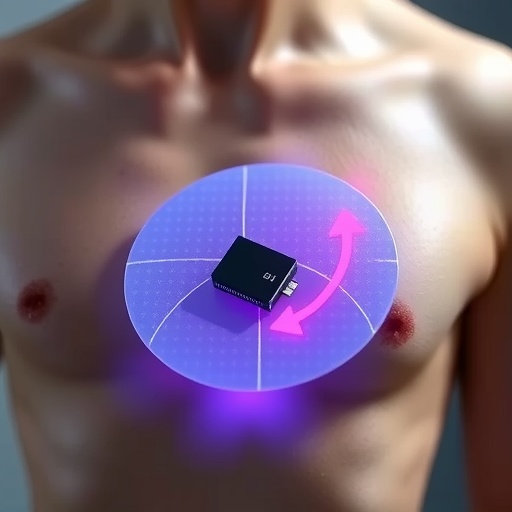
A research team has unveiled a closed-loop theranostic patch designed to tackle the chronic wound problem that persists in many patients despite standard care. Reported in npj Flexible Electronics (2026), the device combines a soft hydrogel matrix with integrated flexible electronics to move beyond passive dressing by actively monitoring wound status and dynamically responding to it.

At the heart of the platform is a hydrogel that functions as more than a moisture-retaining scaffold. Embedded features enable the patch to support therapeutic delivery while maintaining intimate contact with irregular wound surfaces. The researchers leverage this soft interface to improve stability where conventional rigid sensors struggle.

What differentiates the system is its closed-loop logic. Instead of delivering treatment on a fixed schedule, the patch interprets signals from the wound environment and then modulates action accordingly. This adaptive approach targets a persistent gap in wound care: the biochemical trajectory of healing can change hour by hour, yet many therapies do not.

The electronics are engineered for skin-like compliance, allowing the patch to conform during movement. Flexible components are positioned to minimize mechanical mismatch, which is critical for long-term wear. By reducing stress concentrations at the wound margin, the patch aims to maintain reliable sensing and effective drug or bioactive release.

From a theranostic perspective, the patch supports simultaneous “therapy and diagnosis.” Sensing elements capture relevant wound indicators, which the system processes to decide when and how to adjust treatment output. Such feedback control can help suppress lingering inflammation, manage bioburden-related conditions, and support tissue repair rather than waiting for external clinical reassessment.

In chronic wounds, delayed healing often correlates with disrupted microenvironments—oxygen gradients, moisture imbalance, and inflammatory signaling. The closed-loop strategy is intended to counter those dynamics by translating real-time measurements into tailored interventions.

The work also highlights the promise of hydrogel–electronics integration as a design principle for next-generation wearable medical devices. Beyond wound care, similar architectures could be adapted for post-surgical monitoring, diabetic ulcers, and other localized healing problems where timing and dosage are crucial.

The authors cite npj Flex Electron as the venue for the study and provide the DOI record for reference, marking a step toward responsive, data-informed dressings that behave more like embedded care than temporary coverage. If validated broadly, closed-loop patches could shift wound management from reactive to continuous, programmable therapy.

Subject of Research: Chronic wound management using a closed-loop theranostic hydrogel-electronics patch.

Article Title: Closed-loop theranostic hydrogel-electronics patch for chronic wound management.

Article References: Lin, K., Yang, B., Yan, G. et al. Closed-loop theranostic hydrogel-electronics patch for chronic wound management. npj Flex Electron (2026). https://doi.org/10.1038/s41528-026-00623-8

Image Credits: AI Generated

Tags: adaptive wound healing deviceschronic wound management technologychronic wound monitoringclosed-loop wound therapy systemflexible electronics for wound carehydrogel-based therapeutic deliveryintegrated biocompatible electronics for tissue repairlong-term wearable wound monitorsresponsive wound dressing platformsskin-conforming flexible sensorssmart wound dressings with real-time sensingtheranostic hydrogel-electronics patch
Share26Tweet16
Previous Post

Rapid Growth of Enstatite Chondrite-Like Embryos Driving Proto-Earth Impacts

Next Post

Benserazide brain penetration inversely linked to levodopa response in Parkinson’s

Related Posts

KAIST develops semiconductor neuron that harnesses noise to selectively process signals
Technology and Engineering

KAIST develops semiconductor neuron that harnesses noise to selectively process signals

August 16, 2026
Imagining natural and extra robotic thumbs together strengthens kinesthetic sensorimotor networks
Technology and Engineering

Imagining natural and extra robotic thumbs together strengthens kinesthetic sensorimotor networks

August 15, 2026
Epoxy-Engineered PZT Nanocomposite Sensor Array Enables Noise-Resistant Health and Swallowing Monitoring
Technology and Engineering

Epoxy-Engineered PZT Nanocomposite Sensor Array Enables Noise-Resistant Health and Swallowing Monitoring

August 15, 2026
Scientists Increasingly Rely on Black-Box Tools They Neither Control Nor Understand
Technology and Engineering

Scientists Increasingly Rely on Black-Box Tools They Neither Control Nor Understand

August 15, 2026
NIH Pediatric Research Funding Trends and Structural Patterns, 2015–2024
Technology and Engineering

NIH Pediatric Research Funding Trends and Structural Patterns, 2015–2024

August 15, 2026
Anxiety and Mood Disorders Across Lifespan in Very Preterm and Term-Born Individuals
Technology and Engineering

Anxiety and Mood Disorders Across Lifespan in Very Preterm and Term-Born Individuals

August 15, 2026
Next Post
Benserazide brain penetration inversely linked to levodopa response in Parkinson’s

Benserazide brain penetration inversely linked to levodopa response in Parkinson’s

  • Mothers who receive childcare support from maternal grandparents show more

    Mothers who receive childcare support from maternal grandparents show more parental warmth, finds NTU Singapore study

    27656 shares
    Share 11059 Tweet 6912
  • University of Seville Breaks 120-Year-Old Mystery, Revises a Key Einstein Concept

    1061 shares
    Share 424 Tweet 265
  • Bee body mass, pathogens and local climate influence heat tolerance

    682 shares
    Share 273 Tweet 171
  • Researchers record first-ever images and data of a shark experiencing a boat strike

    546 shares
    Share 218 Tweet 137
  • Groundbreaking Clinical Trial Reveals Lubiprostone Enhances Kidney Function

    531 shares
    Share 212 Tweet 133
Science

Embark on a thrilling journey of discovery with Scienmag.com—your ultimate source for cutting-edge breakthroughs. Immerse yourself in a world where curiosity knows no limits and tomorrow’s possibilities become today’s reality!

RECENT NEWS

  • Tropical Forest Biomass Responds to Diverse Climate Controls
  • Survey-Based Model Reveals How Preparedness Constraints Shape Cholera Transmission in Sudan
  • Waste-Based Retrofits Improve Thermal Performance in North Sinai Social Housing
  • KAIST develops semiconductor neuron that harnesses noise to selectively process signals

Categories

  • Agriculture
  • Anthropology
  • Archaeology
  • Athmospheric
  • Biology
  • Biotechnology
  • Blog
  • Bussines
  • Cancer
  • Chemistry
  • Climate
  • Earth Science
  • Editorial Policy
  • Marine
  • Mathematics
  • Medicine
  • Pediatry
  • Policy
  • Psychology & Psychiatry
  • Science Education
  • Social Science
  • Space
  • Technology and Engineering

Subscribe to Blog via Email

Enter your email address to subscribe to this blog and receive notifications of new posts by email.

Join 5,149 other subscribers

© 2025 Scienmag - Science Magazine

Welcome Back!

Login to your account below

Forgotten Password?

Retrieve your password

Please enter your username or email address to reset your password.

Log In
No Result
View All Result
  • HOME
  • SCIENCE NEWS
  • CONTACT US

© 2025 Scienmag - Science Magazine

Discover more from Science

Subscribe now to keep reading and get access to the full archive.

Continue reading
