


On geological timescales, the burial rate of sedimentary organic carbon exerts major control on the concentrations of atmospheric oxygen and carbon dioxide and thus substantially influences Earth’s environmental conditions. In marine sediments, about 20 percent of the organic carbon is directly bound to reactive iron oxides (FeR). However, the fate of reactive iron-bound organic carbon (FeR-OC) in subseafloor sediments and its availability to microorganisms, remain undetermined.

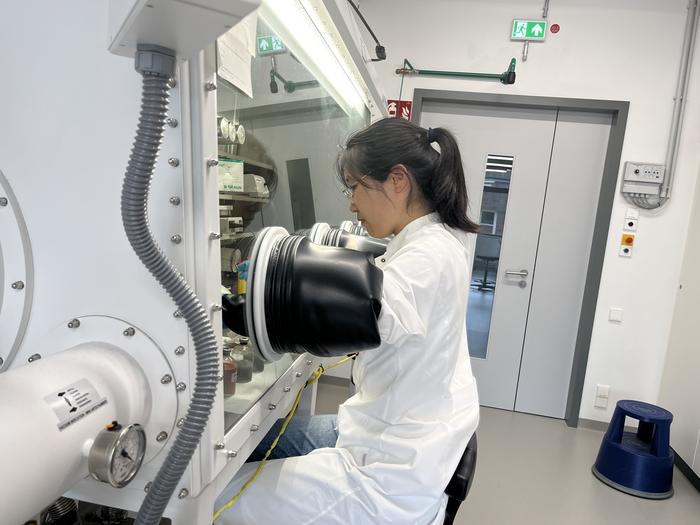
Credit: MARUM – Center for Marine Environmental Sciences, University of Bremen; Y. Chen
On geological timescales, the burial rate of sedimentary organic carbon exerts major control on the concentrations of atmospheric oxygen and carbon dioxide and thus substantially influences Earth’s environmental conditions. In marine sediments, about 20 percent of the organic carbon is directly bound to reactive iron oxides (FeR). However, the fate of reactive iron-bound organic carbon (FeR-OC) in subseafloor sediments and its availability to microorganisms, remain undetermined.
To study this, the team reconstructed continuous FeR-OC records in two sediment cores of the northern South China Sea encompassing the suboxic to methanic biogeochemical zones and reaching a maximum age of around 100,000 years.
The study reveals that in sulfate-methane transition zone (SMTZ) with high microbial activities, FeR-OC is remobilized during microbial-mediated iron reduction processes, and consequently remineralized by microorganisms. The energy produced is able to support a substantial fraction of microbial life in the SMTZ, which is around one meter thick.
With the exception of the SMTZ, a relatively stable proportion of the total organic carbon survives the microbial degradation processes as FeR-OC and is stored in marine sediments over geological time periods. “This means,” says Dr. Yunru Chen, first author of the study and now a postdoctoral researcher at the Cluster of Excellence ‘The Ocean Floor – Uncharted Interface of the Earth, “that the estimated global reservoir of FeR-OC in microbially active Quaternary marine sediments could be 18 to 45 times larger than the atmospheric carbon pool.”
This study takes a critical step in assessing the stability of sedimentary FeR-OC in response to post-depositional microbial activities and sheds lights on its dynamic cycling and persistence in subseafloor sediments. The results will be incorporated into the “Ocean Floor”- Cluster of Excellence, which is coordinated at MARUM.
Participating Institutions:
- MARUM – Center for Marine Environmental Sciences and Faculty of Geosciences, University of Bremen, Bremen, Germany
- Faculty of Geosciences, University of Bremen, Bremen, Germany
- State Key Laboratory of Microbial Metabolism, School of Life Sciences and Biotechnology, Shanghai Jiao Tong University, Shanghai, China
- Key Laboratory of Polar Ecosystem and Climate Change, Ministry of Education, and School of Oceanography, Shanghai Jiao Tong University, Shanghai, China
- Southern Marine Science and Engineering Guangdong Laboratory (Zhuhai), Zhuhai, China
MARUM produces fundamental scientific knowledge about the role of the ocean and the ocean floor in the total Earth system. The dynamics of the ocean and the ocean floor significantly impact the entire Earth system through the interaction of geological, physical, biological and chemical processes. These influence both the climate and the global carbon cycle, and create unique biological systems. MARUM is committed to fundamental and unbiased research in the interests of society and the marine environment, and in accordance with the Sustainable Development Goals of the United Nations. It publishes its quality-assured scientific data and makes it publicly available. MARUM informs the public about new discoveries in the marine environment and provides practical knowledge through its dialogue with society. MARUM cooperates with commercial and industrial partners in accordance with its goal of protecting the marine environment.
Journal
Nature Communications
Article Title
Cycling and persistence of iron-bound organic carbon in subseafloor sediments.
Article Publication Date
29-Jul-2024
Cite Scienmag News
Violet Maxwell. (August 19, 2024). Preservation of organic carbon in the ocean floor. Scienmag. https://scienmag.com/preservation-of-organic-carbon-in-the-ocean-floor/
Violet Maxwell. "Preservation of organic carbon in the ocean floor." Scienmag, 19 August 2024, https://scienmag.com/preservation-of-organic-carbon-in-the-ocean-floor/. Accessed 4 September 2026.
Violet Maxwell. "Preservation of organic carbon in the ocean floor." Scienmag. August 19, 2024. https://scienmag.com/preservation-of-organic-carbon-in-the-ocean-floor/

