


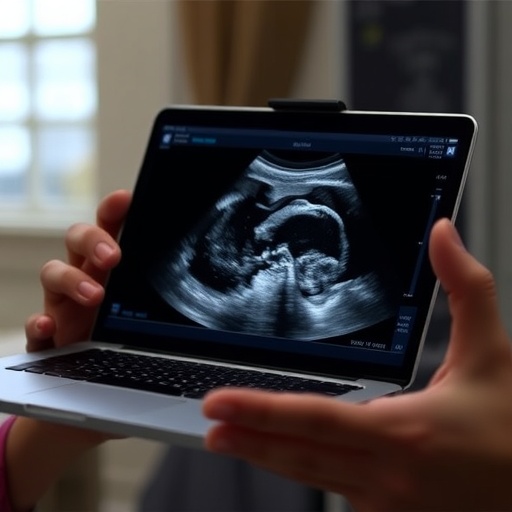
In a groundbreaking development that could redefine breast cancer diagnostics, researchers have unveiled a portable, real-time three-dimensional (3D) ultrasound device designed to minimize operator dependency in breast imaging. This revolutionary technology promises to enhance the accuracy and accessibility of breast screening, potentially saving countless lives through earlier and more reliable detection.
Traditional breast ultrasound imaging, while highly valuable, has long been hindered by variability in operator skill and the physical limitations of existing equipment. This new device addresses these challenges by integrating advanced imaging algorithms with a compact, user-friendly design that enables consistent, high-resolution 3D scans regardless of the operator’s expertise. The implications for both clinical and remote healthcare settings are profound.
At the heart of this innovation lies a sophisticated combination of hardware and software designed for real-time, volumetric image acquisition. Unlike conventional 2D ultrasound machines that produce sectional images requiring expert interpretation and alignment, this system captures volumetric data that can be reconstructed into comprehensive 3D views. This feature drastically reduces the need for operator precision in probe positioning and movement.
The portable design, highlighted in the study by Nayeem et al., prioritizes mobility without sacrificing image quality. This balance was achieved by leveraging state-of-the-art transducer arrays coupled with optimized beamforming techniques. These advancements ensure that the device can be deployed in a variety of clinical environments, from high-resource urban hospitals to remote rural clinics, doubling down on equitable access to quality breast imaging.
Crucially, the technology incorporates automated image processing and machine learning algorithms that analyze the volumetric data in real time. These computational methods assist in lesion detection and characterization, providing standardized diagnostic outputs that reduce subjective interpretation. This operator-independence not only streamlines workflow but also enhances reproducibility and diagnostic confidence.
The real-time capability of the device offers significant advantages during patient examinations. Clinicians can visualize the entire breast volume instantaneously, facilitating precise localization of abnormalities and guiding biopsy procedures. Moreover, this immediate feedback loop reduces examination time, contributing to improved patient comfort and throughput in busy clinical settings.
Beyond clinical efficiency, the researchers emphasize the potential for this portable ultrasound system to empower screening efforts in low-resource areas. The traditional reliance on large, immobile ultrasound machines and highly trained sonographers has limited breast cancer screening coverage, especially where healthcare infrastructure is sparse. This device presents a viable solution to these barriers.
A particularly innovative aspect of the system is its calibration to accommodate different breast sizes and shapes, ensuring consistent image quality across diverse populations. This adaptability is achieved through intelligent probe design and adaptive signal processing, addressing a long-standing challenge in breast imaging technology.
Additionally, the integration of a user-friendly interface facilitates ease of operation by non-specialist healthcare workers. Training requirements are minimal because the device’s software guides users through the scanning process, troubleshooting common difficulties in real time. This democratization of technology could significantly broaden the base of frontline breast cancer screening providers.
The study’s findings underscore that the diagnostic accuracy of this portable 3D ultrasound compares favorably with that of conventional, operator-dependent machines. In pivotal trials, the device demonstrated high sensitivity and specificity in detecting benign and malignant breast lesions, supporting its viability as a frontline diagnostic tool.
Looking toward future applications, the researchers envisage integrating this platform with telemedicine infrastructures. Real-time data transmission to remote experts for consultation could further enhance diagnostic accuracy and patient outcomes, particularly in underserved areas. This connectivity could pave the way for global collaborative efforts in breast cancer management.
Importantly, the adoption of this innovative technology aligns with broader trends in personalized medicine. The volumetric data acquired can be stored and longitudinally analyzed, enabling monitoring of lesion evolution over time. Such longitudinal surveillance heralds a new era in patient-tailored breast cancer care.
Despite the technological achievements, the researchers acknowledge areas for further refinement. Enhancements in battery life, wireless connectivity, and integration with electronic health record systems remain priorities. Continued clinical testing in diverse populations will be essential to validate the device’s robustness and utility.
This portable, real-time 3D ultrasound device epitomizes how engineering ingenuity and clinical insight can converge to overcome entrenched medical challenges. It offers a beacon of hope for improved breast cancer screening, particularly in contexts where expert sonography has been limited or unavailable.
As this technology moves from research to real-world use, its impact may be transformative. Enabling equitable, accurate, and operator-independent breast imaging holds the promise not only of earlier cancer detection but also of reducing disparities in women’s health worldwide. The future of breast imaging appears poised for a revolutionary leap forward.
Cite Scienmag News
Ophelia Keating. (July 1, 2026). Portable Real-Time 3D Ultrasound Revolutionizes Breast Imaging. Scienmag. https://scienmag.com/portable-real-time-3d-ultrasound-revolutionizes-breast-imaging/
Ophelia Keating. "Portable Real-Time 3D Ultrasound Revolutionizes Breast Imaging." Scienmag, 1 July 2026, https://scienmag.com/portable-real-time-3d-ultrasound-revolutionizes-breast-imaging/. Accessed 4 September 2026.
Ophelia Keating. "Portable Real-Time 3D Ultrasound Revolutionizes Breast Imaging." Scienmag. July 1, 2026. https://scienmag.com/portable-real-time-3d-ultrasound-revolutionizes-breast-imaging/


