


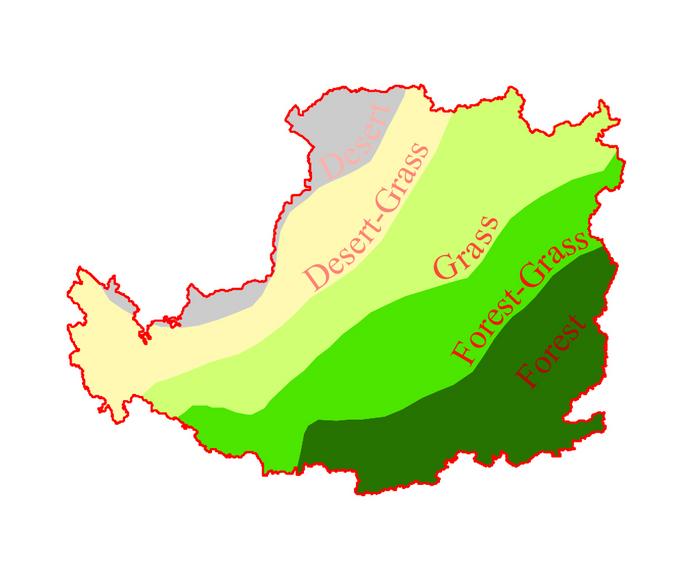
This study is led by Dr. Jinzhao Liu and Prof. Zhisheng An (Institute of Earth Environment, Chinese Academy of Sciences) and Dr. S. Nemiah Ladd (University of Basel). Global warming has become an uncontroversial fact and paleoclimate reconstruction benefit to better understand evolution of the earth system. Plant lipid compounds such as n-alkanes and n-alkanoic acids (n-FAs) have been widely used to reveal past changes of hydroclimates and environments because of their resistance to microbes and excellent preservation in natural archives such as soil and lake sediments.

Credit: ©Science China Press
This study is led by Dr. Jinzhao Liu and Prof. Zhisheng An (Institute of Earth Environment, Chinese Academy of Sciences) and Dr. S. Nemiah Ladd (University of Basel). Global warming has become an uncontroversial fact and paleoclimate reconstruction benefit to better understand evolution of the earth system. Plant lipid compounds such as n-alkanes and n-alkanoic acids (n-FAs) have been widely used to reveal past changes of hydroclimates and environments because of their resistance to microbes and excellent preservation in natural archives such as soil and lake sediments.
The Chinese Loess Plateau is one of the most valuable natural archives for studying global change since its loess-paleosol sequence that was accumulated since late Oligocene, well record the past hydroclimatic history in the region. The authors investigated the all-round modern plants on Chinese Loess Plateau and measured the stable hydrogen isotopes of n-FAs extracted from modern plants’ leaves. They conducted the comparisons of hydrogen isotopes of n-FAs among seasons (spring, summer, autumn) and plant types (dicots, monocots, gymnosperms). They found that at the regional scale of the Chinese Loess Plateau, no seasonal differences in n-FAs distribution and hydrogen isotopes existed, but the plant type effects on hydrogen isotopes of n-FAs becomes more remarkable. When scaling up to global scale, the effect of plant types on hydrogen isotopes of n-FAs is also significant. This finding suggests that plant type effect may overweigh seasonal variation in n-FAs biomarker, so the plant type effect should be carefully considered, instead of seasonal variation, when using hydrogen isotopes of n-FAs for paleoclimatic reconstruction.
Liu J, Ladd S N, Zhao J, Yan D, He D, Cao Y, An Z. 2024. Plant type effect overweighs seasonal variation in n-alkanoic acid biomarker on regional Loess Plateau of China. Science China Earth Sciences, 67(8): 2547-2562,
Journal
Science China Earth Sciences
Cite Scienmag News
Violet Maxwell. (August 14, 2024). Plant type effect overweighs seasonal variation in n-alkanoic acid biomarker on regional Loess Plateau of China. Scienmag. https://scienmag.com/plant-type-effect-overweighs-seasonal-variation-in-n-alkanoic-acid-biomarker-on-regional-loess-plateau-of-china/
Violet Maxwell. "Plant type effect overweighs seasonal variation in n-alkanoic acid biomarker on regional Loess Plateau of China." Scienmag, 14 August 2024, https://scienmag.com/plant-type-effect-overweighs-seasonal-variation-in-n-alkanoic-acid-biomarker-on-regional-loess-plateau-of-china/. Accessed 4 September 2026.
Violet Maxwell. "Plant type effect overweighs seasonal variation in n-alkanoic acid biomarker on regional Loess Plateau of China." Scienmag. August 14, 2024. https://scienmag.com/plant-type-effect-overweighs-seasonal-variation-in-n-alkanoic-acid-biomarker-on-regional-loess-plateau-of-china/

