


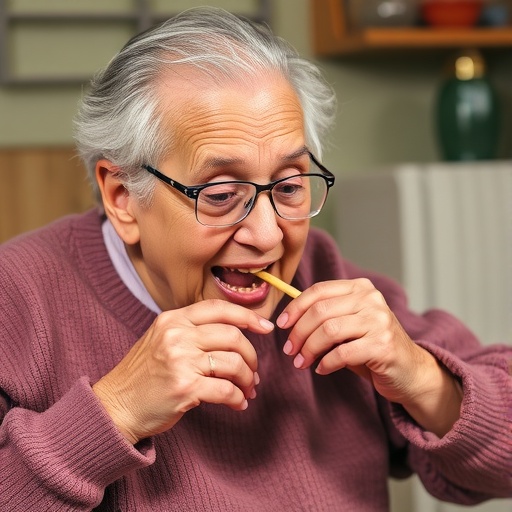
As the global population ages, the pursuit of understanding factors that contribute to healthy aging becomes paramount. Among the myriad physiological elements influencing wellbeing in elderly individuals, the act of chewing—a seemingly simple daily activity—has profound implications extending far beyond nutrition. In a groundbreaking cross-sectional study recently published in BMC Geriatrics, researchers have unveiled robust associations between chewing efficiency, nutritional status, and frailty in geriatric patients, offering novel insights that could reshape clinical approaches to elder care.
Mastication, or the mechanical breakdown of food in the oral cavity, plays a critical role in initiating digestion, facilitating nutrient absorption, and ultimately sustaining metabolic health. However, age-related decline in oral function, including reduced bite force and diminished chewing efficiency, often accompanies tooth loss, salivary changes, and muscular atrophy. These physiological alterations can severely compromise food intake quality and quantity, cascading into malnutrition and frailty—a clinical syndrome characterized by reduced physiological reserves and heightened vulnerability to adverse health outcomes.
The investigative team, led by Könning and colleagues, meticulously assessed chewing efficiency using validated quantitative measures in a diverse cohort of elderly patients. The study integrated comprehensive nutritional evaluations alongside frailty scales to unravel the interdependencies among these variables. Their analytical approach allowed delineation of both direct and indirect pathways linking masticatory performance to overall health status, a methodological advancement that transcends prior associative studies.
Importantly, the findings convey that diminished chewing capability is not merely a localized oral issue but correlates strongly with impaired nutritional profiles. Malnutrition, underpinning numerous age-related pathologies, emerges as a critical mediator in the relationship between chewing function and frailty. Elderly individuals with compromised mastication exhibited lower caloric and micronutrient intake, highlighting the necessity for integrated dental and nutritional interventions to mitigate deterioration.
Frailty, as conceptualized in geriatric medicine, encompasses multiple domains including physical weakness, reduced endurance, and slowed performance. The study’s results suggest that inadequate chewing efficiency may precipitate or exacerbate frailty through nutritional insufficiency, thereby amplifying the risk for falls, hospitalization, and mortality. This paradigm shift underscores the importance of oral health maintenance as a preventative strategy against frailty progression, necessitating interdisciplinary collaboration.
Beyond clinical implications, this research offers valuable insights into the physiological mechanisms linking oral function to systemic health. The decline in masticatory efficiency likely reflects broader neuromuscular degeneration, with potential impacts on swallowing safety and gastrointestinal function. Concomitant muscular weakness in orofacial regions may parallel sarcopenia elsewhere in the body, creating a vicious cycle whereby reduced physical capacity further diminishes nutritional intake and exacerbates frailty.
The study also addresses the underappreciated role of prosthetic dental treatments, such as dentures and implants, in restoring functional mastication. Although prostheses can improve bite force and chewing performance, their efficacy varies widely based on patient adaptation and prosthetic design. Könning et al. emphasize the need for personalized dental rehabilitation plans that consider the complex interaction between masticatory biomechanics, patient nutrition, and overall functional status.
In light of these insights, the integration of oral health assessments into routine geriatric evaluations is strongly advocated. Early detection of chewing inefficiencies could serve as a sentinel marker for impending nutritional decline and frailty onset, prompting timely multidisciplinary interventions. Furthermore, tailored dietary modifications to accommodate reduced masticatory function may help preserve nutrient intake and stave off frailty-related complications.
The study’s cross-sectional nature, while invaluable in identifying associations, invites further longitudinal investigations to elucidate causality and temporal dynamics. Prospective studies could explore whether targeted improvements in chewing function directly translate to enhanced nutritional status and frailty reversal, thus informing evidence-based clinical guidelines.
Public health initiatives might benefit from these findings by incorporating oral health promotion into aging care frameworks. Educational programs stressing the importance of dental hygiene, regular dental check-ups, and appropriate prosthetic use can contribute to sustaining masticatory efficiency and nutritional wellbeing among elders. Preventive strategies targeting oral frailty may ultimately reduce healthcare burdens linked to malnutrition and frailty syndromes.
From a biomechanical perspective, advanced technologies including electromyography and pressure sensors may refine the quantification of chewing efficiency, enabling more precise monitoring and individualized treatment tracking. Such innovations could revolutionize the management of oral function impairments, complementing nutritional and rehabilitative therapies.
The interplay between chewing efficiency and cognitive function is an emergent area warranting attention. Cognitive decline prevalent in geriatric populations may impair self-care behaviors including oral hygiene and meal preparation, compounding nutritional risks. Thus, holistic approaches incorporating neurocognitive assessments alongside oral and nutritional evaluations could optimize patient outcomes.
In summary, the study by Könning et al. illuminates the critical nexus between oral function and systemic health in elderly patients. Their comprehensive analysis underscores the necessity of addressing chewing efficiency as a vital component in the prevention and management of malnutrition and frailty. As the demographic shift toward an aging society accelerates, such research paves the way for innovative, integrative strategies to enhance quality of life and functional independence among older adults.
This compelling evidence challenges clinicians and policymakers alike to rethink traditional silos separating dental, nutritional, and geriatric care. By embracing a multidisciplinary paradigm that acknowledges the centrality of chewing function, healthcare systems can better tackle the multifactorial challenges of aging, promoting resilience and longevity.
Given the global burden of frailty and malnutrition in aging populations, these findings hold transformative potential. Future research expanding on these results could catalyze breakthroughs in preventive geriatrics and rehabilitative medicine, ultimately mitigating the human and economic toll of age-associated decline.
As we deepen our understanding of the intricate relationships governing health in later life, simple yet vital actions like chewing emerge as key determinants of wellbeing. The recognition that oral health influences systemic outcomes accentuates the promise of targeted interventions designed to preserve masticatory efficiency, ensuring that aging does not equate to diminished vitality.
Cite Scienmag News
Beatrice Stafford. (May 23, 2026). Chewing, Nutrition, and Frailty in Elderly Patients. Scienmag. https://scienmag.com/chewing-nutrition-and-frailty-in-elderly-patients/
Beatrice Stafford. "Chewing, Nutrition, and Frailty in Elderly Patients." Scienmag, 23 May 2026, https://scienmag.com/chewing-nutrition-and-frailty-in-elderly-patients/. Accessed 3 September 2026.
Beatrice Stafford. "Chewing, Nutrition, and Frailty in Elderly Patients." Scienmag. May 23, 2026. https://scienmag.com/chewing-nutrition-and-frailty-in-elderly-patients/


