


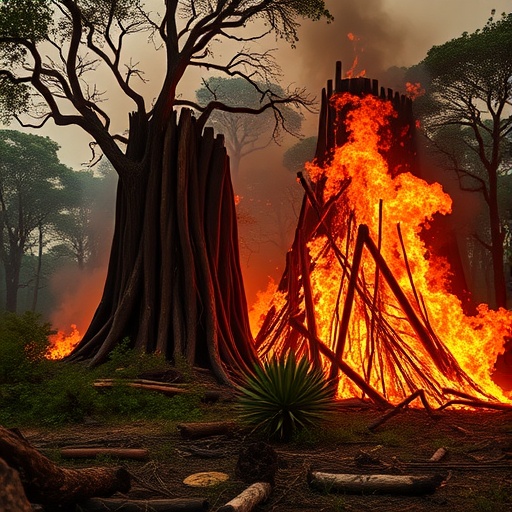
In the vast expanses of the Brazilian Cerrado, a unique savanna ecosystem renowned for its rich biodiversity and crucial role in carbon storage, fire has long been a natural and essential ecological process. However, groundbreaking new research reveals that the fire dynamics in this critical biome are overwhelmingly shaped by human activities rather than natural causes. This paradigm-shifting discovery, detailed in a comprehensive study published in Communications Earth & Environment, challenges longstanding assumptions about fire regimes and provides urgent insights for conservation and land management efforts in the Cerrado.
Traditionally, fires in savanna landscapes like the Cerrado have been understood to result from a complex interplay of climatic conditions, seasonal droughts, and lightning strikes. These natural factors historically dictated the timing, frequency, and intensity of fires, contributing to the ecosystem’s renewal cycles and maintaining its characteristic savanna landscapes. However, through a meticulous analysis involving satellite data integration, advanced fire detection technologies, and land use records, researchers have identified human ignitions as the dominant driver of fires in the Brazilian Cerrado, reshaping our comprehension of fires in this biome.
The study’s authors employed cutting-edge remote sensing methods to map fire occurrences over multiple years with remarkable spatial and temporal precision. They distinguished anthropogenic fire ignitions from natural ones by cross-referencing fire location data with human activity indicators such as agricultural expansion, road networks, and proximity to settlements. Their findings suggest that over 80% of fires in the Cerrado can be traced back directly or indirectly to human ignition sources, including deliberate burning for land clearing, pasture management, and even accidental ignition.
One striking aspect of this research lies in how it unpacks the complexity of human involvement in fire regime alterations. While fire has traditionally been used as a land management tool by local populations, the study reveals that recent escalations in fire frequency are closely linked to intensified agricultural practices, deforestation, and infrastructural development. As Brazil’s Cerrado undergoes rapid transformation driven by soy cultivation and cattle ranching, the anthropogenic ignition footprint expands, significantly impacting fire regimes across the landscape.
The ecological consequences of human-dominated fire regimes in the Cerrado are profound. This ecosystem hosts an extraordinary array of flora and fauna, many of which are adapted to regular fire cycles that historically had a distinct seasonal pattern marked by relatively low intensity. Human-set fires, however, often occur outside these natural cycles, frequently during drier periods that exacerbate fire severity, damaging soil structure, reducing biodiversity, and threatening the survival of numerous endemic species.
Moreover, the alteration of fire regimes driven by anthropogenic ignition raises significant concerns for regional and global climate change mitigation efforts. The Brazilian Cerrado, as a major carbon sink, plays a vital role in sequestering atmospheric carbon dioxide. Escalating firing frequency and intensity fueled by human activity not only release vast amounts of stored carbon but also degrade the ecosystem’s resilience and its capacity for carbon storage, potentially turning this essential biome into a net emitter of greenhouse gases.
The research conducted by Segura-Garcia, Janssen, Libonati, and colleagues employs an interdisciplinary approach combining ecological modeling, spatial data analytics, and socio-environmental assessments. This holistic methodology enables a more nuanced understanding of how land-use changes, agricultural intensification, and human settlement patterns influence fire ignition and propagation in ways that traditional ecological fire studies have not fully captured until now.
An essential insight arising from this study is the temporal shift in fire seasonality linked to human activities. While natural fires in the Cerrado tend to peak during the dry season, anthropogenic ignitions extend fire occurrences beyond traditional seasons, increasing year-round fire risk. This temporal alteration exacerbates the cumulative ecological damage, preventing ecosystems from recovering adequately between fires and promoting invasive species that thrive on disturbed soils.
The study’s implications extend far beyond the Cerrado itself. As similar fire-prone savanna and grassland ecosystems worldwide face mounting pressures from human expansion, the findings serve as a cautionary tale regarding the intricate ways anthropogenic actions influence natural fire regimes. Managing and mitigating these impacts will require integrated strategies that consider both human livelihoods and ecological conservation goals.
Crucially, the researchers advocate for enhanced fire management policies that account for the human origins of most fires in the Cerrado. Current fire control measures often focus solely on suppression but do not sufficiently address the socio-economic drivers of human ignitions. Incorporating community-based approaches, promoting sustainable agricultural practices, and developing early warning systems could significantly mitigate human-caused fire incidence and help restore the delicate ecological balance.
This research also underscores the urgent need for improved fire monitoring infrastructure and longitudinal data collection in the Cerrado. The integration of satellite technology with local ground observations offers a promising path forward for real-time fire detection and response, enabling authorities to act swiftly and prevent fires from escalating uncontrollably.
In conclusion, the revelation that human ignitions dominate fire regimes in the Brazilian Cerrado fundamentally changes how scientists, policymakers, and conservationists understand and respond to fire in this vital ecosystem. It highlights the intertwined challenges of biodiversity loss, climate change, and human land use, calling for coordinated global and local efforts to preserve the Cerrado’s ecological integrity amid mounting anthropogenic pressures. The intricate dance between humans and fire in this biome is no longer natural and must be addressed with innovative, science-based solutions that reflect the realities of human impact on Earth’s fire landscapes.
Cite Scienmag News
Margaret Porter. (May 22, 2026). Human Ignitions Drive Brazilian Cerrado Fire Regimes. Scienmag. https://scienmag.com/human-ignitions-drive-brazilian-cerrado-fire-regimes/
Margaret Porter. "Human Ignitions Drive Brazilian Cerrado Fire Regimes." Scienmag, 22 May 2026, https://scienmag.com/human-ignitions-drive-brazilian-cerrado-fire-regimes/. Accessed 5 September 2026.
Margaret Porter. "Human Ignitions Drive Brazilian Cerrado Fire Regimes." Scienmag. May 22, 2026. https://scienmag.com/human-ignitions-drive-brazilian-cerrado-fire-regimes/


