


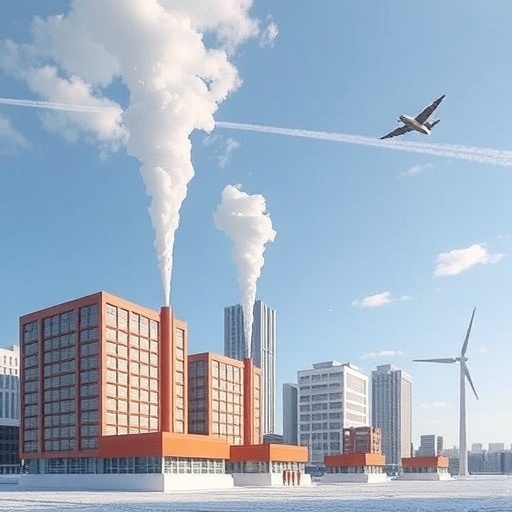
In a groundbreaking study published in Nature Communications, researchers Zhu, M., Zhao, M., Zhu, R., and their colleagues have unveiled how ongoing global warming is drastically altering patterns of energy consumption in buildings worldwide. This discovery underscores the necessity for urgent recalibration of climate mitigation strategies, as the traditional models fail to account for shifting demands in heating and cooling energy requirements. The insights from this research, slated for publication in 2026, are poised to influence global climate policies and urban planning paradigms in profound ways.
The study marks a critical advancement in understanding the direct and indirect consequences of an increasingly warming planet on one of the most energy-intensive sectors: building operations. Buildings account for a substantial fraction of global greenhouse gas emissions, primarily owing to their heating, ventilation, and air conditioning (HVAC) systems. However, the climatic shifts induced by rising temperatures are dynamically reshaping how these systems are used, leading to complex fluctuations in energy demand. The research team meticulously quantified these shifts using a suite of high-resolution climate projections combined with sophisticated building energy simulation models.
Fundamentally, the study reveals a global trend of decreasing heating demands and surging cooling needs. This transition is not uniform across geographical locales; colder regions, traditionally energy reliant on heating, are experiencing significant reductions in heating loads but concurrently facing increased cooling requirements, especially during summer months. Conversely, warmer zones show a robust expansion in cooling demand that overwhelms minor decreases in heating use. This nuanced change poses challenges for existing energy infrastructure, often designed under assumptions of relatively stable seasonality.
Thermal comfort standards and occupant behavior models were tight focal points in the research methodology. The investigators incorporated adaptive comfort models, accounting for how individuals adjust their temperature preferences and building operations in response to changing outdoor climates. This level of detail has enabled a more precise estimation of future energy usage patterns, departing from earlier static models that overlooked human adaptability and behavioral feedback loops.
One of the pivotal outcomes highlighted is the increased strain on electrical grids due to elevated air conditioning loads. Peak cooling demands, particularly during heat waves, can lead to severe electricity supply challenges and heightened risks of blackouts. This portends critical implications for energy system resilience and underscores the urgency to integrate renewable energy sources and energy storage solutions to smooth out demand spikes induced by climatic warming.
Importantly, the researchers emphasize that the warming-driven shifts in building energy use also influence carbon mitigation pathways. The reduction in heating energy might lower carbon emissions in some regions temporarily; however, the proliferation of cooling demand driven by electrification—especially if reliant on fossil-based power generation—could negate any emissions gains. This complex interplay necessitates a recalibrated approach to energy policy that prioritizes clean electricity transitions concurrently with building efficiency improvements.
Furthermore, the study explores how urban heat island effects exacerbate the cooling energy demands in cities. The combined warming from anthropogenic climate change and localized urban heating sources intensifies energy consumption anomalies. Urban planners must, therefore, integrate mitigation strategies such as increased vegetation, reflective surfaces, and innovative urban design to alleviate cooling burdens.
The findings prompt a reevaluation of building codes and standards worldwide. Modern constructions need to be more adaptable to fluctuating seasonal demands, employing smart HVAC systems that can optimize energy use dynamically. The researchers advocate for enhanced building envelope performance standards, passive cooling techniques, and demand-response capabilities that align energy consumption profiles with evolving climatic conditions.
Socioeconomic factors also emerge as critical considerations stemming from this study. Populations in developing countries with limited access to reliable cooling face heightened vulnerability as cooling demands grow, threatening health and productivity. The research calls for equitable energy access solutions that couple efficient cooling technologies with infrastructure investments to mitigate emerging risks from warming-induced energy shifts.
The implications for global carbon budgets are particularly compelling. As the building sector adjusts to new thermal realities, model projections of future emissions trajectories must be updated to incorporate these shifting energy use patterns. Failure to do so risks underestimating future emissions, potentially compromising the efficacy of global climate agreement targets.
Moreover, the research delivers valuable insights for utility companies and energy market regulators. By anticipating changes in demand profiles, utilities can better plan generation capacity expansions, grid upgrades, and the integration of distributed energy resources. Dynamic tariff designs and incentivized demand management programs can be tailored to reflect evolving peak load characteristics shaped by warming trends.
This study also suggests that investments in cooling technologies must proceed with mindful consideration of their carbon footprints. Adoption of high-efficiency, low-global-warming-potential refrigerants, alongside innovative cooling paradigms such as district cooling and geothermal systems, can mitigate the carbon costs associated with increased cooling demands.
Crucially, the interdisciplinary approach embraced by Zhu and colleagues—combining climatology, building science, engineering, and socioeconomics—exemplifies the type of holistic research needed to address multifaceted climate challenges. It serves as a template for future investigations seeking to bridge gaps between scientific understanding and practical implementation in the context of a warming world.
Ultimately, the imperative for global actors to integrate these findings into climate mitigation planning is clear. The shifting landscape of building energy use is both a challenge and an opportunity to steer the world toward a more sustainable energy future. Proactive policies, innovative technological solutions, and international collaboration will be essential to harness this knowledge and transform building sectors into engines of climate resilience rather than vulnerability.
This transformative research not only reshapes our understanding of energy dynamics under climate change but also calls for a paradigm shift in how societies conceive, design, and operate the built environment amidst unprecedented warming pressures. The legacy of this work will be its contribution to grounding climate mitigation efforts in the reality of an evolving energy landscape—a critical step toward securing a habitable and sustainable planet for generations to come.
Cite Scienmag News
Sloane Callahan. (June 11, 2026). Warming Alters Global Building Energy for Climate Plans. Scienmag. https://scienmag.com/warming-alters-global-building-energy-for-climate-plans/
Sloane Callahan. "Warming Alters Global Building Energy for Climate Plans." Scienmag, 11 June 2026, https://scienmag.com/warming-alters-global-building-energy-for-climate-plans/. Accessed 3 September 2026.
Sloane Callahan. "Warming Alters Global Building Energy for Climate Plans." Scienmag. June 11, 2026. https://scienmag.com/warming-alters-global-building-energy-for-climate-plans/


