


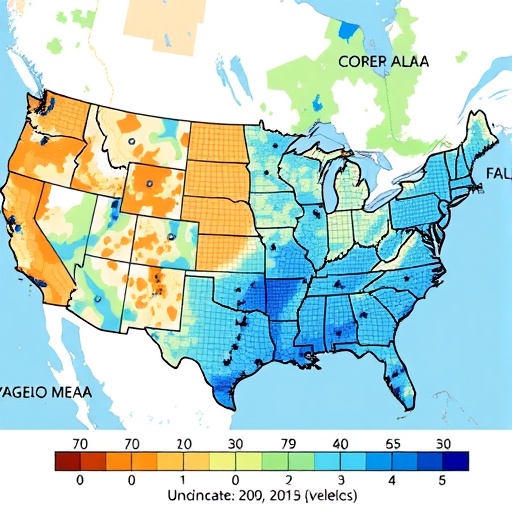
Urban watersheds across the United States are undergoing profound transformations in their sediment dynamics, a phenomenon that has significant implications for aquatic ecosystems, infrastructure planning, and flood risk management. Recent research spearheaded by Safdar, Jefferson, and Underwood, published in Communications Earth & Environment, provides an unprecedented examination of suspended sediment supply and transport regimes within these complex environments. Their findings unveil critical shifts in sediment behavior influenced by urbanization patterns, stormwater management practices, and hydrological alterations, shedding new light on the intricate relationship between urban development and fluvial processes.
Sediment transport is a fundamental component of riverine systems, responsible for shaping channel morphology, influencing water quality, and supporting aquatic habitats. However, in urban watersheds, impervious surfaces, altered drainage networks, and engineered stormwater controls dramatically modify how sediments enter and move through the system. Safdar and colleagues undertook a comprehensive analysis encompassing a diverse range of urban watersheds distributed across the continental United States, utilizing high-resolution sediment monitoring data alongside hydrological modeling to capture spatial and temporal variability in suspended sediment fluxes.
One of the most striking revelations from this investigation is the identification of distinct sediment supply regimes that diverge markedly from natural or rural watershed behaviors. Contrary to expectations that urbanization would consistently increase sediment loads due to construction activities and soil disturbance, the study reveals a nuanced pattern: some urban watersheds experience elevated sediment concentrations predominantly during intense storm events, while others display a marked reduction in sediment export, largely attributed to green infrastructure and sediment retention measures.
This duality is emblematic of the evolving landscape of urban hydrology. In regions where conventional stormwater conveyance systems dominate, rapid runoff promotes both increased erosive forces and mobilization of fine sediments deposited in urban soils and channels. In contrast, watersheds implementing infiltration-based solutions, such as bioswales and permeable pavements, exhibit attenuated runoff volumes and sediment transport, highlighting the efficacy of contemporary stormwater management in modifying sediment supply pathways.
The temporal dynamics of sediment transport further underscore urban complexity. Safdar et al. document a pronounced shift in sediment transport timing, with peak sediment fluxes increasingly decoupled from moderate to low flow conditions and instead tightly coupled to short-duration, high-intensity precipitation events. This turbulence-driven sediment mobilization poses challenges not only for aquatic organisms adapted to seasonal sediment cycles but also for water resource professionals tasked with controlling sediment-related contamination and managing reservoir sedimentation.
Perhaps equally concerning is the study’s assessment of sediment grain size distributions within suspended loads. Urban watersheds frequently exhibit a greater proportion of fine particulates, including silts and clays, which have a higher propensity to transport adsorbed pollutants, such as heavy metals and organic contaminants. The implication of this shift towards finer sediment fractions is multifaceted, extending from enhanced contaminant bioavailability to altered sediment settling patterns that impact sediment deposition zones and channel stability.
Furthermore, Safdar and team explore the feedback loops between urban sediment transport and geomorphological changes. Incremental sediment deposition in low-energy zones can clog stormwater infrastructure, reducing conveyance efficiency and promoting urban flooding. Simultaneously, channel scour during extreme events can undermine bridges and sewer crossings, thereby increasing maintenance costs and risking structural failures. These geomorphological consequences underscore the necessity for integrated watershed management approaches that consider both hydrological alterations and sediment dynamics.
The geographic variability of the study is noteworthy. While all urban watersheds are subjected to anthropogenic influences, the degree to which suspended sediment regimes are altered depends heavily on climatic, geological, and urban planning variables. For example, watersheds in arid to semi-arid regions demonstrate heightened sensitivity to episodic storm events, which generate localized sediment pulses of substantial magnitude. Conversely, urban areas in more humid climates experience more sustained sediment transport due to continuous runoff but benefit from greater vegetative cover to stabilize soils.
Methodologically, the research represents a significant advancement in urban sediment investigations. The integration of in-situ sediment sensors, remote sensing data, and hydrological modeling provides a multi-faceted perspective, enabling the disentanglement of natural variability from urban-induced alterations. This approach allows practitioners to identify critical control points for sediment management and design adaptive strategies based on robust empirical data rather than assumptions or extrapolations from rural analogs.
The broader implications for urban planners, environmental engineers, and policy makers are profound. Understanding that suspended sediment supply and transport regimes in urban watersheds are highly variable and context-dependent means that one-size-fits-all solutions are inadequate. Instead, sediment management must be tailored to the hydrological behavior of each watershed, incorporating local climate patterns, urban infrastructure designs, and geomorphological settings to mitigate adverse impacts effectively.
Critically, the research highlights the role of green infrastructure not merely as flood control or water quality enhancement tools but as active modifiers of sediment transport regimes. By promoting infiltration and reducing runoff velocities, these nature-based solutions help shift sediment dynamics towards regimes more akin to natural conditions, potentially restoring ecological function and lowering maintenance costs for urban water systems.
The study also signals a call to action for more longitudinal sediment monitoring in urban watersheds, emphasizing the need to capture evolving trends as cities grow and climate change influences precipitation patterns. Continuous data acquisition and real-time sediment monitoring can empower urban managers to respond proactively to emerging sediment-related issues, thus safeguarding water resources and urban infrastructure.
Lastly, Safdar and collaborators propose future research avenues focused on the coupling of sediment transport with contaminant fate and transport modeling, recognizing that sediment dynamics are inextricably linked with pollutant pathways in urban environments. This interdisciplinary approach promises to deepen the understanding of urban water quality challenges and foster innovative, integrated management solutions.
In sum, this landmark study elucidates the complexity of suspended sediment dynamics in urban watersheds across the United States, providing critical insights essential for sustainable urban water management. By unraveling how urbanization alters sediment supply and transport regimes under a changing climate, Safdar and colleagues lay the groundwork for a new era of research and practice that aligns urban development with the preservation of fluvial health and resilience.
Cite Scienmag News
Violet Maxwell. (June 11, 2026). Sediment Dynamics in Urban US Watersheds Revealed. Scienmag. https://scienmag.com/sediment-dynamics-in-urban-us-watersheds-revealed/
Violet Maxwell. "Sediment Dynamics in Urban US Watersheds Revealed." Scienmag, 11 June 2026, https://scienmag.com/sediment-dynamics-in-urban-us-watersheds-revealed/. Accessed 4 September 2026.
Violet Maxwell. "Sediment Dynamics in Urban US Watersheds Revealed." Scienmag. June 11, 2026. https://scienmag.com/sediment-dynamics-in-urban-us-watersheds-revealed/


