


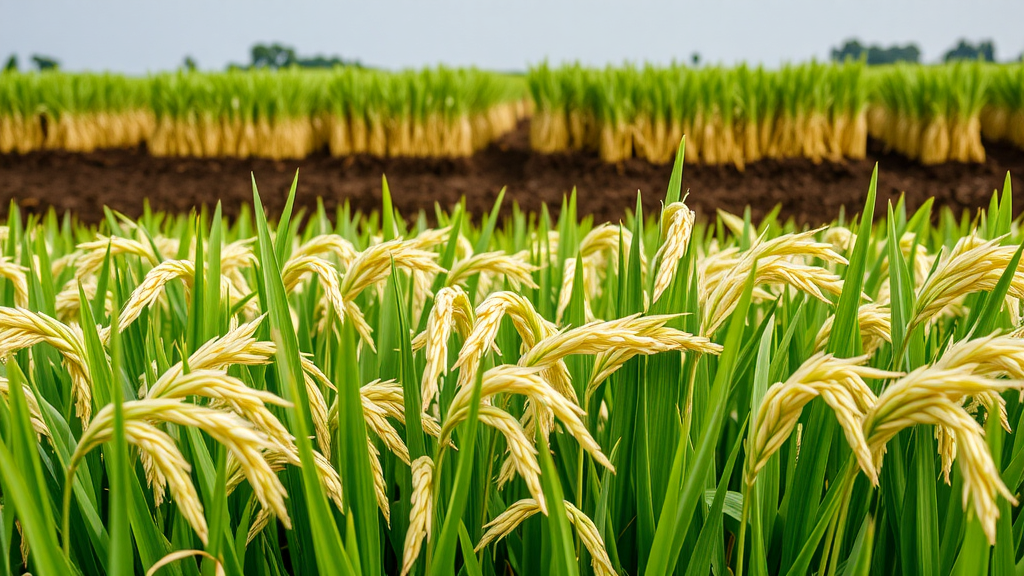
Rice feeds more than half of humanity, and the fine chemical details of each grain — its antioxidants, its vitamins, its stress compounds — are shaped as much by what happens in the soil as by the plant’s own genetics. A new field study from the Panjin region of Liaoning Province, one of China’s most important rice-producing areas, now offers some of the most detailed evidence yet that switching from conventional to organic cultivation measurably reshapes both the chemistry of the harvested grain and the hidden community of microbes surrounding the roots. By pairing untargeted metabolomics with deep sequencing of rhizosphere bacteria and fungi, the researchers traced a coordinated shift: organic fields produced grains richer in antioxidant flavonoids, phenolic acids and vitamin E, while accumulating fewer stress-responsive and putatively undesirable compounds.
The experiment was conducted in Panshan County, where the widely grown japonica variety Yanfeng 47 was cultivated under two management regimes. Conventional plots received synthetic urea, superphosphate and potassium chloride at standard rates of 150, 40 and 100 kilograms per hectare of nitrogen, phosphorus pentoxide and potassium oxide respectively. Organic plots had been managed continuously for three years without synthetic chemicals, receiving only farmyard manure produced from pigs fed rice processing by-products, applied at an equivalent nitrogen rate. Weeds were controlled mechanically, and both systems shared the same irrigation regime, flooding from transplanting to heading followed by intermittent irrigation. Six independent field replicates per treatment anchored the design.
At maturity, the team collected polished-free grain samples from standardized positions on the panicle and rhizosphere soil from the same plants, using sterile brushes to harvest the soil tightly adhering to roots. Grains were freeze-dried and analyzed by untargeted liquid chromatography-tandem mass spectrometry on a Q Exactive HF instrument in both positive and negative ionization modes, with pooled quality-control samples injected throughout the run showing pairwise correlations between 0.99 and 1.00, confirming exceptional instrument stability. Rhizosphere soils underwent DNA extraction and amplification of the bacterial 16S rRNA V4 region and the fungal ITS1 region, followed by sequencing on an Illumina NovaSeq 6000 platform, generating more than 2.2 million high-quality bacterial reads and roughly 1.8 million fungal reads.
The metabolomic results were striking. Principal component analysis completely separated organic and conventional grain samples along the first axis, which explained 52.8 percent of the variance, and a discriminant orthogonal partial least-squares model confirmed the separation with strong fit and predictive parameters that passed 100 permutation tests. In positive ion mode, 161 differential metabolites emerged — 71 upregulated and 90 downregulated under organic management — while negative ion mode revealed 184, with 114 rising and 70 falling. Pathway enrichment pointed to altered ABC transporter activity, a system that mediates phloem loading of nutrients and amino acids, alongside shifts in glycerophospholipid and caffeine metabolism that suggest membrane remodeling and secondary metabolic reorganization.
Among the compounds that climbed under organic cultivation were some of rice’s most celebrated beneficial molecules. Rutin increased 2.91-fold, an isorhamnetin glycoside rose 5.65-fold, 3-O-methylquercetin increased 2.44-fold, oryzanol A rose 1.92-fold, and gamma-tocotrienol, a vitamin E form, climbed 1.76-fold. Isoferulic acid, esculetin and caffeoyl glucose derivatives also rose, as did the sugar alcohol isomalt. Equally notable were the declines: the toxic alkaloid mucronine A fell more than fourfold, and two putatively undesirable compounds, 1-methyl-4-nitroimidazole and indospicine, dropped 2.40-fold and 1.91-fold respectively. Stress-responsive metabolites such as spermidine, proline and citric acid also declined, a pattern the authors interpret cautiously as a broad metabolic reorganization under a less stressful growth environment rather than a simple readout of reduced stress.
Underground, the story was subtler but equally revealing. Bacterial alpha diversity — Shannon index, Chao1 richness and observed features — did not differ significantly between the two systems, and principal coordinate plots showed overlapping clusters. Yet beta diversity was significantly higher under organic cultivation, indicating greater compositional dispersion among replicates, possibly reflecting richer microenvironmental heterogeneity and niche differentiation. Compositionally, organic fields boosted Proteobacteria, Bacteroidota and Verrucomicrobiota while reducing Chloroflexi, Acidobacteriota, Desulfobacterota and Actinobacteriota. Most tellingly, the plant-beneficial genera Lysobacter and Sphingomonas — known for biocontrol and polysaccharide degradation — increased 98.43 and 38.46 percent respectively, alongside enrichment of Roseomonas, Halomonas and other taxa with nitrogen-fixing, phosphate-solubilizing and plant growth-promoting traits. Conventional fields instead favored Gallionella, linked to fertilizer-induced acidification and altered iron chemistry, and an enigmatic archaeal lineage, unidentified Bathyarchaeia, typically associated with anoxic, nutrient-poor conditions.
Functional prediction using Tax4Fun added a mechanistic layer: relative abundances of ABC transporter, quorum sensing and nucleotide excision repair pathways were all significantly higher in the organic rhizosphere. Enhanced transporter activity may improve nutrient uptake and toxin efflux among beneficial microbes, while quorum sensing could coordinate the cooperative behavior of microbial consortia, indirectly influencing root exudation and downstream grain metabolism. The authors stress these are phylogenetic inferences rather than direct metatranscriptomic measurements, but they offer testable hypotheses about how organic management cultivates a functionally richer bacterial community.
Fungi responded differently. Overall fungal structure and beta diversity did not shift significantly, likely because hyphal networks buffer fungi against short-term management changes more effectively than bacteria. Every taxon flagged by LEfSe analysis — including Basidiomycota, the yeast-like genus Mrakia and Tetracladium — was enriched under conventional cultivation, with none crossing the significance threshold in organic soils. Yet functional guild assignment told a different story: under organic management, the plant pathogen group fell by 52.66 percent while undefined saprotrophs rose 15.55 percent, and combined dung-soil-wood saprotrophs surged 159.19 percent. This functional pivot toward decomposers and away from pathogens suggests organic cultivation improves the rhizosphere microecology in ways invisible to taxonomy alone, consistent with long-term observations that organic management reduces pathogen pressure through antagonistic microbial interactions.
The integrative analysis then connected the two worlds. After correcting microbial abundance data for compositional bias and log-transforming metabolite intensities, Pearson correlation analysis revealed coherent patterns: the organic-enriched bacterium Halomonas trended positively with the antioxidants esculetin, gamma-tocotrienol, rutin, oryzanol A and lysophosphatidylcholine, and negatively with spermidine and proline. The conventionally enriched archaeon Bathyarchaeia showed the mirror image — positive trends with stress compounds and 1-methyl-4-nitroimidazole, negative trends with rutin. Among fungi, the organic-enriched Neoschizothecium trended negatively with citric acid and thymidine. SparCC cross-validation supported these directional trends, although the authors emphasize that no individual metabolite-microbe pair survived false-discovery-rate correction, so the associations should be treated as exploratory rather than proven links.
The study’s limitations are candidly acknowledged: a single growing season, one cultivar, and fields with different management histories and baseline soil organic matter, meaning legacy effects could partly explain the differences. Correlation, moreover, cannot establish causation. Still, the work delivers the first integrated grain-metabolome and rhizosphere-microbiome analysis in the Panjin region and lays out a clear research agenda — multi-year validation, metagenomics, metabolic flux tracking and inoculation experiments with key taxa such as Halomonas. If those experiments confirm what the correlations hint at, microbiome-based strategies could one day be deliberately harnessed to breed not better plants alone, but better soils that grow better food.
Subject of Research: Effects of organic versus conventional cultivation on rice grain metabolome and rhizosphere microbiome in the Panjin region of China
Article Title: Organic cultivation alters rice grain metabolome and rhizosphere microbiome in Panjin region
Article References: Zhang, Y., Li, L., Li, Z., Li, G., Guo, C., Lin, Q., Peng, T., & Wu, X. (2026). Organic cultivation alters rice grain metabolome and rhizosphere microbiome in Panjin region. Journal of Agriculture and Food Research, 31, Article 103280. https://doi.org/10.1016/j.jafr.2026.103280
Image Credits: AI Generated
DOI: 10.1016/j.jafr.2026.103280
Keywords: rice, organic cultivation, metabolomics, rhizosphere microbiome, flavonoids, 16S rRNA sequencing, ITS amplicon sequencing, Panjin, plant growth-promoting bacteria, food quality, sustainable agriculture, soil microbiology
Cite Scienmag News
Alan Morgan. (September 12, 2026). Organic Rice Farming Rewrites the Grain Metabolome and Underground Microbiome. Scienmag. https://scienmag.com/organic-rice-farming-rewrites-the-grain-metabolome-and-underground-microbiome/
Alan Morgan. "Organic Rice Farming Rewrites the Grain Metabolome and Underground Microbiome." Scienmag, 12 September 2026, https://scienmag.com/organic-rice-farming-rewrites-the-grain-metabolome-and-underground-microbiome/. Accessed 5 October 2026.
Alan Morgan. "Organic Rice Farming Rewrites the Grain Metabolome and Underground Microbiome." Scienmag. September 12, 2026. https://scienmag.com/organic-rice-farming-rewrites-the-grain-metabolome-and-underground-microbiome/


