


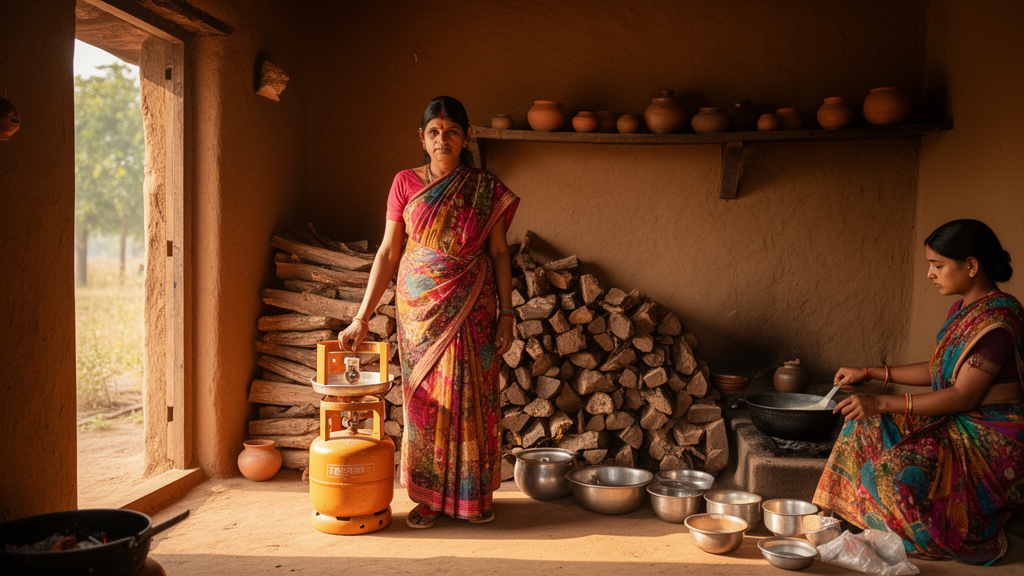
An analysis of 279 below-poverty-line households in rural Madhya Pradesh found limited improvements in cooking-fuel affordability under the Pradhan Mantri Ujjwala Yojana (PMUY). Most respondents reported either no change or worsened affordability, the study said, while continued reliance on traditional fuels suggested that access to clean cooking energy did not necessarily remove households’ financial constraints.
The research used primary data collected through stratified random sampling and examined one rural Indian state. Investigators assessed cooking-fuel affordability as an ordinal outcome ranging from decreased to increased affordability. They applied ordered logit and ordered probit models to analyze the responses. The headline finding was that PMUY had not produced a substantial shift in the overall distribution of affordability outcomes, even though it contributed to wider provision of clean cooking energy and progress toward Sustainable Development Goal 7.
Several household characteristics were associated with the likelihood of occupying higher affordability categories. Higher income, female household headship and use of smaller LPG cylinders were each linked to greater reported affordability. By contrast, nuclear-family households were less likely to report higher affordability than households with other family structures. The two modeling approaches identified similar patterns, but the authors characterized the positive associations as modest and insufficient to offset the broader concentration of no-change or worsening responses.
The survey also documented fuel stacking, meaning that households continued using traditional fuels alongside LPG. This behavior is consistent with affordability remaining a barrier to sustained use of clean cooking energy. The study therefore distinguishes between the availability of a clean-cooking connection and the ability to afford the fuel needed to keep using it. Its results indicate that many households in the sample did not experience a substantial improvement on the measured affordability scale.
The findings are limited to the surveyed population and do not provide a controlled causal estimate of PMUY’s effect. The models identify reported outcomes and associations within the sample rather than demonstrating that the program itself caused each change in affordability or fuel choice. Nevertheless, the results point to a constraint on sustained clean-cooking use: household resources and payment arrangements can influence whether access translates into affordable and continued use.
Within its policy discussion, the study identifies measures that could address affordability constraints beyond the provision of initial connections. The authors cite more reliable subsidy delivery, flexible payment options such as smaller refills or pay-as-you-go systems, and region-specific interventions as potential responses to the observed fuel stacking and limited affordability gains. These proposals were not evaluated as interventions in the reported household analysis.
Affordability also shapes the wider social and environmental benefits associated with clean cooking. The study notes that constrained affordability can limit sustained use, which in turn constrains potential contributions to health, gender empowerment and climate action. Its results suggest that expanding access is only one part of a durable rural clean-energy transition: households must also be able to continue purchasing the fuel they use. For the 279 households examined in rural Madhya Pradesh, the central empirical result was limited movement toward greater cooking-fuel affordability despite participation in PMUY.
Subject of Research: Cooking-fuel affordability among below-poverty-line households participating in India’s clean cooking program
Article Title: Limited affordability gains from Pradhan Mantri Ujjwala Yojana in Rural Madhya Pradesh, India evidence from an Ordered Logit and Probit Analysis
Article References: Ajayan, T. S., Dhengle, A., & Kumar, D. (2026). Limited affordability gains from Pradhan Mantri Ujjwala Yojana in Rural Madhya Pradesh, India evidence from an Ordered Logit and Probit Analysis. Discover Sustainability. https://doi.org/10.1007/s43621-026-04400-5
Image Credits: AI Generated
DOI: 10.1007/s43621-026-04400-5
Keywords: PMUY, energy affordability, clean cooking, rural India, Madhya Pradesh, LPG, fuel stacking, ordered logit, ordered probit, household survey, Limited, affordability
Cite Scienmag News
Violet Maxwell. (October 26, 2026). Ordered models find limited fuel-affordability gains among rural Madhya Pradesh households. Scienmag. https://scienmag.com/ordered-models-find-limited-fuel-affordability-gains-among-rural-madhya-pradesh-households/
Violet Maxwell. "Ordered models find limited fuel-affordability gains among rural Madhya Pradesh households." Scienmag, 26 October 2026, https://scienmag.com/ordered-models-find-limited-fuel-affordability-gains-among-rural-madhya-pradesh-households/. Accessed 26 October 2026.
Violet Maxwell. "Ordered models find limited fuel-affordability gains among rural Madhya Pradesh households." Scienmag. October 26, 2026. https://scienmag.com/ordered-models-find-limited-fuel-affordability-gains-among-rural-madhya-pradesh-households/


