

Monday, July 27, 2026
Science
No Result
View All Result
  • Login
  • HOME
  • SCIENCE NEWS
  • CONTACT US
  • HOME
  • SCIENCE NEWS
  • CONTACT US
No Result
View All Result
Scienmag
No Result
View All Result
Home Science News Marine

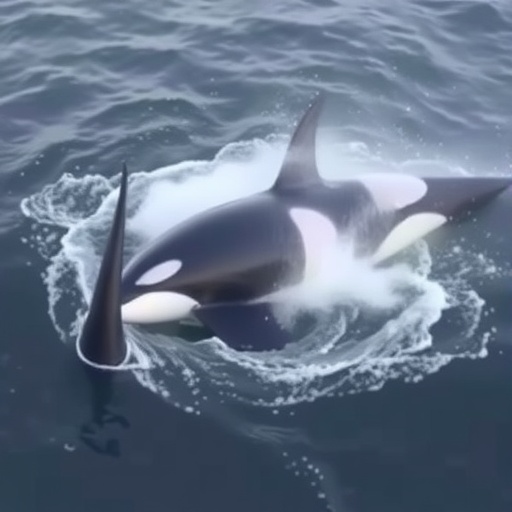
Orcas filmed exploding a giant fish after ramming it with force, possibly playing

July 27, 2026
in Marine
Reading Time: 2 mins read
0
Orcas filmed exploding a giant fish after ramming it with force, possibly playing

Orcas filmed exploding a giant fish after ramming it with force, possibly playing

65
SHARES
587
VIEWS
Share on FacebookShare on Twitter
ADVERTISEMENT

Orcas in the Gulf of California have been documented using a previously undescribed “hold-to-ram” strategy to process prey. Researchers report that the tactic involves stabilizing a dead sharp-tail sunfish by its large tail fin, then releasing it moments before another orca strikes at high speed. The impact disintegrates the tissue into thousands of fragments, changing how the carcass can be consumed.

The findings come from two independent hunting events separated by just over a year. In the first event (observed in July 2024), a group of orcas—including a juvenile—worked around a sunfish that had already been killed. A female held the carcass steady while a male accelerated toward it, and the release occurred immediately before collision.

A second, similar incident was filmed in September 2025 by Héctor Franz. The repeated sequence strongly suggests coordination between individuals, with one orca acting as a “stabilizer” while another delivers the high-energy ramming. Importantly, the prey was not observed to be killed by the ramming itself, pointing instead to processing behavior.

Why fracture the carcass? The team proposes that breaking the sunfish into smaller pieces may help younger orcas feed more easily. Orcas are known to tear and share prey within groups, and distributing accessible fragments would fit established patterns of cooperative feeding.

There may also be a microscopic payoff. Sharp-tail sunfish possess a distinct gelatinous capsule layer and skin microbiome. When tissue shatters, microbial communities associated with the prey can disperse into surrounding seawater, potentially altering nutrient conditions and increasing contact between orca and prey-associated microbes.

In the observations, the juvenile consumed smaller fragments after the ramming, while adult orcas focused on larger remaining portions. This division of feeding behavior aligns with the idea that high-impact processing creates size options within the same carcass.

The ramming technique has not been previously described in orcas, making it a noteworthy addition to known predation toolkits. The authors also consider alternative explanations, including social or playful behavior—because orcas are famous for manipulating objects and “playing” with food.

Still, the events reveal that orcas may use sophisticated, high-energy methods not only to capture prey, but to manage what happens afterward—sometimes turning a single meal into a cloud of bite-sized pieces.

Subject of Research: Animals (Orcinus orca; sharp-tail sunfish)
Article Title: Fragmentation of Sharp-Tail Sunfish (Masturus lanceolatus) Caused by High-Impact Ramming Behaviour in Orcas (Orcinus orca)
News Publication Date: 23-Jul-2026
Web References: http://dx.doi.org/10.3389/fetho.2026.1835536
References: Frontiers in Ethology (Observational study) — DOI: 10.3389/fetho.2026.1835536
Image Credits: Kathryn Ayres
Keywords: orcas, Gulf of California, hold-to-ram, cooperative hunting, prey processing, sharp-tail sunfish, microbiome, observational study, parental investment, animal behavior

Tags: cooperative hunting in orcasGulf of California orcashold-to-ram prey processingkiller whale prey disassemblymarine mammal predation strategiesorca feeding adaptationsorca feeding behaviororca group coordination during huntsOrca hunting strategiesorca prey manipulation techniquesorca social hunting tacticssunfish predation by orcas
Share26Tweet16
Previous Post

Why River Management Is Vital to Protecting a World-Important Wetland

Next Post

Study Finds Species-Specific MANF Function in Nonhuman Primates

Related Posts

São Paulo Archipelago Acts as Breeding Haven for Endangered Sharks
Marine

São Paulo Archipelago Acts as Breeding Haven for Endangered Sharks

July 26, 2026
UMaine-Led Team Selected for DOE Genesis Mission to Advance Underground AI
Marine

UMaine-Led Team Selected for DOE Genesis Mission to Advance Underground AI

July 26, 2026
Redox Mediator Enables Bacterial Cooperation for Anammox Extracellular Electron Transfer
Marine

Redox Mediator Enables Bacterial Cooperation for Anammox Extracellular Electron Transfer

July 26, 2026
Sperm Whales Use Bubble Blowing for Restful, Upright Sleep
Marine

Sperm Whales Use Bubble Blowing for Restful, Upright Sleep

July 26, 2026
NUS Researchers Create Electronic Skin That Senses, Heals, and Thrives Underwater
Marine

NUS Researchers Create Electronic Skin That Senses, Heals, and Thrives Underwater

July 18, 2026
Methane-Consuming River Bacteria Cannot Stop Human-Caused Climate Change
Marine

Methane-Consuming River Bacteria Cannot Stop Human-Caused Climate Change

July 17, 2026
Next Post
Study Finds Species-Specific MANF Function in Nonhuman Primates

Study Finds Species-Specific MANF Function in Nonhuman Primates

  • Mothers who receive childcare support from maternal grandparents show more

    Mothers who receive childcare support from maternal grandparents show more parental warmth, finds NTU Singapore study

    27656 shares
    Share 11059 Tweet 6912
  • University of Seville Breaks 120-Year-Old Mystery, Revises a Key Einstein Concept

    1061 shares
    Share 424 Tweet 265
  • Bee body mass, pathogens and local climate influence heat tolerance

    682 shares
    Share 273 Tweet 171
  • Researchers record first-ever images and data of a shark experiencing a boat strike

    546 shares
    Share 218 Tweet 137
  • Groundbreaking Clinical Trial Reveals Lubiprostone Enhances Kidney Function

    531 shares
    Share 212 Tweet 133
Science

Embark on a thrilling journey of discovery with Scienmag.com—your ultimate source for cutting-edge breakthroughs. Immerse yourself in a world where curiosity knows no limits and tomorrow’s possibilities become today’s reality!

RECENT NEWS

  • Biochar Makes Green Roofs Potent Methane Sinks
  • Study finds mental health treatment for serious offenders reduces harm, costs
  • Researchers Develop New Tool to Study River Temperatures Across Vast Areas
  • New Teaching Method Could Help Aboriginal Languages Survive and Flourish

Categories

  • Agriculture
  • Anthropology
  • Archaeology
  • Athmospheric
  • Biology
  • Biotechnology
  • Blog
  • Bussines
  • Cancer
  • Chemistry
  • Climate
  • Earth Science
  • Editorial Policy
  • Marine
  • Mathematics
  • Medicine
  • Pediatry
  • Policy
  • Psychology & Psychiatry
  • Science Education
  • Social Science
  • Space
  • Technology and Engineering

Subscribe to Blog via Email

Enter your email address to subscribe to this blog and receive notifications of new posts by email.

Join 5,146 other subscribers

© 2025 Scienmag - Science Magazine

Welcome Back!

Login to your account below

Forgotten Password?

Retrieve your password

Please enter your username or email address to reset your password.

Log In
No Result
View All Result
  • HOME
  • SCIENCE NEWS
  • CONTACT US

© 2025 Scienmag - Science Magazine

Discover more from Science

Subscribe now to keep reading and get access to the full archive.

Continue reading
