


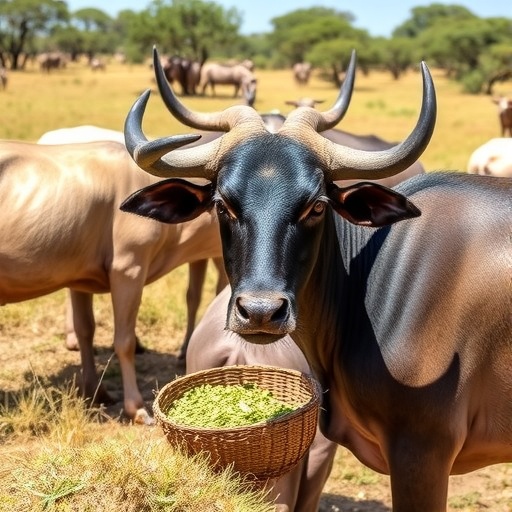
In Namibia’s challenging environment, traditional livestock farming faces considerable obstacles stemming from climatic variability and limited access to high-quality feed. However, a recent review by Mache, Mbango, and Shipandeni has brought renewed hope by focusing on harnessing bush-based feed for ruminants. Their findings suggest that the underutilized indigenous bush species offer a promising alternative to conventional feed resources, thus addressing both nutritional deficiencies and the sustainability of livestock production in the region.
The backdrop of this research lies in the recognition that Namibia’s livestock sector plays a vital role in the economy and food security of the country. With ruminants like cattle, goats, and sheep contributing significantly to rural livelihoods, ensuring a steady and nutritious food supply is paramount. Nonetheless, the country grapples with dry and harsh ecological conditions that limit the availability of conventional grazing lands, compelling farmers to explore alternative feeding strategies. This is where bush-based feeds enter the picture, providing not only nutritional benefits but also representing an avenue for rehabilitation of degraded land.
Bush encroachment has emerged as a pressing issue in Namibia, often leading to reduced biodiversity and compromised ecosystems. However, the review emphasizes a critical contradiction: these invasive bush species can be transformed into a vital resource. The authors assert that instead of viewing bush encroachment merely as a challenge, it should be perceived as an opportunity to repurpose these plants into valuable livestock feed. By doing so, farmers can enhance their resilience and adaptability amidst changing climatic conditions.
Moreover, the review identifies numerous bush species that hold rich nutritional profiles and can be effectively utilized as feed for ruminants. For instance, species such as Dichrostachys cinerea and Acacia mellifera are highlighted for their high protein content and digestibility. The integration of these plants into livestock diets not only offers a solution to feed shortages but also improves the overall health of animals, ultimately resulting in better productivity. The economic implications of adopting bush-based feeds are profound, fostering both increased milk and meat production while simultaneously reducing dependence on external feed supplies.
However, the transition to bush-based feeding practices is not without challenges. The review meticulously outlines various barriers that farmers may face while adopting this new approach. One significant hurdle is the lack of awareness and knowledge regarding the nutritional benefits of these bush species. Many farmers are simply unaware of the potential these plants hold, often resorting to traditional grazing practices that may not be sustainable in the long run. Educational initiatives aimed at informing and training farmers about bush-based feeds are crucial for facilitating this transition.
In addition to knowledge gaps, the authors discuss the importance of addressing cultural perceptions surrounding bush feeding. For many in Namibia, the stigma of utilizing bush species as animal feed lingers, rooted in longstanding beliefs about what constitutes ‘proper’ livestock nutrition. Overcoming these perceptions requires concerted efforts from researchers, extension officers, and policymakers to advocate for the acceptance of bush-based feeds as a legitimate and respectable option for livestock feeding.
Another challenge mentioned in the review pertains to the incorporation of bush feeds into existing livestock management systems. Farmers need guidance on effective feeding strategies that integrate bush species with conventional feeds. This includes understanding optimal ratios, feeding schedules, and how to ensure that animals receive a balanced diet throughout different life stages. Practical, research-based guidelines will be essential in aiding farmers to make informed decisions in this regard.
Furthermore, the review accentuates the potential environmental benefits of utilizing bush-based feeds. By reducing reliance on conventional grazing lands, farmers not only contribute to the conservation of biodiversity but also mitigate soil erosion and promote healthier ecosystems. The responsible use of bush species can lead to a more balanced approach to land management, ensuring that Namibian landscapes remain productive while also supporting wildlife and other native flora.
As the world grapples with the effects of climate change, the authors also address how bush-based feeding practices can act as a buffer against extreme weather events. By diversifying livestock diets, farmers can enhance animal resilience to stressors such as droughts or feed shortages. This adaptive capacity is vital in safeguarding not just the livelihoods of farmers, but also the overall stability of food systems in Namibia.
In summary, the review by Mache, Mbango, and Shipandeni sheds light on an innovative approach to tackling the challenges of livestock feeding in Namibia. By transforming bush encroachment from a nuisance into a resource, farmers can unlock new potentials for their ruminants while fostering a more sustainable agricultural system. While challenges remain, the authors present a blueprint for the future—one that promises better nutrition for livestock, improved productivity, and a more resilient food system for the country.
In conclusion, the enhanced utilization of bush-based feeds represents a paradigm shift in the way livestock farming can be conducted in Namibia. Constructive engagement between researchers and farmers, alongside effective educational initiatives and policy support, will be pivotal in realizing the full promise of this approach. Ultimately, the horizon looks brighter for ruminant farmers in Namibia, with bush-based feeds poised to become a cornerstone of sustainable livestock production.
Mache, M.G., Mbango, O. & Shipandeni, M.N.T. Harnessing bush-based feed for ruminants in Namibia: challenges and opportunities—a review. Discov Agric 3, 145 (2025). https://doi.org/10.1007/s44279-025-00338-w
Cite Scienmag News
Alan Morgan. (September 2, 2025). Optimizing Namibian Bush Feed for Ruminants: Challenges & Prospects. Scienmag. https://scienmag.com/optimizing-namibian-bush-feed-for-ruminants-challenges-prospects/
Alan Morgan. "Optimizing Namibian Bush Feed for Ruminants: Challenges & Prospects." Scienmag, 2 September 2025, https://scienmag.com/optimizing-namibian-bush-feed-for-ruminants-challenges-prospects/. Accessed 7 September 2026.
Alan Morgan. "Optimizing Namibian Bush Feed for Ruminants: Challenges & Prospects." Scienmag. September 2, 2025. https://scienmag.com/optimizing-namibian-bush-feed-for-ruminants-challenges-prospects/


