


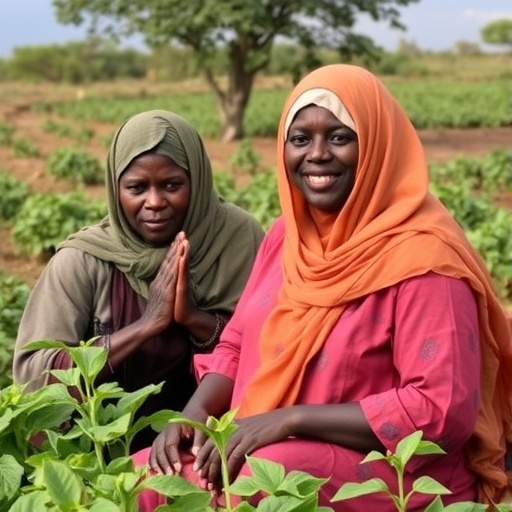
In the peri-urban farming communities that ring Niamey, the capital of Niger, climate change is not an abstract future threat but a lived, seasonal reality. Rainfall in the city has collapsed from 458.87 mm in 1997 to just 141.71 mm in 2020, and the West African Sahel is projected to warm faster than the global average, exceeding 2 °C by 2041–2060 and 3 °C by 2081–2100. Against this backdrop, a new study offers one of the first detailed portraits of how gender shapes who benefits from climate-smart agricultural technologies (CSAT) in Sahelian cities — and the picture it paints is one of stark, statistically measurable inequality inside the farming household itself.
The research, published in the journal Discover Agriculture, was led by Tinawaen Tambol of the West African Centre for Sustainable Rural Transformation at Abdou Moumouni University of Niamey, together with Emmanuel K. Derbile of the University of Business and Integrated Development Studies in Ghana and Moussa Soulé of Dan Dicko Dankoulodo University of Maradi. The team focused on Saga, a peri-urban community in Urban Commune IV of Niamey, where ferruginous soils along the River Niger have been heavily exploited and farming depends on both irrigation and rainfed production. Saga sits in the Sahelo-Sudanese climatic zone, with unimodal rainfall averaging 400 mm and a dry spell lasting eight months, making it a natural laboratory for studying how smallholders adapt under acute climatic stress.
Methodologically, the study stands out for its rigor in a data-scarce setting. The researchers employed a concurrent mixed-method, cross-sectional design, combining a structured survey of 142 smallholder farmers with in-depth key informant interviews and eight gender-segregated focus group discussions involving 56 participants. The sample size was derived from Yamane’s formula applied to the 1,646 farmers registered in the Saga irrigation perimeter, using a 95% confidence level and an 8% precision margin, deemed appropriate given that many peri-urban residents hold primary occupations outside agriculture. Multistage sampling — purposive selection followed by snowball referral with face-to-face screening — was used to reach both male and female smallholders aged 18 to 65, deliberately excluding large commercial farms that already command the resources needed for climate adaptation. Quantitative data were analysed in SPSS version 23 using t-tests and chi-square tests, while qualitative transcripts were coded thematically and triangulated against the survey results.
The headline finding is unambiguous: men adopt climate-smart agricultural technologies at far higher rates than women. Of the 142 farmers surveyed, 124 reported practising CSAT — 99 men against just 25 women — and seven farmers, six of them women, reported not practising these technologies at all, a gender difference that was statistically significant (p = 0.016). Even awareness was skewed: the number of farmers with no idea about the technologies they were using was significantly gendered (p = 0.024), driven largely by men. Yet, intriguingly, the women who did participate showed strong command of the innovations they used. Twenty-four of the 33 women surveyed rated their knowledge as satisfactory, and focus group participants estimated that CSAT-based knowledge among women farmers ran as high as 80 percent, concentrated in climate-smart backyard gardening, composting and small livestock rearing. Men, by contrast, gravitated toward mechanised technologies and larger field operations.
Beneath the adoption gap lies a deeper structure of household power. When asked who decides on the adoption of climate-smart technologies, 110 of the 142 respondents identified men or husbands as the sole decision-makers, with joint husband-and-wife decisions accounting for only 26 cases and women deciding alone in just six. The t-test on decision-making yielded a p-value of 0.02, indicating that women’s farming choices depend strongly on male authority. The pattern extended to crop and livestock decisions: 101 respondents said only the man or husband decides what to plant and rear, while women favoured joint decision-making — 15 of 33 female respondents — a preference the researchers attribute to a combination of cultural norms and economic necessity. Key informants pointed directly to religion and local custom as the forces suppressing joint decision-making in this traditionally polygamous society, where the unitary household model that assumes a single male decision-maker entrenches inequality in resource control.
Access to the inputs of innovation was equally unequal. Self-generated capital was the dominant source of finance for CSAT adoption across genders — 76 men and 19 women — followed by family funds, reflecting the scarcity of credit in one of the world’s lowest-income countries. Information flows told a similar story: family members, friends and neighbours were the primary information channels for both sexes, with cooperatives playing only a minor role for women, and — remarkably — government extension services barely registering as an information source at all. Some respondents doubted whether government extension agents even operated in the area. Extension training followed the same gendered fault line: 66 of 68 male respondents said husbands were the sole recipients of extension capacity building, and 20 of 33 women had never participated in any extension training. The authors argue that this pattern persists even in households where women actually manage the farms, entrenching a training gap that translates directly into a yield gap.
Perhaps most striking was the asymmetry between barriers and opportunities. On barriers, men and women were statistically indistinguishable (p = 0.227): both cited inadequate skills training, lack of access or rights to land, poor access to input markets and insufficient climate information. Focus group discussants described women unable to pay irrigation user fees of 30,000 FCFA per quarter, culturally constrained from working full days on their own fields, and effectively locked out of land ownership by customary inheritance systems that pass land through the paternal line. On opportunities, however, the genders diverged sharply, with significant differences in access (p = 0.003 in the chi-square analysis; p = 0.0013 for access to opportunities overall). Twenty-one women identified access to capital as their principal opportunity, while 58 men did — and male farmers were found to leverage social networks to secure better financing, with subsidy distributions in Niger widely reported to prioritise men.
The stakes of closing these gaps are quantifiable and considerable. Previous research cited in the study estimates that bridging gender gaps in climate-resilient agriculture in Niger could raise crop yields by 10 to 30 percent annually and add roughly 0.25 percentage points to yearly GDP. Adopting adaptation strategies in the Sahelian region of Niger is associated with household income gains of 7,722 FCFA and a 7 to 9 percent higher probability of food security. CSAT themselves carry impressive technical credentials: potential reductions of about 15 percent in drought-related crop losses, productivity improvements of up to 38 percent, soil fertility gains of 20 percent, and greenhouse gas mitigation through practices such as organic manuring, zaï planting pits and Farmer Managed Natural Regeneration. In Saga itself, the head of the farmers’ cooperative reported that on a 0.5-hectare plot, CSAT adoption can lift harvests from five bags to twenty.
The study’s authors are careful to situate their findings within a broader theoretical debate. Older adoption studies often treated the household as a unitary entity, taking the male household head as the sole decision-maker — an assumption the authors reject in favour of a collective, non-unitary model that recognises heterogeneous preferences and joint control of farm resources. In a polygamous, traditionally oriented society like Niger, they argue, the unitary model simply entrenches inequality in capacity building and resource control. Their results also echo regional patterns: CSA adoption among West African women farmers runs between 25 and 55 percent, compared with 55 to 75 percent for men, and agricultural productivity gaps reach 44.3 percent in Niger and 44 percent in Mali, even though women constitute more than 70 percent of the agricultural workforce in West and Central Africa.
The policy implications are direct. The researchers call for gender-differentiated policies embedded in national climate adaptation plans, with budgeted implementation strategies; women-focused extension training programmes; land tenure security for women farmers; and digital financial inclusion to bypass the credit barriers that formal institutions impose on illiterate women. They also recommend incorporating area-specific gender indicators into key performance metrics for CSAT scaling, and they note the potential of cooperatives and NGOs to channel information, fodder, and inputs to women. Without such interventions, they warn, existing inequalities will only widen as Sahelian cities balloon with rural migration. The study, aligned with Sustainable Development Goals 5, 10 and 13, makes the case that in the peri-urban Sahel, climate resilience will not be achieved by technology alone — but by deciding, deliberately, who gets to use it.
Cite Scienmag News
Sloane Callahan. (September 7, 2026). Women’s role in adopting climate-smart farming technologies in the Sahel. Scienmag. https://scienmag.com/womens-role-in-adopting-climate-smart-farming-technologies-in-the-sahel/
Sloane Callahan. "Women’s role in adopting climate-smart farming technologies in the Sahel." Scienmag, 7 September 2026, https://scienmag.com/womens-role-in-adopting-climate-smart-farming-technologies-in-the-sahel/. Accessed 7 September 2026.
Sloane Callahan. "Women’s role in adopting climate-smart farming technologies in the Sahel." Scienmag. September 7, 2026. https://scienmag.com/womens-role-in-adopting-climate-smart-farming-technologies-in-the-sahel/


