


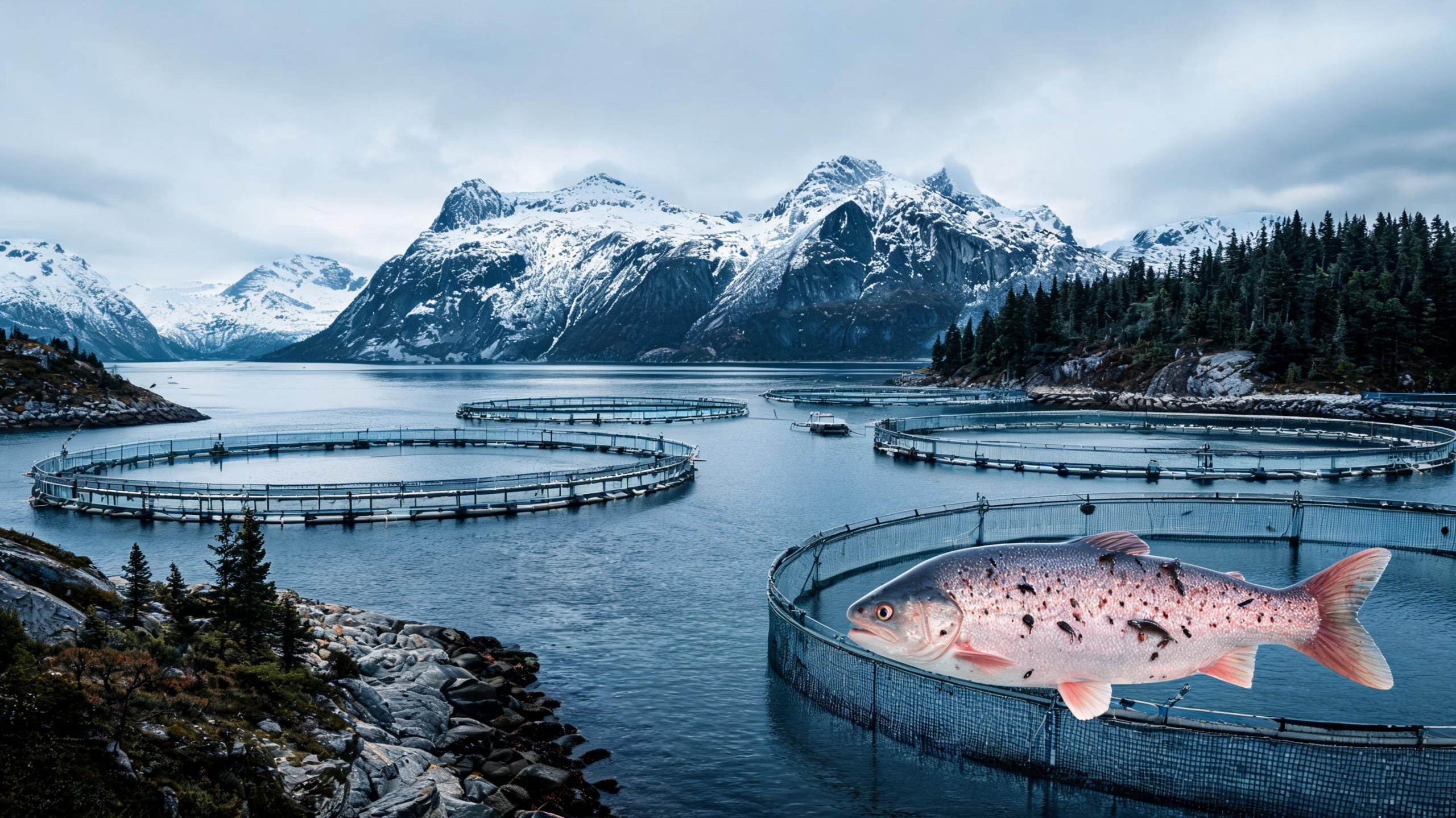
Norway’s marine fish farms are surrounded by a microscopic world that may offer an overlooked measure of coastal environmental health. A review by Isabelle Ewers and Micah Dunthorn identifies at least 24 protistan parasite taxa reported in and around Norwegian aquaculture sites, spanning amoebae, ciliates, diplomonads, ichthyosporeans, kinetoplastids, microsporidians, oomycetes and perkinsids. These organisms are single-celled or fungus-like eukaryotes, but their effects can extend from subtle changes in host condition to severe disease and mortality. The review’s central finding is not that every parasite signals an outbreak, but that the overall composition of parasite communities can reveal how ecosystems are responding to chronic pressure. The authors classify parasites according to where they live, how many hosts they require and how narrowly they select those hosts. Their analysis suggests that Norwegian coastal environments near farms are experiencing continuous moderate to high stress or some degree of degradation. The conclusion is provisional, because many taxa remain poorly studied and some identifications rely on methods that cannot distinguish closely related species.
Parasites are often treated solely as threats to farmed fish, yet they are also components of healthy food webs. They influence host populations, energy transfer, species interactions and biodiversity, making their disappearance as informative as their presence. The review applies an environmental-parasitology framework based on three traits: location on or inside the host, life-cycle complexity and host specificity. External parasites and free-living stages are directly exposed to changes in water quality, temperature, oxygen and other stressors. Internal parasites are buffered by the host and may persist longer as conditions deteriorate. Monoxenous parasites complete development in a single host, whereas heteroxenous parasites depend on two or more hosts, often including an invertebrate vector. Generalists can use multiple host species; specialists depend on a narrower set. Under environmental decline, external heteroxenous specialists are expected to disappear first, while internal monoxenous generalists may remain. That pattern dominated the Norwegian records, whereas parasites typically associated with less disturbed environments were largely absent.
The most prominent example is Paramoeba perurans, the amoeba responsible for amoebic gill disease in Atlantic salmon. The parasite attaches to the gills and contributes to excess mucus, pale patches, fused lamellae and abnormal thickening of the gill epithelium. Damage to the respiratory surface can cause circulatory problems, tissue death and respiratory distress. The amoeba has been detected in numerous fish species worldwide, and salmon, turbot and lumpfish can develop disease, although susceptibility differs among hosts. In Norway, recurrent outbreaks have been documented since 2013 after the first reported cases on the western coast in 2006. Higher salinity and temperatures above about 12 °C increase the likelihood of an outbreak, while optimal laboratory growth conditions are reported near salinity 35 and 15 °C. Mortality can vary widely, reaching as high as 90 percent in some western Norwegian farms. The review classifies P. perurans as an external, monoxenous generalist, a combination that could allow it to persist in moderately stressed waters. Its cells may also carry the bacterium Candidatus Syngnamydia salmonis, illustrating how interactions within a fish’s wider pathobiome can complicate disease.
Other parasites show why detection alone cannot be equated with disease. The kinetoplastid flagellates of the Ichthyobodo complex attach to fish skin and gills, where they can cause grey patches, lesions, mucus production and scale loss. Three described members—Ichthyobodo hippoglossi, I. necator and I. salmonis—have been identified in Norway, alongside incompletely identified forms. Molecular work has revealed that what was once treated as I. necator is a complex of sibling species, making historical records difficult to interpret. These parasites are widespread in farmed and wild salmonids and can act as opportunists when fish are weakened by environmental stress or another pathogen. The review notes their association with gill disorders and pancreas disease, a viral infection caused by salmonid alphavirus. By contrast, the ciliate Trichodina cooperi generally lives as a commensal on Atlantic cod and has not been linked to serious disease in Norway. It is an external, monoxenous specialist, a functional profile more consistent with slightly stressed or relatively healthy conditions. Its presence therefore provides a different ecological signal from the abundance of generalist opportunists.
The review also highlights parasites whose life cycles connect farmed fish with wild hosts or other animals. Paranucleospora theridion, a microsporidian also known by its former name Desmozoon lepeophtherii, develops through cycles in Atlantic salmon and the salmon louse, Lepeophtheirus salmonis. In salmon, it can produce systemic infection, cell damage, gill abnormalities, abdominal lesions, stunted growth and increased mortality. The parasite generates one type of spore that spreads within the fish and another robust form that can enter the environment. When salmon lice feed on infected salmon, they can acquire the microsporidian, which then undergoes a further developmental cycle inside the copepod. The exact route by which infection returns to salmon is not fully resolved, but spores released after infected lice die may form an environmental reservoir. Infection levels are higher in southern Norway but occur in northern farming regions as well. Because warming could increase transmission farther north, the species illustrates how climate change may reshape parasite distributions and intensify complex disease interactions. The authors classify it as an internal, heteroxenous generalist that can persist under moderate environmental stress.
Several microsporidians and related protists have substantial pathogenic potential even where Norwegian outbreaks have not been recorded. Loma morhua infects the gills and organs of Atlantic cod and has been associated elsewhere with impaired growth and mortality, but no disease outbreak caused by it has been reported in Norwegian farmed or wild cod. Loma salmonae forms enlarged cellular structures called xenomas and can cause microsporidial gill disease in salmonids; it was recently detected in sea-run brown trout in Norway, more often in warmer southern fjords. Nucleospora salmonis invades the nuclei of blood-forming cells and can cause severe anemia, immune suppression and a leukemia-like condition. It has been detected in Norwegian sea-run brown trout but has not yet been studied as a cause of Norwegian farm disease. A different threat is Salmoxcellia vastator, a perkinsid described from Norwegian salmonid aquaculture in 2021. It spreads through blood-rich tissues and produces white-yellow lesions in organs including the heart, liver, kidney and muscle. Advanced salmoxcellosis can reduce feeding, damage fillet quality and increase mortality. Reports increased in rainbow-trout farms from 2017, and the condition was observed in farmed Atlantic salmon in 2020. Its life cycle and host range remain uncertain, limiting the confidence of environmental predictions based on its detection.
Temperature-sensitive and vector-borne parasites add another layer of uncertainty. The marine ciliate Cryptocaryon irritans, which causes white-spot disease, has been detected through environmental DNA sequencing in salmon farms on Norway’s western coast, although no outbreak has been reported there. It normally reproduces near 19 °C, but some strains can reproduce in colder water, raising the possibility of future establishment as temperatures rise or adaptation occurs. The freshwater ciliate Ichthyophthirius multifiliis has been detected in a Norwegian salmon hatchery and in wild brown trout from fjords, particularly in lower-latitude areas and farming hotspots, but marine outbreaks have not been reported. Blood parasites such as Trypanosoma murmanense and T. pleuronectidium depend on marine leeches for transmission. The first is associated with the Arctic fish leech Johanssonia arctica, whose distribution restricts the parasite mainly to northern Atlantic regions; the second is transmitted by Calliobdella nodulifera. These heteroxenous specialist parasites were interpreted as indicators of relatively mild stress. Their presence demonstrates that a parasite community reflects not simply pollution or farm intensity, but also temperature, host diversity, vector distributions and food-web structure.
The researchers argue that better surveillance will require more than traditional microscopy and disease reporting. Many protists change shape during their life cycles, resemble close relatives or have unresolved species boundaries, so morphology alone can produce mistaken identifications. Genetic sequencing, environmental DNA and RNA, histopathology and experimental infection studies can help determine which taxa are present, whether they are viable, how they move between hosts and whether they are primary causes of disease or secondary colonizers of already weakened fish. This distinction matters for treatment, because control measures directed at a presumed pathogen may fail when disease results from several interacting organisms. It also matters for environmental assessment: the absence of a parasite may indicate severe degradation, but it may also reflect inadequate sampling. The review is therefore a starting point rather than a definitive ranking of Norwegian farm sites. The authors call for broader taxonomic coverage, clearer life-cycle studies and consistent molecular standards. As farming practices evolve and coastal waters warm, tracking the full protist community could help distinguish emerging threats from harmless residents—and turn some of the smallest organisms in the fjords into early-warning signals for the health of the wider ecosystem.
The ecological signal must be interpreted alongside the physical setting of a farm. Excess feed and faeces release organic matter, nitrogen and phosphorus, which can drive eutrophication in the water column and organic enrichment beneath cages. Altered sediment communities and geochemistry may promote acidic or oxygen-poor conditions, potentially changing both host susceptibility and the survival or transmission of parasite stages. Consequently, parasite records are most informative when paired with measurements of water quality, sediment condition, host health and wild-fish abundance rather than treated as a standalone score.
The review also places protists within a broader management problem. Treatments aimed at parasites can carry environmental costs, while repeated use may reduce sensitivity or select for resistance. Cleaner fish may lower salmon-lice burdens but can also introduce or transmit protists, including organisms not previously established at a site. Surveillance should therefore include farmed fish, cleaner fish, nearby wild hosts and environmental samples. A combined approach could reveal whether a detected organism is actively cycling, merely present as genetic material, or participating in a multi-organism pathobiome. Such evidence would help separate emerging disease risks from ecological indicators and support interventions that protect both production and coastal ecosystem function.
Subject of Research: Protistan parasites as indicators of environmental stress around Norwegian marine fish farms
Article Title: A review of protistan parasites in and around Norwegian marine fish farms
Article References: Ewers, I., & Dunthorn, M. (2026). A review of protistan parasites in and around Norwegian marine fish farms. Ocean Microbiology, 2(1), Article 3. https://doi.org/10.1186/s44375-026-00008-2
Image Credits: AI Generated
DOI: 10.1186/s44375-026-00008-2
Keywords: aquaculture, protist parasites, Norwegian fjords, fish health, ecosystem stress, amoebic gill disease, microsporidia, climate change, review, protistan, parasites, around
Cite Scienmag News
Gavin Prescott. (August 29, 2026). Norwegian Fish Farms Harbor Parasites That Reveal Coastal Ecosystem Stress. Scienmag. https://scienmag.com/norwegian-fish-farms-harbor-parasites-that-reveal-coastal-ecosystem-stress/
Gavin Prescott. "Norwegian Fish Farms Harbor Parasites That Reveal Coastal Ecosystem Stress." Scienmag, 29 August 2026, https://scienmag.com/norwegian-fish-farms-harbor-parasites-that-reveal-coastal-ecosystem-stress/. Accessed 5 October 2026.
Gavin Prescott. "Norwegian Fish Farms Harbor Parasites That Reveal Coastal Ecosystem Stress." Scienmag. August 29, 2026. https://scienmag.com/norwegian-fish-farms-harbor-parasites-that-reveal-coastal-ecosystem-stress/


