


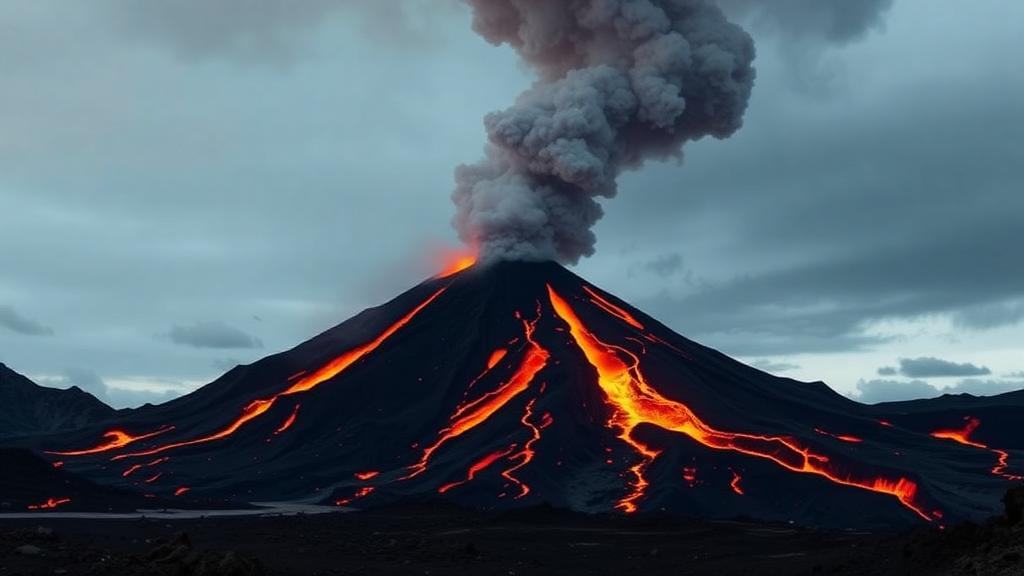
Explosive volcanic eruptions are among the most disruptive natural events on the planet, and among the hardest to anticipate. When basaltic magma ascends and fragments, it launches pyroclasts—fragments of magma and rock torn from the volcano—into the atmosphere and across surrounding landscapes. The consequences can ripple far beyond the crater. During this summer’s eruption of Mount Etna in Italy, ash fell over the nearby city of Catania and forced the closure of its international airport for weeks, a vivid reminder that even comparatively small mafic eruptions can paralyze infrastructure, aviation, and daily life across an entire region.
The size of the particles an eruption produces is not a trivial detail. It is the single most important factor controlling how far pyroclasts travel, how long they remain aloft, and what hazards they pose once they land. Coarse bombs and lapilli fall close to the vent, while fine ash can drift for hundreds or thousands of kilometers, fouling jet engines, coating crops, and settling into water supplies. Yet despite decades of study, volcanologists have lacked a complete picture of exactly how and where these particles form inside and around an erupting volcano. A new study published in Geology, led by Jacopo Taddeucci, a volcanologist at Italy’s Istituto Nazionale di Geofisica e Vulcanologia, now offers the most detailed microtextural evidence yet that the answer is far more complicated than simplified eruption models have assumed.
The stakes are easy to underestimate. As Taddeucci explains, volcanic ash and larger pyroclasts interfere with nearly every aspect of life downwind of an eruption. They disrupt air traffic and road traffic, and once the eruption is over the work has only begun: the material must be removed, and its effects on crops, plants, vegetation in general, and wildlife must be assessed. Understanding how these particles are formed, he argues, is essential precisely because the formation process controls their features—their size, shape, density, and ultimately their behavior in the atmosphere and on the ground.
To interrogate that process, the research team turned to techniques more often associated with materials science than with volcanology. Using scanning electron microscopy and X-ray microtomography, they analyzed pyroclasts collected from three mafic, or basaltic, volcanoes: Etna and Stromboli in Italy, and Cumbre Vieja in Spain. These instruments allowed the researchers to peer inside individual particles at microscopic scales, resolving features far too small to see with the naked eye but large enough to record the physical history of the magma that produced them. Scanning electron microscopy reveals surface textures and fine-scale fractures, while X-ray microtomography builds three-dimensional images of a particle’s interior without cutting it open, preserving the spatial relationships between crystals, voids, and welded fragments.
What the team found inside these particles was a record of violence and repair. By identifying and quantifying characteristic microtextures—including broken crystals, sutures, and incorporated clasts—the researchers demonstrated that fragmentation does not occur at a single depth and a single moment, as many simplified eruption models assume. Instead, the process is protracted, unfolding across several distinct stages. As Taddeucci puts it, this is not a process occurring at a single point in space and time; it covers a span of time and a span of spaces that reaches from inside the volcano to outside it. The particles that rain down on cities like Catania are, in effect, archives of a prolonged sequence of breaking and healing events that began deep within the plumbing system.
Some of this protracted behavior had already been documented in the open air. Volcanologists have long observed bombs and lapilli breaking apart in flight, shattering into smaller fragments as they arc away from the vent. What has remained invisible is everything that happens before the magma exits the volcano, where direct observation is impossible. The new study provides the first microtextural evidence that fragmentation is also protracted inside a volcano, extending the known sequence of breaking events from the observable exterior into the hidden interior of the edifice. The microscopic scars preserved in pyroclasts—fractured crystals, sutured contacts, embedded fragments of earlier generations of magma—now serve as a proxy for processes no camera can reach.
Perhaps the most consequential finding concerns the opposite of breaking. The team showed that crack healing and the welding together of pyroclasts can be just as important as fragmentation in controlling the final particle size distribution. Taddeucci notes that researchers are accumulating more and more evidence that not only the breaking of the magma controls the size of the particles, but also the fact that different particles can stick together after they are broken. In other words, an eruption’s ash output is not simply the residue of how thoroughly the magma shattered; it is the net result of a dynamic competition between fracturing and reassembly. Cracks can close, and fragments that separate can fuse back together, particularly in hot, low-viscosity basaltic systems where freshly exposed surfaces remain plastic enough to weld.
This reframing has direct implications for hazard modeling. Particle size governs how pyroclasts are dispersed through the atmosphere, and computer models of eruptions rely on assumptions about that size distribution to forecast ash cloud trajectories, ground deposition, and aviation impacts. If fragmentation is protracted and healing is significant, then models that treat fragmentation as a single instantaneous event at a fixed depth may systematically misestimate the grain size of the erupted material—and with it, the reach of the hazard. Incorporating the full break-and-heal history into eruption models could therefore sharpen forecasts of how far ash will travel and how long airports, roads, and agricultural areas will remain affected.
The microtextures identified in the study are not unique to the three volcanoes examined. Asked whether the same features would appear in material from Etna’s eruption this summer, Taddeucci did not hesitate: yes, of course, he says, adding that most basaltic eruptions that are explosive in nature will produce these kinds of features. That generality is what makes the finding powerful. Rather than a quirk of one volcano or one eruption, the break-and-heal signature appears to be a common feature of explosive basaltic volcanism worldwide, from the pulsing fountains of Stromboli to the sustained activity of Cumbre Vieja on La Palma.
There is also a retrospective dimension to the work. Because these microtextures can be preserved in rocks from past eruptions, researchers can use them to reconstruct the fragmentation conditions of events that occurred centuries or millennia ago, extending the observational record far beyond the era of modern monitoring. Taddeucci highlights this as a significant advantage volcanology holds over other geophysical hazards: unlike earthquakes, which leave no comparable physical archive of their internal dynamics, eruptions preserve a durable record of the conditions under which their products formed. Reading that record could improve models of future eruptions at well-studied volcanoes and at sites whose behavior is known only from ancient deposits. Taddeucci also emphasizes that the research depended on collaboration, comparing eruptions across different volcanoes and countries—a scope possible only through cooperation with colleagues at observatories and institutions, including researchers beyond the paper’s official list of co-authors. As ash clouds continue to test the resilience of aviation and communities, the microscopic scars inside volcanic particles are proving to be one of the most informative records science has of what really happens when magma comes apart.
Subject of Research: Microtextural evidence for protracted magma fragmentation and healing during basaltic explosive eruptions
Article Title: Scientists find microscopic evidence that magma repeatedly breaks and heals during eruptions
Article References: Scientists find microscopic evidence that magma repeatedly breaks and heals during eruptions. (n.d.). Original publication
Image Credits: AI Generated
DOI: Not provided
Keywords: volcanology, pyroclasts, magma fragmentation, Mount Etna, Stromboli, Cumbre Vieja, scanning electron microscopy, X-ray microtomography, volcanic ash, basaltic eruptions, Geology journal, eruption modeling
Cite Scienmag News
Violet Maxwell. (October 5, 2026). Magma Breaks and Heals Repeatedly Before Volcanic Ash Ever Reaches the Sky. Scienmag. https://scienmag.com/magma-breaks-and-heals-repeatedly-before-volcanic-ash-ever-reaches-the-sky/
Violet Maxwell. "Magma Breaks and Heals Repeatedly Before Volcanic Ash Ever Reaches the Sky." Scienmag, 5 October 2026, https://scienmag.com/magma-breaks-and-heals-repeatedly-before-volcanic-ash-ever-reaches-the-sky/. Accessed 5 October 2026.
Violet Maxwell. "Magma Breaks and Heals Repeatedly Before Volcanic Ash Ever Reaches the Sky." Scienmag. October 5, 2026. https://scienmag.com/magma-breaks-and-heals-repeatedly-before-volcanic-ash-ever-reaches-the-sky/


