


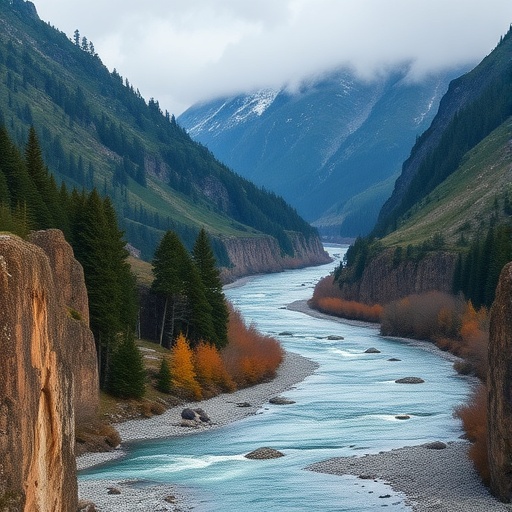
A hidden microbial process is reshaping the flow of nitrogen into Arctic fjords, potentially accelerating ecological change in some of the planet’s fastest-warming coastal environments. A new study by Hodson, Verret, Nowak and colleagues reports that nitrification increases the delivery of riverine nitrate to Arctic fjord ecosystems, revealing that rivers may transport more biologically available nitrogen than previously recognized.
The finding focuses on a transformation carried out by microorganisms rather than on a visible physical change in the landscape. Nitrification is a two-step microbial process in which ammonium, a reduced form of nitrogen, is oxidized first to nitrite and then to nitrate. The reaction is performed mainly by specialized bacteria and archaea that obtain energy from these chemical conversions. Although nitrate is essential for plant and algal growth, excessive or newly available nitrate can alter the balance of coastal food webs.
Arctic fjords are particularly sensitive to changes in nutrient delivery. These long, narrow inlets connect rivers, glaciers and terrestrial watersheds with marine environments. Their waters are shaped by powerful seasonal contrasts: winter darkness, spring snowmelt, summer sunlight, glacier runoff and shifting ocean circulation. When river water enters a fjord, it carries dissolved substances from soils, wetlands, rocks and thawing landscapes. The new research highlights that the chemical form of nitrogen can continue to change during this journey, even after it has left the land.
That transformation matters because nitrate is highly mobile in water. Ammonium can be retained by soils or consumed close to where it is produced, but once converted into nitrate, nitrogen may be transported farther downstream. Nitrate is also readily available to many primary producers, including phytoplankton and algae. In Arctic fjords, where light and nutrients can tightly regulate biological productivity, an increase in nitrate supply could influence the timing, intensity and composition of seasonal blooms.
The study’s central message is not that every fjord will respond in the same way, but that nitrification must be included when scientists calculate how much nitrogen rivers deliver to the Arctic Ocean. Conventional estimates may treat riverine nitrogen as a relatively stable mixture or focus mainly on the amount entering the waterway. The research instead emphasizes that nitrogen is chemically dynamic. Microbial processing within rivers and streams can change both the form and the ecological consequences of the nutrient before it reaches coastal waters.
This process is unfolding against a backdrop of rapid Arctic warming. Higher temperatures can stimulate microbial activity, while permafrost thaw, increased soil erosion and expanding runoff may expose new pools of organic matter and nitrogen to decomposition. As organic material breaks down, microorganisms can release ammonium that later becomes nitrate through nitrification. Changes in hydrology may also increase the time or surface area available for microbial reactions, although the outcome will depend on local conditions such as oxygen availability, water residence time, acidity and the amount of organic carbon.
The implications extend beyond the nitrogen cycle. In fjords, nitrate can support phytoplankton growth, which forms the base of many marine food webs. More primary production may benefit some organisms, but sudden or prolonged nutrient enrichment can also favor particular species and shift community structure. When algae die, their decomposition consumes oxygen, potentially creating stressful conditions for animals in poorly ventilated waters. The actual response will depend on how nitrate interacts with light, phosphorus, silicate, mixing and ocean circulation, but the study identifies a previously underappreciated pathway linking terrestrial change to marine ecosystems.
The Arctic is often described as a remote region, yet its waters are deeply connected to global climate processes. Fjords receive freshwater from landscapes responding to warming, while their biological communities influence carbon cycling and the exchange of greenhouse gases. By increasing nitrate transport, nitrification could affect how efficiently fjord ecosystems absorb carbon during periods of high productivity. At the same time, changes in biological activity and oxygen consumption could modify how carbon and nutrients are stored, exported or returned to the atmosphere. These effects are complex, and the study does not reduce them to a simple “more nitrate means more productivity” equation.
The findings also carry a message for monitoring. Measuring only total nitrogen at the mouth of a river may miss the microbial transformations that determine how that nitrogen behaves after it enters a fjord. Researchers may need to track ammonium, nitrite and nitrate separately, along with oxygen, temperature, organic carbon and flow conditions. Such measurements could help distinguish whether rising nutrient delivery is caused by greater nitrogen release on land, stronger in-stream processing, changing hydrology or a combination of all three.
As Arctic landscapes continue to change, the chemistry of rivers may become an increasingly important early warning signal for coastal ecosystems. The study by Hodson and colleagues shows that microscopic organisms can amplify the movement of a major nutrient across the land–sea boundary. Their work turns attention toward a process that is nearly invisible but ecologically powerful: the conversion of nitrogen inside flowing water. In a warming Arctic, understanding that conversion may be essential for predicting which fjords remain nutrient-limited, which experience intensified blooms and how rapidly coastal food webs are transformed.
Cite Scienmag News
Gavin Prescott. (August 10, 2026). Nitrification boosts river-borne nitrate delivery to Arctic fjords amid ecosystem change. Scienmag. https://scienmag.com/nitrification-boosts-river-borne-nitrate-delivery-to-arctic-fjords-amid-ecosystem-change/
Gavin Prescott. "Nitrification boosts river-borne nitrate delivery to Arctic fjords amid ecosystem change." Scienmag, 10 August 2026, https://scienmag.com/nitrification-boosts-river-borne-nitrate-delivery-to-arctic-fjords-amid-ecosystem-change/. Accessed 4 September 2026.
Gavin Prescott. "Nitrification boosts river-borne nitrate delivery to Arctic fjords amid ecosystem change." Scienmag. August 10, 2026. https://scienmag.com/nitrification-boosts-river-borne-nitrate-delivery-to-arctic-fjords-amid-ecosystem-change/


