

Monday, October 26, 2026
Science
No Result
View All Result
  • Login
  • HOME
  • SCIENCE NEWS
  • CONTACT US
  • HOME
  • SCIENCE NEWS
  • CONTACT US
No Result
View All Result
Scienmag
No Result
View All Result
Home Science News

Nine-feature model predicts visual impairment in Saudi diabetes cohort

October 26, 2026
in Science News
Teresa Odom
By Teresa Odom Scienmag Editorial Profile - Machine Learning
Reading Time: 3 mins read
0
Nine-feature model predicts visual impairment in Saudi diabetes cohort

Nine-feature model predicts visual impairment in Saudi diabetes cohort

65
SHARES
587
VIEWS
Share on FacebookShare on Twitter
ADVERTISEMENT

A machine-learning model based on nine selected health, demographic and lifestyle indicators achieved 95% accuracy and a 0.96 area under the curve for predicting visual impairment among people with type 2 diabetes at King Abdulaziz University Hospital in Saudi Arabia. The retrospective cross-sectional study analyzed medical records from 1,000 patients and found that a feature-selected CatBoost model performed better than comparison models, although the results do not establish how the tool would perform outside this hospital or in routine clinical care.

Researchers divided the records into two analytical groups: a full dataset containing patients with hemoglobin A1c, or HbA1c, levels of at least 6.5%, and a clinically relevant high-risk subgroup with HbA1c above 8%. The reduced subgroup incorporated 19 demographic, lifestyle and lipid-profile features. Models developed with this reduced dataset consistently performed better across the algorithms evaluated. The strongest result came from a CatBoost model whose features were selected with the Whale Optimization Algorithm, abbreviated WOA, and used nine indicators.

Within the high-risk subgroup, WOA-CatBoost achieved an accuracy of 0.95 and an area under the receiver operating characteristic curve, or AUC, of 0.96, with a 95% confidence interval of 0.94 to 0.98. A Random Forest model using features selected through the Black Widow Optimization Algorithm, or BWO, reached 0.92 accuracy and an AUC of 0.90, with a 95% confidence interval of 0.87 to 0.93, using 10 features. The baseline multilayer perceptron reached 0.91 accuracy and an AUC of 0.94, with a 95% confidence interval of 0.91 to 0.97, using 13 features. Models were developed with an 80/20 stratified train-test split, and five-fold cross-validation was conducted within the training set for internal validation.

Paired comparisons of the five-fold cross-validation accuracies further favored WOA-CatBoost. Bonferroni-corrected paired t-tests, using a significance threshold of 0.017, identified a statistically significant performance advantage over BWO-Random Forest, with a t value of 10.17 and p below 0.001. Predictors recurring across the three best-performing models were HbA1c, body mass index, age, occupation, triglycerides, type of food and smoking. The supplied findings do not report individual feature-importance scores or coefficients, so the relative contribution of each predictor cannot be determined from the available evidence.

Because the research was retrospective and cross-sectional, it evaluated model performance using existing medical records rather than testing the system prospectively or measuring effects on patient outcomes. The single-hospital sample also limits how directly the findings can be generalized to other Saudi healthcare settings or populations. Within the studied cohort and analytical subgroup, however, the results show that WOA-CatBoost combined strong measured discrimination with a smaller feature set than the comparison models. The authors described the approach as a parsimonious predictive tool for visual-impairment risk stratification in type 2 diabetes within the Saudi healthcare context, while further validation would be needed to assess its usefulness beyond the analyzed records.

Subject of Research: Machine-learning prediction of visual impairment in a Saudi type 2 diabetes cohort

Article Title: Predicting visual impairment in type 2 diabetes using key performance indicators identified by the Black Widow and Whale Optimization Algorithms: A case study in Saudi Arabia

Article References: Al-hussein, F., Tafakori, L., Abdollahian, M., & Al-Shali, K. (2026). Predicting visual impairment in type 2 diabetes using key performance indicators identified by the Black Widow and Whale Optimization Algorithms: A case study in Saudi Arabia. PLOS One, 21(10), e0361022. https://doi.org/10.1371/journal.pone.0361022

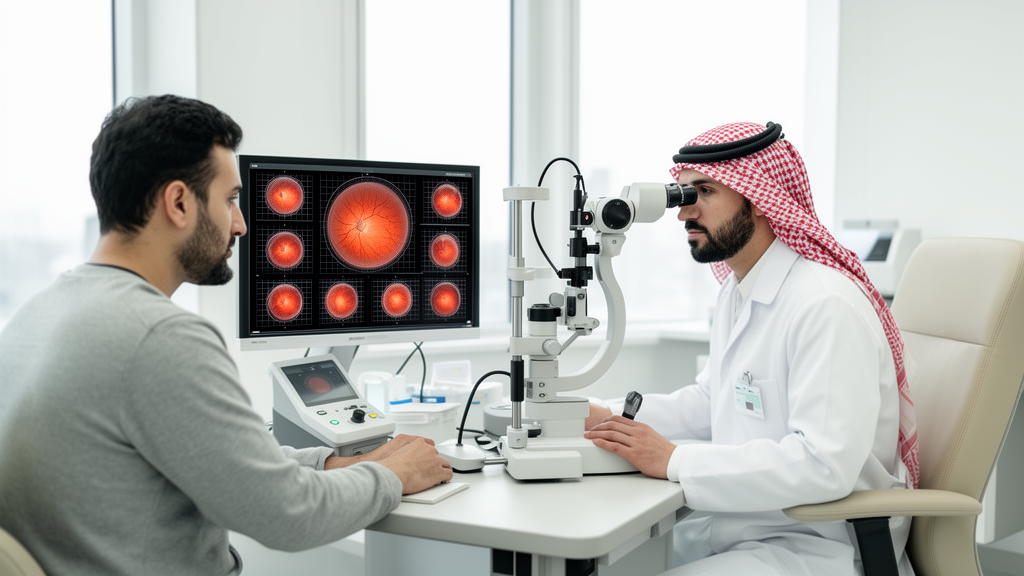
Image Credits: AI Generated

DOI: 10.1371/journal.pone.0361022

Keywords: visual impairment, type 2 diabetes, machine learning, CatBoost, feature selection, HbA1c, risk prediction, Saudi Arabia, medical records, retrospective study, Predicting, visual

Cite Scienmag News

Teresa Odom. (October 26, 2026). Nine-feature model predicts visual impairment in Saudi diabetes cohort. Scienmag. https://scienmag.com/nine-feature-model-predicts-visual-impairment-in-saudi-diabetes-cohort/

Teresa Odom. "Nine-feature model predicts visual impairment in Saudi diabetes cohort." Scienmag, 26 October 2026, https://scienmag.com/nine-feature-model-predicts-visual-impairment-in-saudi-diabetes-cohort/. Accessed 26 October 2026.

Teresa Odom. "Nine-feature model predicts visual impairment in Saudi diabetes cohort." Scienmag. October 26, 2026. https://scienmag.com/nine-feature-model-predicts-visual-impairment-in-saudi-diabetes-cohort/


Tags: accuracy and AUC metrics in medical predictive modelsapplication of Whale Optimization Algorithm in feature selectionCatBoostCatBoost algorithm for diabetic complication predictionfeature selectionHbA1chigh-risk subgroup analysis in diabetes-related visual impairmentimpact of lifestyle and demographic factors on diabetic retinopathyMachine learningmachine learning models outperforming traditional methods in diabetic eyemachine learning prediction of visual impairment in Saudi diabetes patientsmedical recordsnine-feature health model for diabetic eye diseasePredictingretrospective studyretrospective study of diabetes outcomes in Saudi Arabiarisk predictionrole of HbA1c levels in predicting visual impairmentSaudi ArabiaType 2 diabetesvisualvisual impairment
Share26Tweet16
Previous Post

Norovirus infections in China linked to CNY 20.23 billion annual medical cost

Next Post

Random Forest Leads Land-Cover Mapping in Eastern Nepal’s Sankhuwasabha District

Related Posts

Review maps how generative AI literacy is evidenced in language education
Technology and Engineering

Review maps how generative AI literacy is evidenced in language education

October 26, 2026
Sentinel-2 and Random Forest Map Seasonal Shifts in Forest Canopy
Science News

Sentinel-2 and Random Forest Map Seasonal Shifts in Forest Canopy

October 26, 2026
Research report: Individual versus group feedback in a peer-led mock OSCE: a randomised pilot study of medical students’ confidence, anxiety and perceived feedback quality
Science Education

Research report: Individual versus group feedback in a peer-led mock OSCE: a randomised pilot study of medical students’ confidence, anxiety and perceived feedback quality

October 26, 2026
Phytoplasma protein structurally mimics regulators of flower development
Chemistry

Phytoplasma protein structurally mimics regulators of flower development

October 26, 2026
Aligarh mixed-methods study links civic engagement to smart-city satisfaction
Earth Science

Aligarh mixed-methods study links civic engagement to smart-city satisfaction

October 26, 2026
Monk parakeet aggression shows no major sex-based difference
Biology

Monk parakeet aggression shows no major sex-based difference

October 26, 2026
Next Post
Random Forest Leads Land-Cover Mapping in Eastern Nepal’s Sankhuwasabha District

Random Forest Leads Land-Cover Mapping in Eastern Nepal’s Sankhuwasabha District

  • Mothers who receive childcare support from maternal grandparents show more optimized

    Mothers who receive childcare support from maternal grandparents show more parental warmth, finds NTU Singapore study

    27656 shares
    Share 11059 Tweet 6912
  • University of Seville Breaks 120-Year-Old Mystery, Revises a Key Einstein Concept

    1061 shares
    Share 424 Tweet 265
  • Bee body mass, pathogens and local climate influence heat tolerance

    682 shares
    Share 273 Tweet 171
  • Researchers record first-ever images and data of a shark experiencing a boat strike

    546 shares
    Share 218 Tweet 137
  • Groundbreaking Clinical Trial Reveals Lubiprostone Enhances Kidney Function

    531 shares
    Share 212 Tweet 133
Science

Embark on a thrilling journey of discovery with Scienmag.com—your ultimate source for cutting-edge breakthroughs. Immerse yourself in a world where curiosity knows no limits and tomorrow’s possibilities become today’s reality!

RECENT NEWS

  • Review maps how generative AI literacy is evidenced in language education
  • Sentinel-2 and Random Forest Map Seasonal Shifts in Forest Canopy
  • Research report: Individual versus group feedback in a peer-led mock OSCE: a randomised pilot study of medical students’ confidence, anxiety and perceived feedback quality
  • Phytoplasma protein structurally mimics regulators of flower development

Categories

  • Agriculture
  • Anthropology
  • Archaeology
  • Athmospheric
  • Biology
  • Biotechnology
  • Blog
  • Bussines
  • Cancer
  • Chemistry
  • Climate
  • Earth Science
  • Editorial Policy
  • Marine
  • Mathematics
  • Medicine
  • Pediatry
  • Policy
  • Psychology & Psychiatry
  • Science Education
  • Science News
  • Social Science
  • Space
  • Technology and Engineering

Subscribe to Blog via Email

Enter your email address to subscribe to this blog and receive notifications of new posts by email.

Join 5,151 other subscribers

© 2025 Scienmag - Science Magazine

Welcome Back!

Login to your account below

Forgotten Password?

Retrieve your password

Please enter your username or email address to reset your password.

Log In
No Result
View All Result
  • HOME
  • SCIENCE NEWS
  • CONTACT US

© 2025 Scienmag - Science Magazine

Discover more from Science

Subscribe now to keep reading and get access to the full archive.

Continue reading