


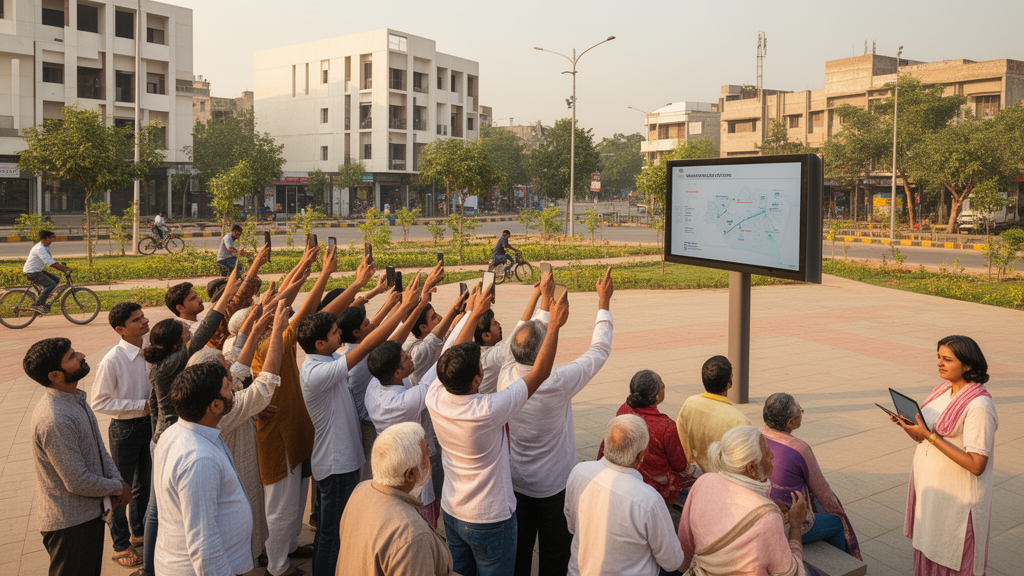
A mixed-methods study of India’s Smart Cities Mission in Aligarh, Uttar Pradesh, found that citizen satisfaction was most strongly associated with awareness of official initiatives and community engagement, while overlapping responsibilities, uneven organisational capacity and unequal digital access constrained implementation. The findings offer diagnostic insights from one Tier-2 city, rather than evidence that the same relationships or barriers apply throughout India.
Researchers examined the national mission, which aims to transform 100 cities through digitally enabled and sustainable urban environments aligned with Sustainable Development Goal 11. Their evidence combined questionnaires answered by 170 Aligarh residents, 12 semi-structured interviews with stakeholders, and analysis of academic literature and official documents. Online recruitment produced a sample that was disproportionately urban, educated and digitally literate. The authors therefore cautioned that the quantitative findings describe Aligarh’s digitally connected population and are not representative of the city’s wider citizenry.
Multiple regression analysis within that subsample explained 63% of the variation in citizen satisfaction, with an R² of 0.63. Awareness of Smart Cities Mission initiatives had the largest reported beta value, at β = 0.26, followed by community engagement at β = 0.23. Infrastructure satisfaction was associated with satisfaction at β = 0.20, attitudes toward technology adoption at β = 0.18, and perceived public–private partnership effectiveness at β = 0.15. The supplied findings do not specify that these beta values were standardized. They represent statistical associations in a cross-sectional analysis, not experimental effects, and the study does not establish that changing any associated factor would cause satisfaction to rise. Community engagement also showed the strongest reported association with technology-adoption attitudes, at r = 0.59, indicating a close relationship within the sampled group.
Interviews and documentary evidence complemented the survey through an institutional-capacity perspective spanning individual, institutional and environmental dimensions. This material identified a persistent structural–functional implementation gap, meaning that the structures created to advance the mission were not consistently producing effective functions. Responsibilities overlapped between the Special Purpose Vehicle and municipal authorities, organisational capacity was uneven, and access to digital services was unequal. The study documents these constraints in the Aligarh case but does not quantify their prevalence or effects across other cities. It also does not compare Aligarh longitudinally with another urban centre, so the results should not be read as evidence of change over time.
Together, the statistical and qualitative findings portray smart-city implementation in Aligarh as a governance and participation challenge alongside its technical dimensions. Awareness and engagement emerged as prominent correlates of citizen satisfaction, while the qualitative evidence highlighted coordination, institutional capability and inclusive digital participation as features of implementation. The research does not demonstrate that any particular digital system, partnership model or institutional arrangement will improve urban outcomes. Its principal limitations are the non-probability, digitally skewed survey sample and the single-city, cross-sectional design, which limit generalisation and causal interpretation. Even so, the study provides a contextually grounded account of the constraints facing a structurally comparable Tier-2 city and points to governance capacity, coordination and meaningful participation as matters requiring attention in similar settings.
Subject of Research: Institutional and participation barriers to smart-city implementation in Aligarh, India
Article Title: Challenges and opportunities in smart city implementation in Tier-2 India based on evidence from Aligarh
Article References: Ahmad, S., & Naaz, I. (2026). Challenges and opportunities in smart city implementation in Tier-2 India based on evidence from Aligarh. Discover Sustainability. https://doi.org/10.1007/s43621-026-04726-0
Image Credits: AI Generated
DOI: 10.1007/s43621-026-04726-0
Keywords: smart cities, Aligarh, urban governance, citizen satisfaction, community engagement, digital inclusion, institutional capacity, public-private partnerships, India, Challenges, opportunities, smart
Cite Scienmag News
Violet Maxwell. (October 26, 2026). Aligarh mixed-methods study links civic engagement to smart-city satisfaction. Scienmag. https://scienmag.com/aligarh-mixed-methods-study-links-civic-engagement-to-smart-city-satisfaction/
Violet Maxwell. "Aligarh mixed-methods study links civic engagement to smart-city satisfaction." Scienmag, 26 October 2026, https://scienmag.com/aligarh-mixed-methods-study-links-civic-engagement-to-smart-city-satisfaction/. Accessed 26 October 2026.
Violet Maxwell. "Aligarh mixed-methods study links civic engagement to smart-city satisfaction." Scienmag. October 26, 2026. https://scienmag.com/aligarh-mixed-methods-study-links-civic-engagement-to-smart-city-satisfaction/


