


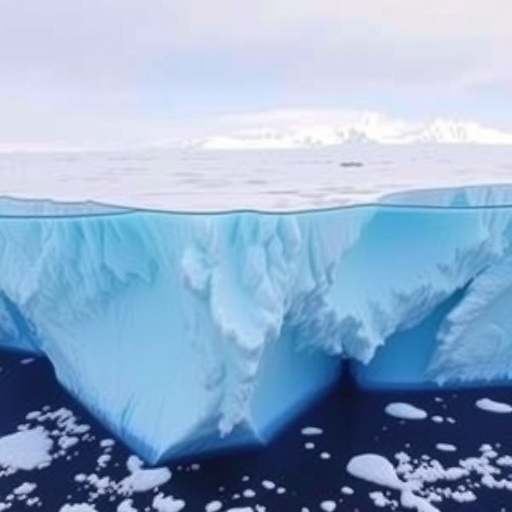
Antarctic ice shelves, the colossal floating extensions of the continent’s glaciers, have long been regarded as critical regulators of global sea level rise. Recent research from a team based in Norway unveils a startling mechanism that suggests the threat these ice shelves pose to future sea levels may be far greater than previously estimated. The study, published in Nature Communications, sheds new light on how the intricate underwater topography beneath these ice shelves amplifies their vulnerability to ocean warming, accelerating melting at rates that were hitherto unrecognized.
The stability of Antarctic ice shelves is paramount because they act as natural buttresses, restraining vast amounts of glacial ice from flowing rapidly into the ocean. These ice shelves float on the ocean’s surface but are essentially anchored to the coastline, slowing down the discharge of ice from the continent into the sea. However, the study focuses on a detailed examination of the Fimbulisen Ice Shelf in East Antarctica, a region traditionally thought to be less susceptible to immediate warming effects compared to West Antarctica. Here, subtle but critical variations in ice shelf base topography bear profound implications for the future integrity of the ice shelf system.
A key revelation from this research is the identification of long, channel-like grooves etched into the undersides of the ice shelves. These channels are not merely passive indentations; instead, they act as heat traps that ensnare relatively warm ocean water beneath the ice. The entrapment fosters a sustained presence of warmer water in localized areas, significantly intensifying basal melting. By creating small-scale overturning circulations, these channels effectively retain heat, preventing it from being flushed out and thus perpetuating localized erosive melt.
Modeling efforts combining high-resolution oceanographic data with detailed topographical maps of the ice shelf base allowed researchers to isolate how differing geometries influenced water flow and melting patterns. Scenarios contrasting smooth ice shelf bases with the more realistic channelized forms demonstrated a stark increase in melting rates—up to an order of magnitude locally—in the presence of these grooves. This finding highlights the crucial influence of micro-scale ice geometry on the macro-scale stability of the Antarctic ice sheet.
Such melting dynamics carry significant ramifications. Accelerated melting within the channels leads not only to the deepening and widening of these grooves but also to a compounding loss of ice shelf thickness. This uneven thinning weakens the mechanical strength of the ice shelves, rendering them less capable of holding back the massive glaciers feeding them. Consequently, the downstream ice flow can accelerate dramatically, flooding the ocean with ice and contributing to sea-level rise beyond current projections.
Importantly, these findings challenge existing climate and ice sheet models, which often treat ice shelf bases as relatively smooth and overlook micro-topographic effects. The failure to capture the role of channelized topography means many simulations may substantially underestimate the sensitivity of ‘cold’ East Antarctic ice shelves to small changes in ocean temperature. Given that even modest inflows of warmer deep water can trigger substantial melting in these channels, the risk posed by warming ocean currents is unexpectedly high.
The study’s insights arise from an integrated approach combining long-term observational data with sophisticated numerical simulations. Field measurements under the Fimbulisen Ice Shelf, some conducted by lead author Tore Hattermann himself after hundreds of days in Antarctic conditions, informed the modeling parameters. The approach underscores the necessity of coupling empirical data with high-resolution computational models capable of resolving fine-scale ocean-ice interactions.
Ecologically, the implications extend beyond ice and sea levels. Changes in meltwater discharge patterns can modify local ocean circulation and nutrient distributions around Antarctica, impacting marine ecosystems that rely on stable environmental conditions. Furthermore, uneven ice shelf thinning and potential collapse could produce broad-scale feedback effects, altering both regional and global climate systems.
The broader scientific community and policymakers alike must grapple with these findings. Anticipating sea-level rise accurately is essential for coastal planning, infrastructure development, and mitigation strategies worldwide. This research signals an urgent need to refine ice sheet and climate models to incorporate the complexities of ice shelf basal topography and its influence on melting sensitivity. Failure to do so risks gross underestimation of future sea-level rise, with profound socio-economic consequences.
In conclusion, the newly uncovered channelized melting process redefines our understanding of Antarctic ice shelf vulnerability. East Antarctica, traditionally deemed more stable, emerges as a region where even slight warming can have outsized effects on ice shelf integrity. In the race to predict and mitigate the impacts of climate change, such breakthroughs are invaluable, offering a more nuanced map of the challenges ahead and highlighting the intricate interplay between ocean currents and polar ice.
Cite Scienmag News
Thomas Green. (May 7, 2026). New Study Warns Rapid Melting of Antarctic Ice Shelves Could Accelerate Global Sea Level Rise Beyond Current Predictions. Scienmag. https://scienmag.com/new-study-warns-rapid-melting-of-antarctic-ice-shelves-could-accelerate-global-sea-level-rise-beyond-current-predictions/
Thomas Green. "New Study Warns Rapid Melting of Antarctic Ice Shelves Could Accelerate Global Sea Level Rise Beyond Current Predictions." Scienmag, 7 May 2026, https://scienmag.com/new-study-warns-rapid-melting-of-antarctic-ice-shelves-could-accelerate-global-sea-level-rise-beyond-current-predictions/. Accessed 3 September 2026.
Thomas Green. "New Study Warns Rapid Melting of Antarctic Ice Shelves Could Accelerate Global Sea Level Rise Beyond Current Predictions." Scienmag. May 7, 2026. https://scienmag.com/new-study-warns-rapid-melting-of-antarctic-ice-shelves-could-accelerate-global-sea-level-rise-beyond-current-predictions/


