


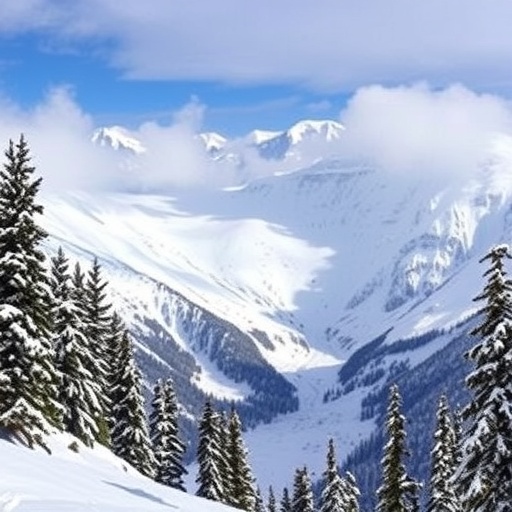
This past winter, the Rocky Mountains, an iconic mountain range that spans several western U.S. states, endured an unprecedented snow drought, a troubling event that threatens water supplies for tens of millions of people living in the arid American West. For these communities, the annual snowpack serves not only as a scenic natural spectacle but also as a critical freshwater reservoir. Snowmelt from these mountains replenishes rivers, reservoirs, and aquifers essential for drinking water, agriculture, and ecosystem health. Yet, a new and less visible phenomenon may be quietly exacerbating the situation: sublimation, the direct transformation of solid snow into water vapor without passing through the liquid phase.
In a recent study published in the prestigious journal Geology, researchers led by Jeffrey Munroe, a geologist affiliated with Middlebury College and the University of Innsbruck, investigated the long-term geologic record of snowpack sublimation. Sublimation is familiar to many through the everyday experience of freezer burn on ice cubes, where the ice seemingly vanishes over time despite being frozen solid. Munroe remarks on this phenomenon: “We swear we made ice a few weeks ago and yet the tray is empty or the ice cubes are half gone.” This seemingly mundane process has profound implications when scaled to vast mountainous landscapes.
The study centers on Bear Ice Cave in northern Utah, a unique natural laboratory where seasonal snowmelt percolates through the ground in spring and refreezes within the cave’s permanently freezing interior, creating layered ice deposits. These ice layers act like an archival record, retaining the isotopic signature of the winter snowpack above. Munroe and his co-author, Christoph Spötl, analyzed these layers and found a surprising trend: over the past six millennia, the proportion of winter snow lost to sublimation increased steadily from about 30% to 45%.
This result highlights sublimation as a potent but often overlooked component of the mountain water cycle. Unlike melting, which converts snow to liquid water feeding streams and reservoirs, sublimation returns water directly to the atmosphere, effectively removing it from the hydrologic system. This loss is particularly concerning as climate change warms the atmosphere and alters the microclimates that govern snowfall and snow retention.
The unique microclimate inside Bear Ice Cave is essential to the study’s revelations. Its geometry enables cold air, denser than warm air, to sink and settle in the cave during winter, cooling the cave floor below freezing year-round. In summer, the temperature inside remains subfreezing as warm air cannot sink into the cave’s depths. This natural refrigeration allows the cave to preserve layers of ice that document snowpack processes without melting away. Nonetheless, the researchers warn that rising global temperatures threaten these icy archives, emphasizing the urgency to study them before they vanish completely.
Delving deeper into the cave’s ice, the researchers utilized stable isotope analysis—specifically examining variants of hydrogen and oxygen atoms in water molecules that contain extra neutrons. Sublimation, they explain, selectively removes lighter isotopes, which more readily transition into water vapor. The remaining snow and ice therefore become “heavier” isotopically, a characteristic preserved in each ice layer. By carefully interpreting this isotopic fingerprint over thousands of years, Munroe and Spötl reconstructed the history of sublimation rates, establishing its increasing role in snowpack depletion.
While this long-term record does not directly predict yearly snowpack variations or immediate future conditions, it unequivocally demonstrates that sublimation is a dynamic and significant process influencing mountain snowpack volumes over millennia. Current climate shifts likely intensify this effect, rendering even more winter precipitation subject to conversion into atmospheric vapor rather than replenishing regional water supplies.
The implications of these findings extend beyond academic interest. Water managers and policymakers in western states must now consider sublimation’s potentially escalating water losses when developing conservation strategies and estimating water availability. Munroe emphasizes, “Sublimation is often just ignored, and yet any water manager is going to sit up and take notice if you tell them half the snow that falls in winter might just go back into the air, and that value could change over time.”
This discovery also underscores the intricate interplay between climate dynamics, landscape features, and hydrology. Understanding sublimation’s magnitude encourages a reevaluation of how mountain water cycles function under changing environmental conditions, ultimately contributing to more accurate climate models and resource management plans.
From a geological perspective, the layered ice within Bear Ice Cave serves as an invaluable archive akin to tree rings or sediment cores, offering insights into past environmental conditions otherwise difficult to discern. The skillful use of isotope geochemistry combined with cave climatology demonstrates the innovative methodologies pushing the boundaries of Earth science research.
The study’s results echo broader concerns about the vulnerability of critical cryospheric features globally, including glaciers, permafrost, and alpine snowfields, to warming and drying trends. As these frozen water reserves diminish, the ripple effects will cascade through ecosystems, economies, and societies dependent upon consistent freshwater supply.
Ultimately, this research champions the importance of subtle and complex processes like sublimation in shaping our planet’s hydrological future. By unveiling the hidden pathways through which water disappears, Munroe and Spötl provide groundbreaking knowledge that should inform environmental stewardship, scientific inquiry, and public awareness alike.
News Publication Date: March 19, 2026
Web References: https://pubs.geoscienceworld.org/gsa/geology/article/doi/10.1130/G54328.1/727757/Stable-isotopes-in-cave-ice-reveal-Holocene
References: Munroe, J., Spötl, C., 2026, Stable isotopes in cave ice reveal Holocene changes in mountain snowpack sublimation; Geology
Cite Scienmag News
Russell Cooper. (March 25, 2026). New Study Reveals Crucial Role of Sublimation in Rocky Mountain Snowpack Dynamics. Scienmag. https://scienmag.com/new-study-reveals-crucial-role-of-sublimation-in-rocky-mountain-snowpack-dynamics/
Russell Cooper. "New Study Reveals Crucial Role of Sublimation in Rocky Mountain Snowpack Dynamics." Scienmag, 25 March 2026, https://scienmag.com/new-study-reveals-crucial-role-of-sublimation-in-rocky-mountain-snowpack-dynamics/. Accessed 4 September 2026.
Russell Cooper. "New Study Reveals Crucial Role of Sublimation in Rocky Mountain Snowpack Dynamics." Scienmag. March 25, 2026. https://scienmag.com/new-study-reveals-crucial-role-of-sublimation-in-rocky-mountain-snowpack-dynamics/


