


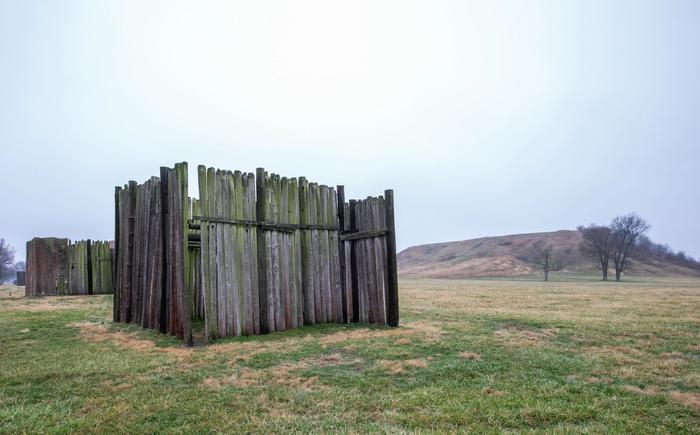
Nine hundred years ago, the Cahokia Mounds settlement just across the Mississippi River from present-day St. Louis bustled with roughly 50,000 people in the metropolitan area, making it one of the largest communities in the world. By 1400, however, the once-popular site was practically deserted, a mass departure that remains shrouded in mystery.

Credit: Photo: Joe Angeles / Washington University
Nine hundred years ago, the Cahokia Mounds settlement just across the Mississippi River from present-day St. Louis bustled with roughly 50,000 people in the metropolitan area, making it one of the largest communities in the world. By 1400, however, the once-popular site was practically deserted, a mass departure that remains shrouded in mystery.
One popular theory is that the Cahokia residents abandoned the settlement after a massive crop failure brought on by a prolonged drought. But a new study in the journal The Holocene by Natalie Mueller, assistant professor of archaeology in Arts & Sciences at Washington University in St. Louis, and Caitlin Rankin, PhD ’20, suggests the Cahokians likely had other reasons to leave town.
Rankin dug deep into the soil at the historic Cahokia site to collect isotopes of carbon, atoms left behind by the plants growing when the human population collapsed and drought was common across the Midwest.
All plants use one of two types of carbon, Carbon 12 and Carbon 13, for photosynthesis, but not all plants do photosynthesis the same way. Plants adapted to dry climates — including prairie grasses and maize, an important new crop during the Cahokia period — incorporate carbon into their bodies at rates that leave behind a tell-tale signature when the plants die and decay.
Most of the other plants that the Cahokians would have harvested for food — including squash, goosefoot and sumpweed — will leave a different signature, one they share with plants from wetlands and native forests.
Rankin’s samples showed that ratios of Carbon 12 and Carbon 13 stayed relatively consistent during that crucial period — a sign there was no radical shift in the types of plants growing in the area. “We saw no evidence that prairie grasses were taking over, which we would expect in a scenario where widespread crop failure was occurring,” Mueller said.
The Cahokians are known for their ingenuity, and Rankin said they may have had the engineering and irrigation skills to keep crops flourishing under difficult conditions. “It’s possible that they weren’t really feeling the impacts of the drought,” said Rankin, now an archaeologist with the Bureau of Land Management in Nevada.
Mueller added that the sophisticated society that blossomed at Cahokia almost certainly included a storage system for grains and other foods. Residents also enjoyed a varied and diverse diet — including fish, birds, deer, bear and forest fruits and nuts — that would have kept them nourished even if a few food sources disappeared.
To get a better grasp of the diets and agricultural practices of Indigenous people of the Midwest, Mueller hopes to build a database that collects paleo-botanical evidence from across the region. “Gathering that information would help us see if people switched to different crops in response to climate change,” she said. She’s also planning to grow certain food crops in controlled conditions on campus to understand how they might have responded to ancient droughts and other challenges.
So, why did the Cahokians leave their land of plenty? Mueller suspects it was a gradual process. “I don’t envision a scene where thousands of people were suddenly streaming out of town,” she said. “People probably just spread out to be near kin or to find different opportunities.”
“They put a lot of effort into building these mounds, but there were probably external pressures that caused them to leave,” Rankin said. “The picture is likely complicated.”
This story was originally published on the Ampersand website.
Journal
The Holocene
Article Title
Correlating Late-Holocene climate change and population dynamics at Cahokia Mounds (American Bottom, USA)
Article Publication Date
19-Jun-2024
Cite Scienmag News
Courtney Benton. (July 3, 2024). New study adds to mystery of Cahokia exodus. Scienmag. https://scienmag.com/new-study-adds-to-mystery-of-cahokia-exodus/
Courtney Benton. "New study adds to mystery of Cahokia exodus." Scienmag, 3 July 2024, https://scienmag.com/new-study-adds-to-mystery-of-cahokia-exodus/. Accessed 4 September 2026.
Courtney Benton. "New study adds to mystery of Cahokia exodus." Scienmag. July 3, 2024. https://scienmag.com/new-study-adds-to-mystery-of-cahokia-exodus/

