


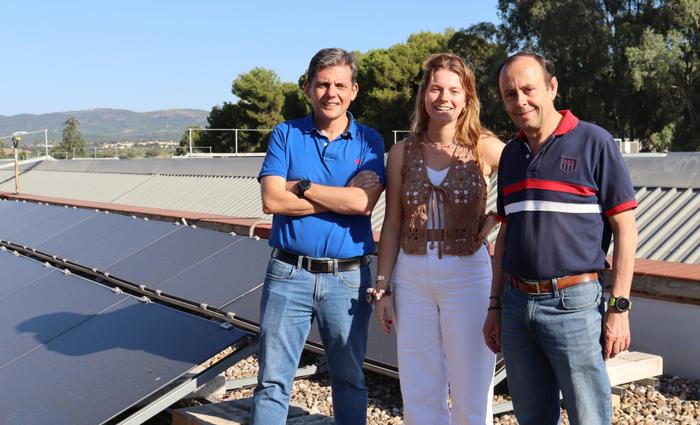
Irrigation faces the challenge of making its activity more sustainable, both environmentally and economically. In this context, energy self-sufficiency is proposed as a path to follow for the agriculture of the future. The Lower Guadalquivir Valley Irrigation Community, covering almost 19,000 hectares and with more than 2,000 irrigators, began self-supplying through solar energy in 2019 through the installation of a 6-megawatt photovoltaic plant, the largest of all irrigation systems in Spain. This has made it a trailblazer and testing ground available to the scientific community as efforts are being made to shift towards an environmentally and economically sustainable irrigation model.

Credit: University of Cordoba
Irrigation faces the challenge of making its activity more sustainable, both environmentally and economically. In this context, energy self-sufficiency is proposed as a path to follow for the agriculture of the future. The Lower Guadalquivir Valley Irrigation Community, covering almost 19,000 hectares and with more than 2,000 irrigators, began self-supplying through solar energy in 2019 through the installation of a 6-megawatt photovoltaic plant, the largest of all irrigation systems in Spain. This has made it a trailblazer and testing ground available to the scientific community as efforts are being made to shift towards an environmentally and economically sustainable irrigation model.
The most recent example is its close collaboration with the María de Maeztu Unit of Excellence’s Hydraulics and Irrigation research group, in association with the University of Cordoba’s Department of Agronomy (DAUCO), which has proposed different strategies to maximize the use of the solar energy it produces, prevent the surplus from being lost, and reduce dependence on external energy sources.
The researchers responsible for the study, Maaike van de Loo, Emilio Camacho and Juan Antonio Rodríguez, explain that more solar energy is currently produced than is used, generating a surplus of around 50%, while a secondary source is necessary to meet energy needs when solar energy is not being produced; at night, for example. To resolve this situation, two possible solutions have been studied that would contribute to reducing the volume of energy lost and optimizing its use, ideas having been published in the journal Renewable Energy.
The first one proposes a change in growers’ habits, adjusting irrigation schedules to coincide with the daytime hours when solar energy is produced, and avoiding nighttime irrigation. This approach, the research team explains, represents a paradigm shift since traditionally the Lower Valley Community had opted for irrigation at night due to the advantages it entailed: cheaper energy rates and milder temperatures, which reduce water evaporation levels. However, the drop in energy costs thanks to the construction of the photovoltaic plant, and the expansion of drip irrigation, which reduces water consumption by up to 60% compared to other conventional methods (by allowing for more precise application, thereby minimizing losses) means that irrigators have reason to change their routines.
The strategy that the research group proposes is to abandon on-demand irrigation (24 hours of water availability) and concentrate its use in a space 8 to 12 hours, when there is sunshine, which would significantly increase the ready supply of photovoltaic energy, above 90%. The researchers clarify that, even if this model is implemented, it would always be necessary to have an additional energy source to supplement solar due to its dependence on weather and environmental conditions. However, in a region like Andalusia, with more than 3,000 hours of sunshine per year, the strategy would significantly reduce dependence on external sources and contribute to a more sustainable irrigation model, both economically and environmentally.
The second scenario is economic and consists of selling surplus energy, something that the Lower Valley Community has been doing since the plant’s installation. An increase in solar energy production at the national and European levels, however, has led to lower prices, which reduces its profitability.
The study concludes that, thus far, there is no solution that guarantees 100% exploitation of solar energy, though it constitutes a valuable resource. Nevertheless, the researchers are confident that research like this, together with the experience of the Lower Valley Irrigation Community, can pave the way for the irrigation of the future, one capable of combining environmental protection with economic profitability by taking full advantage of the territory’s potential.
Journal
Renewable Energy
Method of Research
Experimental study
Subject of Research
Not applicable
Article Title
Defining the optimization strategy for solar energy use in large water distribution networks: A case study from the Valle Inferior irrigation system, Spain
Article Publication Date
1-May-2024
Cite Scienmag News
Faith Mcneil. (July 3, 2024). From daytime irrigation to selling surplus energy: solutions to optimize the use of solar energy in irrigation communities. Scienmag. https://scienmag.com/from-daytime-irrigation-to-selling-surplus-energy-solutions-to-optimize-the-use-of-solar-energy-in-irrigation-communities/
Faith Mcneil. "From daytime irrigation to selling surplus energy: solutions to optimize the use of solar energy in irrigation communities." Scienmag, 3 July 2024, https://scienmag.com/from-daytime-irrigation-to-selling-surplus-energy-solutions-to-optimize-the-use-of-solar-energy-in-irrigation-communities/. Accessed 3 September 2026.
Faith Mcneil. "From daytime irrigation to selling surplus energy: solutions to optimize the use of solar energy in irrigation communities." Scienmag. July 3, 2024. https://scienmag.com/from-daytime-irrigation-to-selling-surplus-energy-solutions-to-optimize-the-use-of-solar-energy-in-irrigation-communities/

