


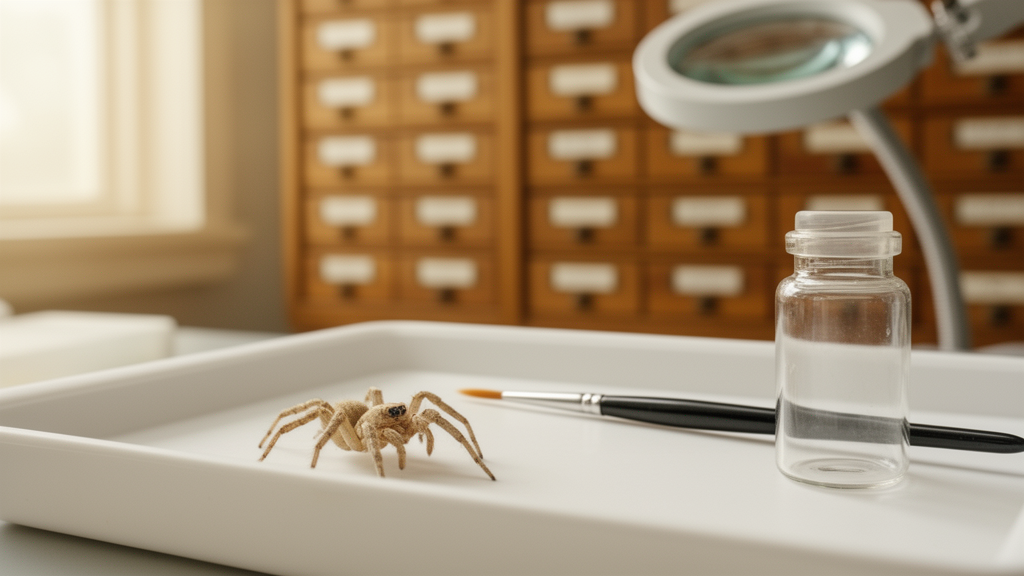
On a barren volcanic peak rising from the middle of the South Atlantic, a spider has been hiding in plain sight for more than sixty years. A new study of the ground spiders of Ascension Island, published in the journal African Invertebrates, has revealed a species entirely new to science — and, remarkably, the specimens that proved its existence had been sitting in museum collections since the 1950s. The find reshapes what scientists know about the spider fauna of one of the world’s most isolated landmasses and highlights how much biodiversity still waits in the drawers of natural history museums.
Ascension Island, part of the United Kingdom Overseas Territory of Saint Helena, Ascension and Tristan da Cunha, lies roughly midway between South America and Africa. Its invertebrate life has long been understudied, with the spider fauna previously examined in detail only a handful of times — most notably by ecologist Eric Duffey in 1964 and by Philip and Myrtle Ashmole in the 1990s. The new survey, led by researchers sorting through both historical and freshly collected specimens, focused on the family Gnaphosidae, commonly known as ground spiders. With roughly 2,458 described species across 150 genera worldwide, this is one of the largest spider families, yet only a few of its members had ever been recorded from Ascension.
The team’s updated checklist confirms five gnaphosid species on the island, spread across five genera. Three of these — Marinarozelotes jaxartensis, Urozelotes rusticus and Zelotes laetus — were already known from earlier records, though sometimes under names now considered junior synonyms. Their continued presence on the island is now verified with modern specimens, including individuals caught in pitfall traps as recently as 2022 and 2023. But the real headline is the two species newly recorded for Ascension: Synaphosus syntheticus, an invasive species found on the mainland, and an entirely undescribed spider now named Australoechemus vickyae.
Australoechemus vickyae is the star of the study. The genus Australoechemus was previously known only from the Cape Verde Islands, some 2,900 kilometres away, making its discovery on Ascension a significant biogeographic surprise. The new species was described from both sexes, with the holotype — an adult male — collected on Boatswain Bird Island, a small islet off the coast of Ascension, during Duffey’s 1957 expedition. Additional specimens, including females and an immature male, came from the same islet, while two more females were collected recently on Ascension’s mainland near English Bay Road and at South Gannet Hill, suggesting the species is more widespread than once thought.
The species name honours Vicky Wilkins, a British conservationist and entomologist with the Species Recovery Trust and co-chair of the IUCN SSC Mid-Atlantic Islands Invertebrate Specialist Group, in recognition of her contributions to invertebrate conservation across UK Overseas Territories. The spiders themselves are modest in appearance: light brown, with males reaching around 6 to 7 millimetres in body length and females slightly larger at 8 to 9 millimetres. But under the microscope, their anatomy tells a different story.
Distinguishing a new spider species requires close examination of the copulatory organs — the male palp and the female epigyne — which are often the only reliable markers between closely related species. In male A. vickyae, the retrolateral tibial apophysis, a small appendage on the leg-like palp used during mating, is nearly as long as the tibia itself and tapers to a non-bifurcated tip. In the closely related A. celer from Cape Verde, this structure is shorter, broader at the tip and forked. The female’s epigyne differs too: its fovea, a pit-like structure, is widest at the front rather than in the middle, and the internal receptacles are smaller than the bursa copulatrix, reversing the pattern seen in A. celer. The male also sports a distinctive U-shaped sperm duct running along the margin of the tegulum and a membranous lamellar extension on the front of that structure — features that set Australoechemus apart from other ground spider genera.
Placing the new species in Australoechemus was not entirely straightforward. The genus was erected in 1994 to house two species from Cape Verde, but its type species, A. oecobiophilus, is known only from a juvenile specimen, and the original description was so brief and vague that it consisted of a single sentence distinguishing the genus from another by the absence of preening combs on certain leg segments. The authors of the new study relied on a much more detailed redescription of A. celer published in 2007 to make their case, noting that the morphology of A. vickyae — from the shape of the sperm duct to the presence of a trochanteral notch in both sexes — aligns clearly with Australoechemus as currently understood. They stress that future workers must clarify the taxonomy of the type species using adult specimens, and suggest molecular work could help resolve the genus’s broader evolutionary relationships.
The second new record, Synaphosus syntheticus, tells a very different story. Originally described from California in 1924, this species has since been found across Africa, the Middle East and is thought introduced to the United States and Mexico. Its presence on Ascension, confirmed from specimens caught in baited pitfall traps at Travellers Hill in March 2022, adds another piece to the puzzle of how invasive ground spiders colonise remote oceanic islands. The other three gnaphosids on the island are similarly well-travelled: M. jaxartensis was originally described from Central Asia but now occurs across the Holarctic and beyond; U. rusticus was first described from the Alps but is now found on every continent; and Z. laetus, described from what was then Palestine, has been introduced to Hawaii, the Americas and Peru.
The study also cleans up the island’s spider list in another way. Duffey had recorded the species Gnaphosa funerea from Ascension in 1964, but when the researchers examined the relevant specimens held at the Natural History Museum in London, they found them all to be immature gnaphosids of indeterminate genus — impossible to confirm at species level. That record has now been removed from the island’s inventory, a reminder of how historical identifications based on juvenile specimens can persist unchallenged for decades until someone goes back to the originals.
For a remote island whose terrestrial fauna has been shaped by volcanic origins and centuries of human traffic, the gnaphosid fauna remains depauperate — a thin slice of the diversity found on continental landmasses. Yet the discovery of a genus previously thought restricted to Cape Verde, surviving on a lonely islet and its neighbouring mainland, underscores both the value of revisiting old collections and the fragility of island ecosystems. Boatswain Bird Island, the type locality of A. vickyae, hosts several unique endemic arachnids, and the new species serves as a reminder that even the most seemingly well-surveyed corners of the globe can still yield surprises — sometimes from specimens collected before the Apollo programme had even begun.
Subject of Research: Taxonomic survey of ground spiders (Gnaphosidae) on Ascension Island with description of a new species
Article Title: A survey of Gnaphosidae ( Arachnida , Araneae ) from Ascension Island with description of a new species of Australoechemus Schmidt & Piepho, 1994
Article References: Sherwood, D., Marusik, Y. M., Sharp, A., & Ashmole, P. (2023). A survey of Gnaphosidae (Arachnida, Araneae) from Ascension Island with description of a new species of Australoechemus Schmidt & Piepho, 1994. African Invertebrates, 64(3), 291-302. https://doi.org/10.3897/afrinvertebr.64.113946
Image Credits: AI Generated
DOI: 10.3897/afrinvertebr.64.113946
Keywords: Ascension Island, Gnaphosidae, ground spiders, new species, Australoechemus vickyae, taxonomy, arachnology, Boatswain Bird Island, invasive species, South Atlantic, biodiversity, museum collections
Cite Scienmag News
Margaret Porter. (October 18, 2026). New spider species discovered on remote Ascension Island after decades in museum drawers. Scienmag. https://scienmag.com/new-spider-species-discovered-on-remote-ascension-island-after-decades-in-museum-drawers/
Margaret Porter. "New spider species discovered on remote Ascension Island after decades in museum drawers." Scienmag, 18 October 2026, https://scienmag.com/new-spider-species-discovered-on-remote-ascension-island-after-decades-in-museum-drawers/. Accessed 18 October 2026.
Margaret Porter. "New spider species discovered on remote Ascension Island after decades in museum drawers." Scienmag. October 18, 2026. https://scienmag.com/new-spider-species-discovered-on-remote-ascension-island-after-decades-in-museum-drawers/


