


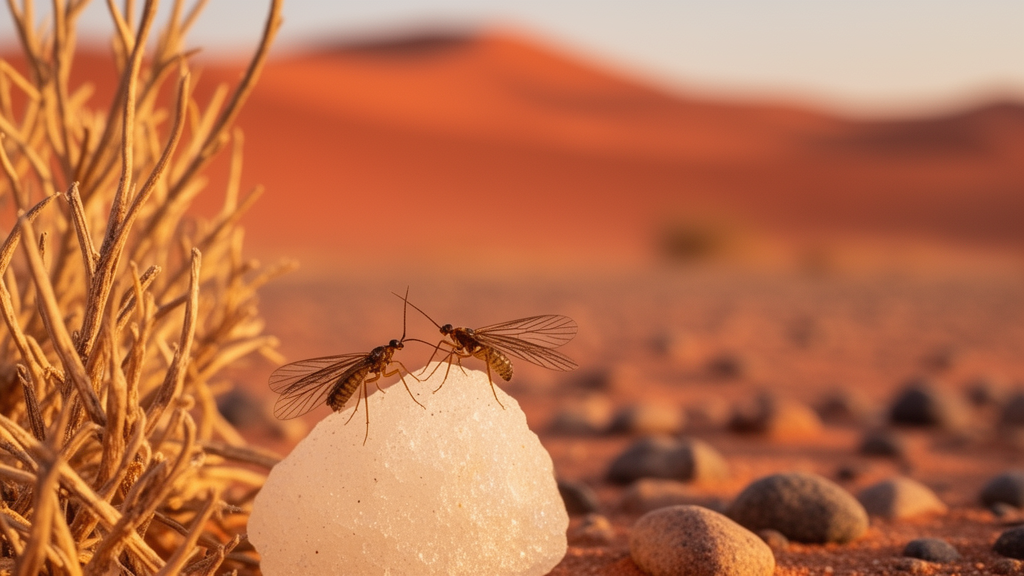
Deep in the hyper-arid sands of the Arabian Peninsula, a team of entomologists has quietly added two brand-new species to the catalogue of life, and in the process solved a decades-old mystery about a tiny desert insect that has baffled scientists for half a century. The insects in question are thrips, slender insects measuring barely a millimeter or two, and the genus in question is Eremiothrips, a group so pale and delicate that most people would never notice one even if it landed on their hand. Published in the open-access journal ZooKeys, the study describes Eremiothrips tetraenae and Eremiothrips xerophilus as species new to science, and delivers the first-ever description of the male of Eremiothrips brunneus, a species known since 1975 only from females collected in Morocco.
The genus Eremiothrips is what biologists call eremophilous, meaning it thrives in deserts. Its 22 previously described species stretch in a great arc from Morocco across the Sahara Desert to the Arabian Peninsula and Iran, with a handful of outliers in northern Mediterranean regions, India and China. Nine of those species were already known from Saudi Arabia and the wider Arabian Peninsula, and the new research adds three more to that tally when the newly recognized Saudi population of E. brunneus is counted. What makes this distribution scientifically exciting is that it confirms a substantial Saharo-Arabian component to the genus. For years, Eremiothrips was regarded as predominantly a Mediterranean inhabitant, but its presence in the world’s largest continuous sand sea, the Empty Quarter or Rub’ al-Khali, tells a very different evolutionary story.
Finding these insects is not easy. Members of the genus are generally very small and usually quite pale, blending into the bleached stems and leaves of desert plants. The males are smaller than the females and considerably rarer, and the study’s authors note that they are all too easily overlooked, a problem that has persisted since researchers first flagged it in the 1970s. That oversight matters because males carry several distinctive structures on the ninth abdominal segment and on the underside segments of the abdomen, structures that turn out to be extremely helpful for telling species apart. Without males, taxonomists are often left working with female characters alone, which can blur the boundaries between closely related species.
The specimens behind the new descriptions were collected from southwestern, northern and central regions of Saudi Arabia using a technique called beating, in which researchers tap plant foliage so that hidden insects drop into vials of 80 percent ethanol. Back in the laboratory, the team prepared microscopic slides following established protocols and examined the morphological structures under a Leica DM2500 phase-contrast microscope, producing stacked digital images with an Automontage system. Every measurement was taken in microns, a unit one thousandth of a millimeter, which gives a sense of the scale involved. In a nice example of international collaboration, a curator of small orders at the Natural History Museum in London examined a paratype specimen of E. brunneus to confirm the placement of a key set of bristles on the seventh abdominal sternum, settling a detail that the original 1975 description had never indicated.
The first new species, Eremiothrips tetraenae, was collected in the Jazan region of southwestern Saudi Arabia, at an elevation of 715 meters, from the leaves and flowers of Tetraena simplex, a succulent plant in the Zygophyllaceae family. The species name honors that host plant. The holotype female, the single specimen upon which the formal description is anchored, is entirely pale including its legs, with the pterothorax and abdominal segments shaded grey at the sides. Its antennae have nine segments, and its body length measures 1025 microns, just over a millimeter. Sixteen additional females and seven males were collected alongside the holotype, giving researchers a solid series to work with. The male carries large transverse pore plates on abdominal segments three through seven and lacks a pair of hook-like structures called drepanae on the ninth tergite, a combination shared with only one other species in the genus.
That absence of drepanae is more significant than it might sound. Until this study, only four Eremiothrips species were known to lack these paired structures on the male’s ninth abdominal segment, and one of those, E. similis, has structures so reduced and colorless that they give a false impression of drepanae. With the male of E. brunneus now described and the two new species added, the roster of species lacking paired drepanae grows to seven. To help future researchers navigate this tricky group, the authors provide a complete identification key to those seven species, built on characters such as the number of antennal segments, the arrangement of bristles on the pronotum, the pattern of pore plates on the abdominal sternites, and the relative lengths of the ocellar setae, the fine bristles near the simple eyes on the head.
The second new species, Eremiothrips xerophilus, carries a name drawn from the Greek words for dry and loving, a fitting tribute to an animal adapted to some of the driest environments on Earth. It was collected from Tamarix trees in the Al Jouf region of northern Saudi Arabia at 517 meters elevation, with additional specimens from Khayber in the Madinah region. The holotype female measures 1130 microns long, and the species is pale throughout, with grey shading on the outer segments of the nine-segmented antennae. Its males are smaller and paler than the females, ranging from 700 to 840 microns, and their pore plates are so narrow and faint that the authors describe them as hardly visible. That subtlety is exactly the kind of character that separates xerophilus from its closest relative, the newly described tetraenae, which shares the nine-segmented antennae and transverse pore plates but differs in the length of its ocellar setae and the visibility of its pore plates.
The rediscovery of Eremiothrips brunneus in Saudi Arabia adds its own twist. The species was originally described from a large series of females collected in southern Morocco in February 1965, and it was later reported from the Canary Islands, but no male was ever found on those expeditions. The Saudi population, collected in the Empty Quarter at Uruq bani ma’arid, is shaded grey rather than the largely brown coloring of the Moroccan females, hinting at interesting variation across the species’ vast range. The newly described male is pale and unicolorous except for grey terminal antennal segments, measures just 755 microns long, and bears large transverse pore plates on sternites four through seven. Its head carries three pairs of anteocellar setae, a feature that makes it unique among all its close relatives and one of the characters that anchors it firmly in the identification key.
Although Eremiothrips species are considered plant-eaters, their distribution appears to depend more on the particular habitat than on any specific host plant. In Saudi Arabia, these thrips have frequently been collected from succulent plants in the Amaranthaceae, Cleomaceae, Poaceae and Zygophyllaceae families, as well as from Tamarix trees in the Tamaricaceae, all of which are adapted to xeric ecosystems. That flexibility suggests the genus has radiated across the desert belt of the Old World by following suitable arid habitats rather than co-evolving tightly with individual plant species, an insight with implications for how scientists model biodiversity in regions where the climate is becoming steadily hotter and drier.
All the specimens from the study are deposited in the King Saud University Museum of Arthropods, building a permanent physical record of Saudi Arabia’s insect diversity. For a genus whose members are small, pale, and easily missed, the addition of two new species and a first-ever male description in a single paper represents a meaningful leap forward. It also serves as a reminder that some of the planet’s least glamorous habitats, the sand seas and saltbush flats that most people fly over without a second glance, still hold undiscovered species waiting for anyone patient enough to beat the right shrub at the right moment and look closely at what falls out.
Subject of Research: Taxonomic description of two new Eremiothrips thrips species from Saudi Arabia
Article Title: Two new species of the genus Eremiothrips Priesner ( Thysanoptera , Thripidae ) from Saudi Arabia
Article References: Rasool, I., & Aldhafer, H. M. (2026). Two new species of the genus Eremiothrips Priesner (Thysanoptera, Thripidae) from Saudi Arabia. ZooKeys, 1291, 239-249. https://doi.org/10.3897/zookeys.1291.200571
Image Credits: AI Generated
DOI: 10.3897/zookeys.1291.200571
Keywords: Eremiothrips, thrips, Saudi Arabia, taxonomy, new species, desert insects, Thysanoptera, ZooKeys, entomology, xeric environments, Empty Quarter, biodiversity
Cite Scienmag News
Gavin Prescott. (October 18, 2026). Two New Thrips Species Emerge From Saudi Arabia’s Deserts. Scienmag. https://scienmag.com/two-new-thrips-species-emerge-from-saudi-arabias-deserts/
Gavin Prescott. "Two New Thrips Species Emerge From Saudi Arabia’s Deserts." Scienmag, 18 October 2026, https://scienmag.com/two-new-thrips-species-emerge-from-saudi-arabias-deserts/. Accessed 18 October 2026.
Gavin Prescott. "Two New Thrips Species Emerge From Saudi Arabia’s Deserts." Scienmag. October 18, 2026. https://scienmag.com/two-new-thrips-species-emerge-from-saudi-arabias-deserts/


