


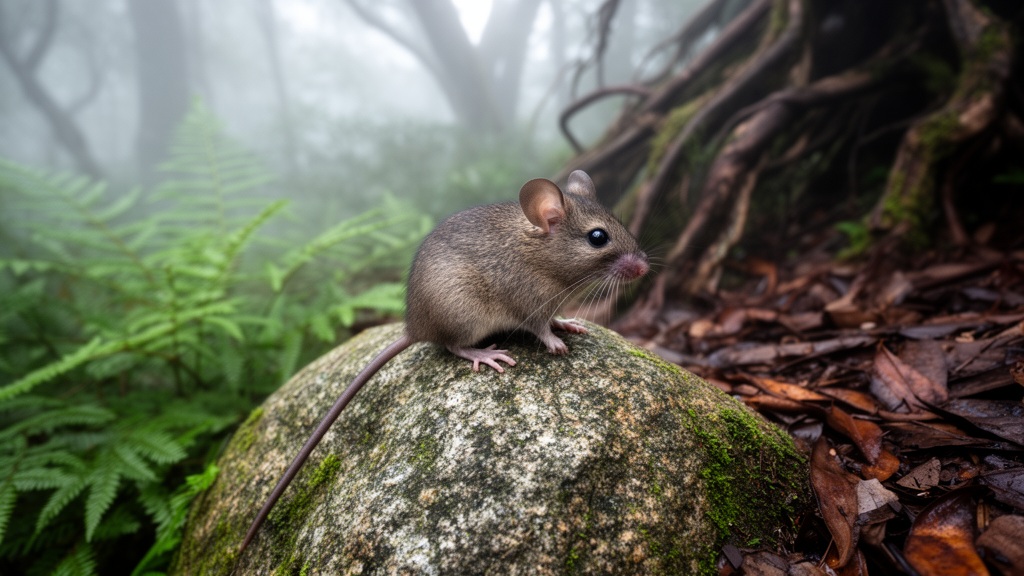
Deep in the moss-draped forests of Fanjing Mountain in China’s Guizhou Province, a small rodent with tiny eyes, oversized ears, and a long tufted tail has just been formally introduced to science. Researchers surveying small mammals on this remote peak collected five specimens of the genus Typhlomys, a group of rodents so cryptic that they were long thought to be a single species. After sequencing five genes and measuring dozens of skulls, the team concluded that these animals belong to an entirely new species, now named Typhlomys zhengkuni. The discovery, published in the journal Zoosystematics and Evolution, brings the number of recognized species in this enigmatic genus to eight and adds a fresh branch to the mammalian tree of life.
Typhlomys rodents are commonly known as blind mice, a nod to their remarkably small eyes, which are of little use in the dark forests where they live. Instead, these animals rely on other senses and on a suite of adaptations for a nocturnal, arboreal lifestyle: large ears for detecting sound, elongated hind feet for gripping branches, and long tails for balance. Even more strikingly, recent research has identified them as a newly discovered echolocating lineage within mammals, a trait otherwise known mainly from bats and some cetaceans. That makes any new member of this genus more than a taxonomic curiosity; it is a potential window into how echolocation evolves.
For decades, the genus was considered monotypic, containing only Typhlomys cinereus, first described in 1877, along with a handful of subspecies. That picture changed dramatically in 2017, when molecular and morphological analyses revealed substantial hidden divergence within the group. Since then, multiple new species have been described from across southern China and northern Vietnam, and the pace of discovery shows no sign of slowing. The Fanjing Mountain specimens, collected during fieldwork between 2024 and 2025, immediately stood out in preliminary genetic screening as distinct from every recognized species, prompting a full taxonomic investigation.
To assess the status of the five specimens, the researchers extracted genomic DNA from muscle and liver tissues preserved in ethanol and stored at minus 80 degrees Celsius. They amplified three mitochondrial genes, cytochrome b, cytochrome c oxidase subunit I, and NADH dehydrogenase subunit 2, together spanning roughly 3,400 base pairs, and two nuclear genes, the growth hormone receptor gene and the interphotoreceptor retinoid-binding protein gene, adding another 2,100 base pairs. These fragments were then analyzed using Bayesian inference and maximum likelihood phylogenetic methods, with millions of generations of Markov chain Monte Carlo sampling to reconstruct the evolutionary relationships among all known Typhlomys lineages.
The genetic results were unambiguous. The new lineage forms its own distinct branch in every phylogenetic tree, appearing as a sister group to Typhlomys taxuansis, a species described only in 2024. Kimura 2-parameter genetic distances based on cytochrome b between the new species and all other members of the genus ranged from 8.2 percent to 17.9 percent, well within the range typically used to delimit mammalian species. Species delimitation analyses, including the Poisson tree processes model and Bayesian Phylogenetics and Phylogeography, consistently recognized the Fanjing Mountain animals as an independent evolutionary lineage, reinforcing the molecular case for species status.
Morphology told a complementary story. The team measured eleven craniodental metrics on 76 specimens using digital calipers graduated to 0.01 millimeters, deliberately excluding external measurements such as body mass and tail length because these vary with nutrition and observer technique. Principal component analysis showed that the new species clusters closest to Typhlomys daloushanensis and Typhlomys fengjiensis, with which it partially overlaps in skull shape. However, discriminant function analysis correctly classified 98.7 percent of specimens, and the new species can be distinguished from its closest relatives by a larger overall skull, a more rounded zygomatic arch, and crucially, by the fine structure of its molars, including a closed parafossette on the first upper molar and a shorter mesofossettid on the first lower molar.
The new species is relatively large for the genus, with a head-body length averaging 84 millimeters and a skull length averaging 25 millimeters. Its dorsal fur is dark gray with a blackish base, while its underside is slate gray overlaid with creamy white hair, a pattern that clearly separates it from the yellowish-white belly of Typhlomys chapensis. Its tail, covered with short hairs at the base and longer brownish hairs toward the rear, ends in a distinctive tuft of long white hair. The braincase is flattened, the palate bears three pairs of palatine foramina, and the upper molar row is the longest described in any member of the genus.
The species is so far known only from Fanjing Mountain, where all specimens were captured at elevations between 2,079 and 2,266 meters in broad-leaved forest among moss-covered stone piles. The mountain, a UNESCO World Heritage site, rises like an ecological island above the surrounding karst landscape, and the researchers suggest that its complex topography and environmental isolation may be a key driver of speciation for small mammals. The new species shares its habitat with shrews, moonrats, and other rodents, and the team believes that comprehensive biodiversity surveys on the mountain are likely to uncover additional unique lineages.
The specific epithet zhengkuni honors Zhengkun Hu, a forest ranger at Fanjing Mountain whose contributions to the fieldwork made the discovery possible, and the proposed common name is Zhengkun’s Blind Mouse. Yet some questions remain open. The sister relationship between the new species and Typhlomys taxuansis received only low statistical support in the phylogenetic analyses, possibly because of incomplete gene sequences and incomplete lineage sorting during a recent, rapid radiation. A recent study using complete mitochondrial genomes has proposed alternative topologies, highlighting the limitations of relying on a few gene fragments. The researchers call for genome-scale data and expanded sampling to definitively resolve the evolutionary history of this genus, and to confirm whether the Fanjing Mountain blind mouse has close relatives still waiting in the moss.
Subject of Research: Taxonomy and evolutionary biology of rodents
Article Title: A new species of the genus Typhlomys Milne-Edwards, 1877 ( Rodentia , Platacanthomyidae ) from Fanjing Mountain, Guizhou, China
Article References: Zhang, T., Hu, Z., Zou, Q., Gu, L., Zhuang, W., Gu, P., Zhan, J., Mi, X., Liu, S., & Chen, S. (2026). A new species of the genus Typhlomys Milne-Edwards, 1877 (Rodentia, Platacanthomyidae) from Fanjing Mountain, Guizhou, China. Zoosystematics and Evolution, 102(2), 659-670. https://doi.org/10.3897/zse.102.181212
Image Credits: AI Generated
Keywords: Typhlomys, new species, Fanjing Mountain, rodents, phylogenetics, China biodiversity, species, genus, Milne-Edwards, Rodentia, Platacanthomyidae, Fanjing
Cite Scienmag News
Gavin Prescott. (October 18, 2026). A new species of the genus Typhlomys Milne-Edwards, 1877 (Rodentia, Platacanthomyidae) from Fanjing Mountain, Guizhou, China. Scienmag. https://scienmag.com/a-new-species-of-the-genus-typhlomys-milne-edwards-1877-rodentia-platacanthomyidae-from-fanjing-mountain-guizhou-china/
Gavin Prescott. "A new species of the genus Typhlomys Milne-Edwards, 1877 (Rodentia, Platacanthomyidae) from Fanjing Mountain, Guizhou, China." Scienmag, 18 October 2026, https://scienmag.com/a-new-species-of-the-genus-typhlomys-milne-edwards-1877-rodentia-platacanthomyidae-from-fanjing-mountain-guizhou-china/. Accessed 18 October 2026.
Gavin Prescott. "A new species of the genus Typhlomys Milne-Edwards, 1877 (Rodentia, Platacanthomyidae) from Fanjing Mountain, Guizhou, China." Scienmag. October 18, 2026. https://scienmag.com/a-new-species-of-the-genus-typhlomys-milne-edwards-1877-rodentia-platacanthomyidae-from-fanjing-mountain-guizhou-china/


