


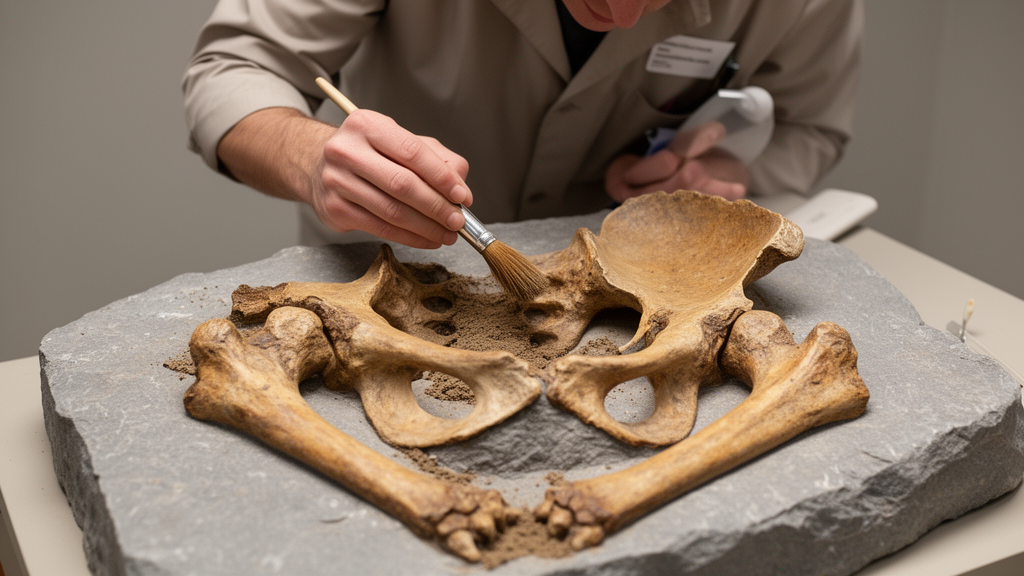
Deep in the Late Triassic rocks of Krasiejów, Poland, lie the bones of Metoposaurus krasiejowensis, a crocodile-sized temnospondyl amphibian that lurked in ancient lakes more than 200 million years ago. For years, paleontologists have sliced through nearly every part of this animal’s skeleton to read the microscopic record of its growth. One region, however, remained stubbornly unexamined: the pelvis. A new study published in Fossil Record has now sectioned three ilia and one ischium from Metoposaurus, providing the first detailed look at the bone histology of the hip girdle in this giant amphibian and revealing surprising clues about how the animal moved through its watery world.
The pelvic girdle holds a special place in the story of tetrapod evolution. In lobe-finned fishes, the pelvis is a simple crescent-shaped bone anchored to the body wall, but in four-limbed vertebrates it became a structure of paired ilia, ischia and pubes connected to the vertebral column via sacral ribs. This shift, which allowed hindlimbs to play a greater role in propulsion, traces back to transitional forms such as Tiktaalik roseae, whose expanded sacral rib processes hint at a ligamentous link to an enlarged iliac blade, and is fully realized in early limbed tetrapods like Ichthyostega. Yet despite this evolutionary importance, the pelvis remains one of the least histologically studied regions of the early tetrapod skeleton, with prior work limited to a handful of temnospondyl species.
Metoposaurus krasiejowensis is arguably the best histologically known temnospondyl of all. Researchers have cut and analyzed almost every skeletal element, from limb bones to intercentra, building a detailed picture of its growth patterns. The pelvic bones were the conspicuous gap. Because most Metoposaurus fossils from Krasiejów are disarticulated, the team relied on proportions taken from articulated skeletons of the closely related metoposaurid Dutuitosaurus ouazzoui from Morocco to estimate body sizes and ages, treating ilium length as roughly equal to femur length.
The four sectioned bones represent different life stages. The smallest ilium, specimen UOBS 02917, measures just over 55 millimeters along its main axis and belongs to an animal estimated at one to two years old. A medium-sized ilium, UOPB 00055, records about three years of growth, while the largest, UOBS 02916, at nearly 90 millimeters, may have belonged to an individual more than five years old. The single ischium, UOPB 00037, appears to match the medium-sized ilium in age. One of the ilia was also scanned with micro-computed tomography to map its internal architecture in three dimensions before destructive sampling.
Under the microscope, all the pelvic elements shared a strikingly porous construction. With the exception of the middle segment of the iliac dorsal blade, the bones are riddled with cavities and built of thin cortices surrounding spongy interiors. The dominant tissue is coarse parallel-fibred bone, a matrix of thick collagen fibers, interspersed with fine parallel-fibred bone in growth zones. Dense bundles of Sharpey’s fibers, the collagen anchors that tie muscle to bone, are especially abundant on the lateral side of the ilia, marking strong muscle attachment points along the hip.
The growth record written into these bones is distinctive. Growth marks appear as thick zones of faster deposition alternating with unusually thick annuli, each hosting a few rest lines. Notably, Lines of Arrested Growth, the sharp halts in bone deposition that signal harsh dormant seasons in many vertebrates, are entirely absent. This pattern matches exactly what has been documented in the long bones of Metoposaurus from the same locality, and it reflects the local Late Triassic climate: a long unfavorable season that slowed growth considerably but never stopped it completely. Intriguingly, phytosaurs and aetosaurs from Krasiejów show a remarkably similar growth signature, suggesting a shared environmental signal across very different groups.
Counting and retrocalculating these growth cycles showed that the pelvic elements preserve an age estimate very close to that derived from femora of the same size class. This is a significant result for skeletochronology, the science of aging extinct animals from their bones. In the Permian temnospondyl Rhinesuchus, the ilium preserves far more growth lines than the femur, but in Metoposaurus the two elements agree well, making the ilium a reliable substitute when femora are unavailable, as is often the case with disarticulated bonebed material. The ischium, with its less distinct marks, is less useful but still consistent with the ilium-based age.
Perhaps the most intriguing discovery came from the ischium, the first ischium of any early tetrapod ever sectioned. Its surfaces and even the spaces between its thin trabeculae are covered in calcified cartilage, a tissue normally replaced by bone during development. This extended persistence of cartilage echoes findings in the intercentra and exoccipitals of Metoposaurus and points to a strikingly slow ossification of the endochondral skeleton. The cartilage covering the rough surfaces also suggests the ischium remained connected to an unossified pubis throughout life, confirming that the Metoposaurus pelvis never consisted of more than two bony elements per side.
The functional implications are equally revealing. Bone loses strength and stiffness as porosity increases, so the osteoporotic condition of both the ischium and most of the ilium indicates these bones experienced low biomechanical loading. Apart from the strong muscle attachments on the lateral ilium, the pelvic girdle appears poorly adapted to high stress. This supports previous analyses of fossil trackways showing that metoposaurids relied far less on their hindlimbs for underwater locomotion than on their forelimbs or their tail. In other words, the hips of this giant amphibian really do not lie: they record an animal that swam with its front end while its hindlimbs faded into evolutionary redundancy.
The study also carries taxonomic lessons. Krasiejów hosts two temnospondyl species, Metoposaurus krasiejowensis and Cyclotosaurus intermedius, and disarticulated bones of the two can be difficult to tell apart. The smallest ilium shows proportions and a dorsal blade shape that leave open the possibility it belongs to a juvenile Cyclotosaurus rather than a young Metoposaurus, although the overall histological characters, including the lack of LAGs, abundant Sharpey’s fibers and coarse matrix, favor a Metoposaurus identity for all three ilia. The findings similarly suggest that a small ilium of the Indian metoposaurid Panthasaurus maleriensis, previously interpreted as an old individual because of its missing growth marks, more likely belonged to a juvenile whose short life simply left too little time to deposit typical zones and annuli. With only four bones sampled so far, the authors caution that more specimens, ideally articulated, will be needed to calibrate pelvic-based age estimates and fully separate the species in these rich Triassic bonebeds.
Subject of Research: Bone histology of the pelvic girdle of the Late Triassic temnospondyl Metoposaurus krasiejowensis from Poland
Article Title: Hips do not lie… histology of the pelvic girdle elements of Metoposaurus from the Late Triassic of Poland
Article References: Konietzko-Meier, D., Prino, A., & Teschner, E. M. (2025). Hips do not lie… histology of the pelvic girdle elements of Metoposaurus from the Late Triassic of Poland. Fossil Record, 28(1), 165-178. https://doi.org/10.3897/fr.28.153929
Image Credits: AI Generated
DOI: 10.3897/fr.28.153929
Keywords: Metoposaurus, temnospondyl, paleohistology, pelvic girdle, Late Triassic, skeletochronology, growth marks, Krasiejów, calcified cartilage, Sharpey's fibers, locomotion, Fossil Record
Cite Scienmag News
Gavin Prescott. (October 18, 2026). Ancient Giant Amphibian Hips Reveal a Life of Lazy Swimming. Scienmag. https://scienmag.com/ancient-giant-amphibian-hips-reveal-a-life-of-lazy-swimming/
Gavin Prescott. "Ancient Giant Amphibian Hips Reveal a Life of Lazy Swimming." Scienmag, 18 October 2026, https://scienmag.com/ancient-giant-amphibian-hips-reveal-a-life-of-lazy-swimming/. Accessed 18 October 2026.
Gavin Prescott. "Ancient Giant Amphibian Hips Reveal a Life of Lazy Swimming." Scienmag. October 18, 2026. https://scienmag.com/ancient-giant-amphibian-hips-reveal-a-life-of-lazy-swimming/


