


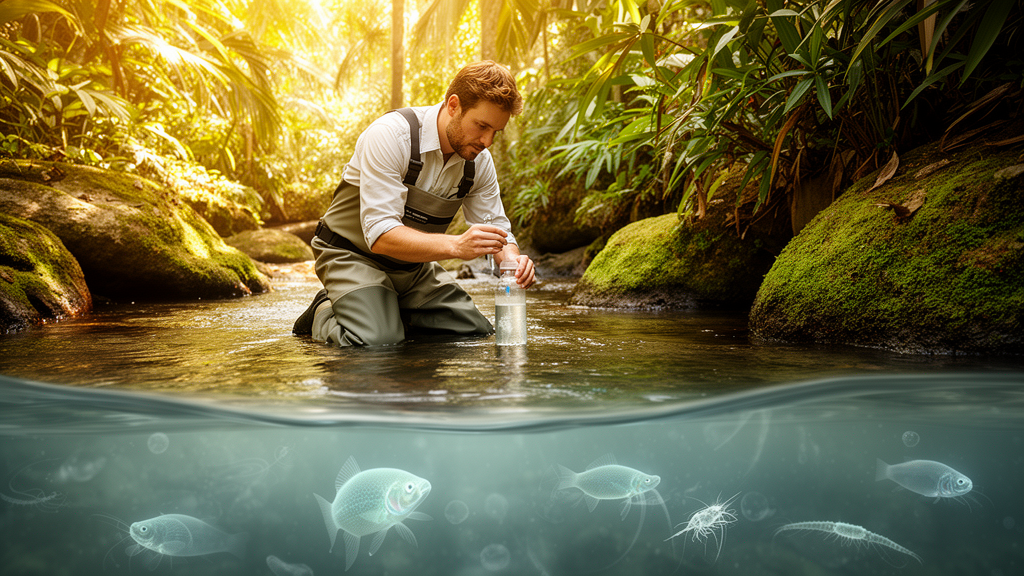
On the Caribbean island of Martinique, a quiet revolution in biodiversity science is underway — one that begins not with a net or a fishing rod, but with a bottle of river water. Researchers there have demonstrated that environmental DNA (eDNA) metabarcoding can outperform traditional electrofishing in cataloguing the fish and decapod crustaceans that inhabit the island’s streams. The study, published in the journal Metabarcoding and Metagenomics, offers a compelling blueprint for how biodiversity monitoring could be transformed across the Caribbean, a region often described as understudied despite its extraordinary ecological wealth.
The stakes could hardly be higher. Freshwater ecosystems cover less than 0.8 percent of the Earth’s surface yet provide habitat for at least 6 percent of known species — and probably many more awaiting discovery. Since 1970, an estimated 84 percent of freshwater biodiversity has been lost, and nearly one species in three is now threatened with extinction across all taxa. Tropical islands like Martinique are particularly vulnerable: they combine low species diversity with high endemism on small areas, making their native communities exquisitely sensitive to disruption. Martinique, a rugged island in the Lesser Antilles with more than 70 permanent rivers, sits within one of the planet’s 25 biodiversity hotspots, yet its freshwater life remains poorly inventoried.
For decades, the standard tool for surveying freshwater fish has been electrofishing, a technique that uses electric currents to temporarily stun fish so they can be captured, identified and released. While effective, the method is stressful — sometimes harmful — to the organisms it targets, and it can disturb fragile ecosystems harboring small populations that researchers seek to protect. It is also labor-intensive and time-consuming, limiting its use across larger or more remote areas. In Martinique, these drawbacks have led to electrofishing being progressively abandoned for routine monitoring, creating an urgent need for an alternative that is both reliable and non-disruptive.
Enter environmental DNA. Organisms constantly shed genetic material into their surroundings — through skin cells, mucus and feces — and this DNA can be captured from water samples and sequenced to reveal which species are present, even at low population densities, without ever observing the animals directly. The approach can detect rare, cryptic or elusive taxa at any life stage, regardless of size or ecology, including species that live underground or in disconnected ditches. When combined with metabarcoding, which amplifies and sequences DNA from many species simultaneously, eDNA offers a non-disruptive, easily scalable alternative to traditional capture methods.
To test whether this molecular approach could work in Martinique’s challenging tropical conditions, the research team selected 14 stations spread from the island’s north to its south, chosen to represent the full diversity of its river systems. Each station was sampled in April 2023 by both eDNA filtration and electrofishing, with filtration performed first to minimize contamination risks. The team used two independent eDNA samples per station, filtered through 0.45-micrometer nitrocellulose membranes until clogging occurred — typically between one and 2.5 liters per replicate. Rigorous decontamination protocols, including 20 percent bleach treatment of sampling equipment and blank control samples of distilled water, were applied throughout to guard against false positives.
The molecular workflow was technically demanding. DNA was extracted from filter fragments in dedicated, bleach-disinfected rooms, and two-step PCRs were performed using two primer pairs: MiFish, targeting a 175-base-pair fragment of the mitochondrial 12S rRNA gene for fish, and MiDeca, targeting a 164-base-pair fragment of the mitochondrial 16S rRNA gene for crustaceans. Each eDNA sample was amplified four times, producing eight PCR reactions per station, with negative controls and three positive mock communities — equimolar mixes of DNA from 19 decapod and 27 fish species — used to calibrate taxonomic inference. Sequencing was carried out on an Illumina NextSeq 2000, generating over 11.6 million reads for fish and 14.8 million reads for decapods across the 14 stations. Bioinformatic processing with the DADA2 pipeline removed primers, merged paired-end reads, eliminated chimeras, and filtered out low-abundance sequences likely to represent contaminants or errors.
The results were striking. Electrofishing captured between one and seven fish species per station and three to seven decapod species, while eDNA metabarcoding detected between four and eleven fish species and four to nine decapod species. Statistically, eDNA detected significantly more fish species than electrofishing — 7.93 versus 4.28 on average — and more decapod species as well. Most importantly in a validation context, eDNA succeeded in detecting all fish species caught by electrofishing, sometimes reporting species never observed in the field. At one southern station, eDNA revealed seven fish species where electrofishing found only one. The molecular method also excelled at detecting hard-to-find species such as the tiny shrimp Jonga serrei, the introduced Neocaridina denticulata, and — more worryingly — the highly invasive red claw crayfish Cherax quadricarinatus at a northern station where it was previously unknown.
The study was not without limitations. The researchers could not confidently discriminate between two genetically close species of the goby genus Sicydium — S. plumieri and S. punctatum — despite extensive efforts to complete the genetic reference database, possibly due to the species’ extreme genetic similarity or even hybridization between them. Electrofishing, by contrast, was more effective at detecting certain decapods such as Xiphocaris elongata and Macrobrachium heterochirus, probably because these crustaceans shed DNA at lower rates than fish. The team also noted that visual identification during electrofishing can be confounded by morphological similarities between species, particularly among juvenile Macrobrachium and the small, almost transparent Atyidae shrimp, which include both native and introduced species.
Beyond simply counting species, the eDNA data allowed the team to assess the ecological state of each station using the Simpson index, a measure of species dominance and community evenness. Southern stations generally exhibited species-poor assemblages dominated by invasive taxa such as Oreochromis tilapia and C. quadricarinatus, with relatively low Simpson index values reflecting community homogenization. Northern stations, by contrast, harbored more diverse and evenly distributed communities composed largely of native species such as the mountain mullet Agonostomus monticola and Atya shrimp. Redundancy analysis revealed that north-south exposure was the most influential driver of community composition across all datasets, supported by Mantel tests showing that nearby stations host more similar communities. The southern rivers’ vulnerability to invasion likely reflects a combination of higher anthropogenic disturbance and greater propagule pressure from aquaculture and the ornamental trade.
The approach also updated occurrence records for several ecologically important species. It confirmed the presence of Martinique’s only endemic freshwater fish, Anablepsoides cryptocallus, at six stations and suggested its presence at two more. The cryptic mangrove rivulus Kryptolebias marmoratus, previously known from a single station, was detected at two new sites with plausible habitat characteristics — high conductivity and proximity to mangroves. More alarmingly, the study expanded the known invasion zone of C. quadricarinatus and potentially revealed several invasive Loricariidae catfish species on the territory where only one, Hypostomus robinii, had been documented. The researchers emphasize that eDNA should complement, not replace, traditional methods, which remain indispensable for biometric data, population densities and genetic studies. They call for harmonized eDNA protocols and encourage stakeholders to join the initiative, arguing that the molecular approach could shed light on rich biodiversity in poorly studied regions and facilitate the fight against invasive species — one of the leading causes of biodiversity loss worldwide.
Subject of Research: Metabarcoding outperforms traditional electrofishing in decapod and fish inventories, paving the way for enhanced biodiversity monitoring in the Caribbean
Article Title: Metabarcoding outperforms traditional electrofishing in decapod and fish inventories, paving the way for enhanced biodiversity monitoring in the Caribbean
Article References: Baudry, T., Vasselon, V., Delaunay, C., Arqué, A., Rateau, F., Lala, G., Maurice-Madelon, C., & Grandjean, F. (2025). Metabarcoding outperforms traditional electrofishing in decapod and fish inventories, paving the way for enhanced biodiversity monitoring in the Caribbean. Metabarcoding and Metagenomics, 9, Article e151675. https://doi.org/10.3897/mbmg.9.151675
Image Credits: AI Generated
Keywords: Metabarcoding, outperforms, traditional, electrofishing, decapod, fish, inventories, paving, enhanced, biodiversity, monitoring, Caribbean
Cite Scienmag News
Margaret Porter. (October 18, 2026). Environmental DNA Reveals Hidden Freshwater Life in Caribbean Streams. Scienmag. https://scienmag.com/environmental-dna-reveals-hidden-freshwater-life-in-caribbean-streams/
Margaret Porter. "Environmental DNA Reveals Hidden Freshwater Life in Caribbean Streams." Scienmag, 18 October 2026, https://scienmag.com/environmental-dna-reveals-hidden-freshwater-life-in-caribbean-streams/. Accessed 18 October 2026.
Margaret Porter. "Environmental DNA Reveals Hidden Freshwater Life in Caribbean Streams." Scienmag. October 18, 2026. https://scienmag.com/environmental-dna-reveals-hidden-freshwater-life-in-caribbean-streams/


