


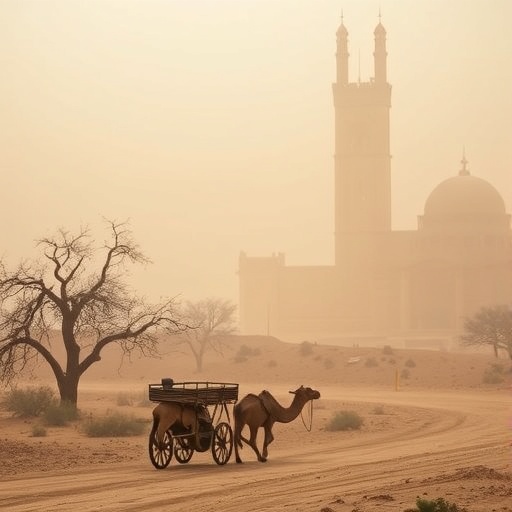
In a groundbreaking collaborative study, researchers from Reichman University and the Technion have unveiled the remarkable survival strategies of bacteria that endure atmospheric transport within dust particles carried by desert storms originating from the Sahara Desert and Egypt. These microscopic survivors endure the grueling airborne journey to Israel, challenging previous assumptions about microbial viability in such harsh environmental conditions. This discovery not only advances our understanding of microbial ecology but also reshapes the broader relationship between the microbiome and the atmosphere, revealing complex bacterial communities thriving within airborne dust.
The international research team was spearheaded by Dr. Ilana Kolodkin-Gal, a senior lecturer and researcher at the Scojen Institute for Synthetic Biology at Reichman University, alongside Prof. Naama Lang-Yona from the Technion’s Faculty of Civil and Environmental Engineering. Their meticulous work also involved contributions from Dr. Hilit Levy-Barazany, head of Dr. Kolodkin-Gal’s laboratory, Dr. Liat Rahamim Ben-Navi, and graduate students Prem Murugan and Ella Lahav. Their combined expertise facilitated a comprehensive exploration into how microscopic life withstands extreme environmental stressors encountered during long-range atmospheric transport.
At the heart of this study lies the revelation that bacteria within dust particles do not exist as solitary cells but instead assemble into multilayered biofilms—microscopic communal structures that offer protection from desiccation, intense ultraviolet radiation, and nutrient scarcity. These biofilms operate as sophisticated microecosystems, fostering a division of labor among bacterial cells and enabling intricate chemical communication. Such communal living mitigates the environmental stresses of open-air transit, effectively turning dust particles into life-sustaining microhabitats.
This finding challenges prior paradigms that portrayed airborne bacteria primarily as isolated cells carried passively through the atmosphere. Instead, these data illuminate a dynamic biological process where communities actively organize, survive, and adapt during transport. By developing protective biofilms, bacteria can maintain metabolic activity, exchange genetic material, and potentially influence the ecosystems they ultimately colonize. Such insights highlight a hitherto underestimated complexity in airborne microbial ecology and its implications for global biogeochemical cycles.
Significantly, one of the dominant bacterial strains identified within these biofilms belongs to the Bacillus subtilis family—a bacterial group esteemed for its diverse applications in agriculture, bioconstruction, and medical probiotics. The researchers hypothesize that the environmental pressures encountered in dust storms exert selective forces favoring Bacillus strains with enhanced adaptability and innovation in gene expression. This selective process may amplify beneficial traits, thereby potentiating the use of these bacteria in sustainable agricultural practices and novel biotechnological applications.
Methodologically, the study employed cutting-edge experimental techniques combining atmospheric sampling with advanced microscopy, genetic sequencing, and biochemical assays. By closely examining dust collected post-storm events, the researchers could unravel the biofilm architecture and decipher the genetic and metabolic profiles of the hitchhiking bacteria. This integrative approach allowed for unprecedented insights into the survival mechanisms of microbes in extreme airborne habitats, providing a template for future environmental microbiology research.
Beyond fundamental science, the implications of this discovery reach into human health and environmental policy. Airborne bacteria originating from distant deserts harbor genetic traits that may integrate into local microbial communities, including the human microbiome. Understanding the interaction between transported bacteria and host environments is critical for assessing potential respiratory impacts and devising strategies to mitigate adverse effects or harness beneficial microbial functions in healthcare and ecological restoration.
The study underscores an essential paradigm shift: dust storms are not mere meteorological phenomena but conduits for microbial dispersal, genetic exchange, and ecological innovation. The resilience of these bacterial communities illustrates nature’s capacity to adapt and thrive even under the most formidable conditions, emphasizing the interconnectedness of biospheric systems across vast geographic distances. Such insights encourage reconsideration of atmospheric processes within the broader context of microbial ecology and evolutionary biology.
Dr. Kolodkin-Gal eloquently summarizes the transformative nature of this research, stating, “Dust storms are not just a meteorological phenomenon — they serve as a transport route for particularly resistant bacteria. These bacteria arrive in the human environment carrying new genes that may affect, and even benefit, our microbiome. This discovery opens the door to new possibilities for harnessing these bacteria in medicine, agriculture, and green industries.” Her words highlight the translational potential of this foundational discovery and its capacity to influence diverse scientific and industrial fields.
In addition to unveiling microbial survival strategies, the research opens avenues for exploring how airborne bacteria contribute to ecosystem dynamics upon deposition. The genetic traits carried across continents could modify soil microbiomes, influence plant health, and drive evolutionary processes, thereby participating in the Earth’s biogeochemical cycles on a global scale. This underscores the necessity of integrating microbial ecology within atmospheric science to fully comprehend the biosphere-atmosphere interface.
Future research inspired by these findings will likely focus on characterizing the functional roles of airborne microbial communities in health and environment, deciphering their gene flow pathways, and developing biotechnological applications harnessing extremophile bacteria. As dust storms continue to shape climatic phenomena and ecosystem health, understanding their microbial passengers is paramount for predicting and managing their ecological and societal impacts.
This pioneering study thus establishes a new frontier in science, bridging microbiology, atmospheric science, and environmental biology. It elevates the importance of microscopic life in global environmental processes and lays the groundwork for innovative research into the intersection of microbial communities and atmospheric dynamics, with transformative implications for science and technology.
News Publication Date:
12-Jul-2025
Web References:
http://dx.doi.org/10.1038/s43247-025-02534-4
Cite Scienmag News
Morgan Morrow. (August 28, 2025). New Reichman University Study Reveals Dust Storms Carry Bacteria Introducing Novel Genetic Traits into Our Atmosphere. Scienmag. https://scienmag.com/new-reichman-university-study-reveals-dust-storms-carry-bacteria-introducing-novel-genetic-traits-into-our-atmosphere/
Morgan Morrow. "New Reichman University Study Reveals Dust Storms Carry Bacteria Introducing Novel Genetic Traits into Our Atmosphere." Scienmag, 28 August 2025, https://scienmag.com/new-reichman-university-study-reveals-dust-storms-carry-bacteria-introducing-novel-genetic-traits-into-our-atmosphere/. Accessed 7 September 2026.
Morgan Morrow. "New Reichman University Study Reveals Dust Storms Carry Bacteria Introducing Novel Genetic Traits into Our Atmosphere." Scienmag. August 28, 2025. https://scienmag.com/new-reichman-university-study-reveals-dust-storms-carry-bacteria-introducing-novel-genetic-traits-into-our-atmosphere/


