


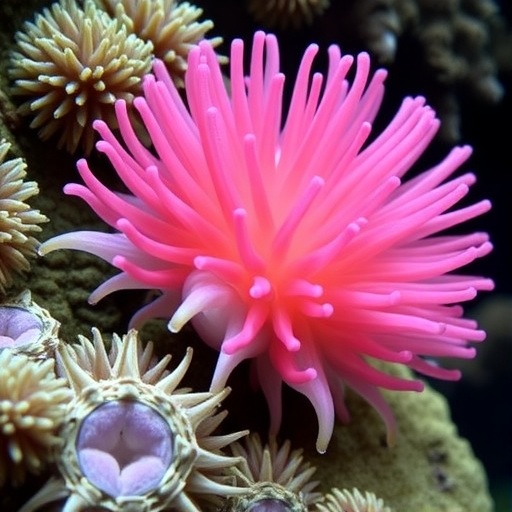
In the uncharted depths off the Pacific coast of Japan, researchers from Kumamoto University and their collaborators have unearthed a remarkable biological phenomenon: a newly identified species of sea anemone that engages in an extraordinary form of mutualism with hermit crabs. This novel species, named Paracalliactis tsukisome, exhibits a unique adaptation among cnidarians by secreting a calcified, shell-like structure known as a carcinoecium, which effectively expands and fortifies the protective casing of its hermit crab hosts. This discovery sheds new light on the complexity of symbiotic relationships and co-evolutionary mechanisms in the largely unexplored deep-sea ecosystem.
Paracalliactis tsukisome was discovered inhabiting the shells utilized by the hermit crab Oncopagurus monstrosus at depths ranging from 200 to 500 meters along the coasts of Mie and Shizuoka Prefectures. Unlike conventional sea anemones that rely solely on soft tissues and lack any form of rigid exoskeleton, this species has evolved the ability to deposit a robust carcinoecium. This adaptation markedly enhances the crab’s protective enclosure, illustrating an intricate mutualistic interaction that benefits both organisms. The anemone gains mobility and access to nutrient-rich niches, while the crab enjoys augmented shell durability and additional defense against predation.
Stable isotope analyses conducted on specimens of P. tsukisome indicate a novel feeding strategy that includes consumption of organic particulate matter and the fecal deposits of its hermit crab host. This atypical diet suggests an efficient nutrient recycling system occurring within the deep-sea benthic environment. The recycling of waste materials not only sustains the anemone but also optimizes resource utilization in an ecosystem where energy sources are sporadic and limited. These findings accentuate the ecological importance of symbiotic interactions in energy-limited habitats.
Advanced micro-CT scanning technology unveiled that P. tsukisome attaches to the hermit crab’s shell in a highly consistent, unidirectional manner. This spatial arrangement likely correlates with both feeding efficiency and the mechanism of carcinoecium construction. By adhering to specific regions of the shell, the anemone maximizes its exposure to organic particulates in the water column while systematically secreting calcium carbonate or analogous mineral compounds to thicken and extend the shell structure. This precision in behavioral patterning highlights a refined physiological adaptation for environmental navigation and resource exploitation.
Moreover, the mutualism confers significant physiological advantages to the hermit crab host. Comparative studies revealed that O. monstrosus individuals bearing P. tsukisome-built shells exhibited larger body sizes relative to conspecifics in unassociated shells. The enhanced protective capacity afforded by the carcinoecium likely reduces mortality risks and permits greater growth potential. This positive feedback loop illustrates a model of co-evolution where both species exert selective pressures that promote increasingly sophisticated interdependencies.
The soft pink hue of this novel anemone inspired its species epithet, tsukisome, a term harkening back to the ancient Japanese poetry anthology Man’yōshū. In classical literature, “tsukisome-dyed” garments evoked sentiments of gentle yet sincere affection, mirroring the tender and faithful association between the anemone and its crab counterpart. This poetic nomenclature emphasizes the aesthetic as well as scientific importance of the discovery, linking cultural heritage with contemporary biological research.
Associate Professor Akihiro Yoshikawa of Kumamoto University, who led the research, emphasized the significance of this finding by stating that the evolutionary emergence of shell-building behaviors in such a basal animal group underscores the complexity inherent even in simple organisms. The ability to perceive spatial orientation and produce directional biomineralized structures may provide pivotal insights into the evolutionary origins of animal cognition and environmental interaction. These behaviors push the boundaries of our understanding of neurobiology and biomineralization in early-diverging metazoans.
This investigation also highlights the ecological dynamics of deep-sea benthic communities, where mutualisms such as that between P. tsukisome and O. monstrosus contribute to biodiversity and habitat structuring. The interplay between species not only facilitates individual survival but also enhances ecosystem resilience against environmental variability. Understanding these relationships is crucial for conservation efforts, particularly in deep-sea environments increasingly threatened by anthropogenic impacts such as deep-sea mining.
Published in the Royal Society Open Science on October 22, 2025, this pioneering study utilized a multidisciplinary approach, blending in situ observations, stable isotope assays, and cutting-edge imaging techniques to unravel the complexities of this mutualistic relationship. Such integrative research methodologies exemplify the future direction of marine biology, where traditional taxonomy intersects with advanced technology to reveal unprecedented ecological insights.
The evolutionary novelty presented by P. tsukisome’s carcinoecium challenges established paradigms regarding cnidarian physiology. Traditionally viewed as soft-bodied, sessile organisms, sea anemones have now been shown capable of sophisticated biomineralization processes that substantially alter their ecological roles. This discovery invites a reevaluation of the evolutionary plasticity of marine invertebrates and their capacity to occupy specialized niches through adaptive innovation.
Furthermore, this mutualism provides a model system for studying the genetic and molecular underpinnings of biomineralization and symbiotic signaling pathways. Deciphering the genetic basis for carcinoecium formation and host interaction may unlock new avenues in biomimetics and evolutionary developmental biology. Such translational research holds the potential to inform material sciences and ecosystem management strategies alike.
Ultimately, Paracalliactis tsukisome embodies a remarkable testament to the adaptive intricacies of life in the ocean’s twilight zones. Its discovery enriches our comprehension of symbiotic evolution, deep-sea ecological processes, and the hidden marvels that persist beneath the waves. As exploration of these frontiers continues, species like P. tsukisome offer a compelling glimpse into the evolutionary ingenuity forged under extreme environmental pressures.
Cite Scienmag News
Gavin Prescott. (November 4, 2025). New Pink Sea Anemone That “Builds Homes” for Hermit Crabs Discovered in Japan’s Deep-Sea Waters. Scienmag. https://scienmag.com/new-pink-sea-anemone-that-builds-homes-for-hermit-crabs-discovered-in-japans-deep-sea-waters/
Gavin Prescott. "New Pink Sea Anemone That “Builds Homes” for Hermit Crabs Discovered in Japan’s Deep-Sea Waters." Scienmag, 4 November 2025, https://scienmag.com/new-pink-sea-anemone-that-builds-homes-for-hermit-crabs-discovered-in-japans-deep-sea-waters/. Accessed 3 September 2026.
Gavin Prescott. "New Pink Sea Anemone That “Builds Homes” for Hermit Crabs Discovered in Japan’s Deep-Sea Waters." Scienmag. November 4, 2025. https://scienmag.com/new-pink-sea-anemone-that-builds-homes-for-hermit-crabs-discovered-in-japans-deep-sea-waters/


