


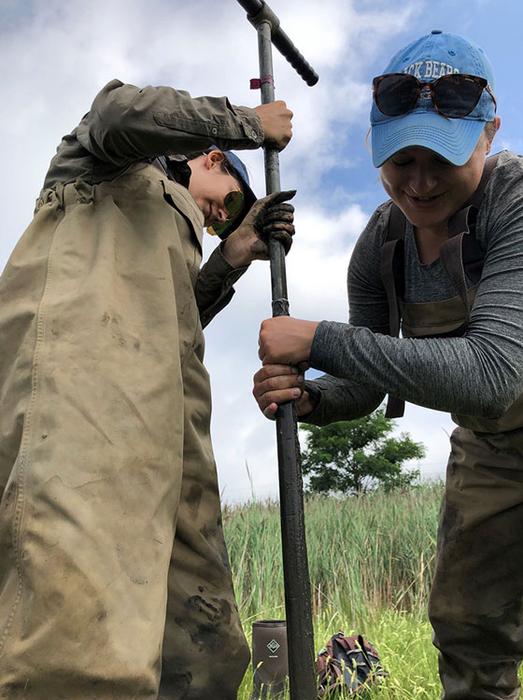
A Rutgers University-New Brunswick-led research team employing an emerging technique to detect signs of past hurricanes in coastal sediments has found evidence of storms dating back more than 400 years. In doing so, they have confirmed an approach that could give them a better understanding of how the frequency of storms changes when the climate changes.

Credit: K Joyse/Rutgers University
A Rutgers University-New Brunswick-led research team employing an emerging technique to detect signs of past hurricanes in coastal sediments has found evidence of storms dating back more than 400 years. In doing so, they have confirmed an approach that could give them a better understanding of how the frequency of storms changes when the climate changes.
Reporting in The Journal of Quaternary Science, scientists described finding eight storm deposits forming sediment layers below the surface of New Jersey’s Cheesequake State Park wetlands in Old Bridge, including evidence of a hurricane that occurred as early as 1584 and predates existing instrumental records in the region. In doing so, they have generated a new geological record from these so-called “overwash deposits.”
“These sediment records, which we’ve used to reconstruct past storm histories, allow us to look much further back in time than current instrumentation allows us,” said Kristen Joyse, the study’s lead author who conducted the research between 2019 and 2021 as a doctoral student in the Department of Earth and Planetary Sciences in the Rutgers School of Arts and Sciences.
Scientists seeking patterns of past hurricanes have long relied on records provided by tidal gauges, which are floating sensors installed along coastlines or on ocean platforms that continuously collect data on water height by the minute, hour and day. Researchers also have availed themselves of historical records, such as shipping logs and newspapers, to aid in their analyses.
Such records, however, do not allow researchers to investigate the distant past, said Joyse, a coastal sedimentologist who, after earning her doctoral degree from Rutgers, is now working at the environmental consulting firm, Alluvium, in Australia. Extending the geological timeline more deeply into the past is necessary for better understanding, she said.
Overwash events ̶ produced when hurricanes create storm surges that carry sand from the beach and dunes to the coastal wetlands ̶ are believed to be another way of finding evidence of past severe storms. To ascertain the accuracy of this record, what scientists refer to as its “preservation potential,” the team compared a portion of the sediment cores they collected with contemporaneous tidal gauge records showing extreme high-water events.
The team located and dated eight cores with records of storm deposits, including one from Hurricane Sandy in 2012. They concluded that four samples showed evidence of storms occurring before the existence of tidal gauges, with the remaining four within the currency of modern tidal gauge records. The tidal records used were collected by some of the country’s longest-operating instruments, both operating in the New York metropolitan area – one located off the coast of Sandy Hook, N.J. (operational since 1932), and the second in the waters near lower Manhattan, N.Y., known as the Battery (operational since 1920).
The sediment samples, made of cores eight feet deep, were collected from both peaty and sandy spots and analyzed for grain size, organic content, carbon isotopes and microfossil content. Such characteristics allowed the researchers to distinguish the sandy storm layers from background wetland sediments. They determined age through radiocarbon dating of woody plant material and concentrations of pollen and heavy metals in the sediment.
The oldest deposits included:
- Overwash deposit #5, dated between 1874 and 1923, which corresponds with the Hurricane of 1938
- Overwash deposit #6, 1773 – 1810, Hurricane of 1788
- Overwash deposit #7, 1651 – 1731, Hurricane of 1693
- Overwash deposit #8, 1584 – 1658, pre-historic storm (pre-dates all historical and instrumental records from the region)
The four newer deposits they collected mesh with tidal records of: Hurricane Sandy (2012); Nor’easter of 1953/Hurricane Donna (1960)/Ash Wednesday Nor’easter (1962); Nor’easter of 1950/Hurricane of 1944)/Hurricane of 1938; and Hurricane of 1944/Hurricane of 1938.
The scientists found that the four more modern sediment samples, while accurately capturing evidence of at least four extreme storm events, did not represent a complete record.
Both tidal gauges recorded some extreme water level events (defined as a 1 in 10 year event) that were not reflected in the sediments – the Sandy Hook gauge showed four additional events, and the New York gauge showed seven additional ones.
“What this tells us is that we know these sediment records can be used to reconstruct past storm histories, but not to the resolution of instrumental records like tide gauges,” said Robert Kopp, a co-author on the study, a distinguished professor in the Department of Earth and Planetary Sciences and director of the Megalopolitan Coastal Transformation Hub (MACH). “These records allow us to look much further back in time, and we just have to acknowledge that they don’t capture every extreme storm that makes landfall.”
The findings also provide fodder for further investigations.
“This will allow us to make better hypotheses and improve our understanding of how storm frequencies may be impacted by other climate variables and what that means for future storm frequency under a changing climate,” Joyse said. “It also allows us to ask new questions: Why do some storms get preserved by the sediment record and not others? How does the probability of a storm being preserved change with time?”
Linda Godfrey, an associate research professor in the Department of Earth and Planetary Sciences in the Rutgers School of Arts and Sciences, also co-authored the study.
Other scientists on the study included: Jennifer Walker of Rowan University, Margaret Christie of McDaniel College; D. Reide Corbett of East Carolina University; and Timothy Shaw and Benjamin Horton of Nanyang Technological University in Singapore.
Journal
Journal of Quaternary Science
DOI
Method of Research
Observational study
Subject of Research
Not applicable
Article Title
The preservation of storm events in the geologic record of New Jersey, USA
Article Publication Date
15-May-2024
Cite Scienmag News
Russell Cooper. (July 18, 2024). New Jersey salt marsh sediments offer evidence of hurricanes back to the 1500s. Scienmag. https://scienmag.com/new-jersey-salt-marsh-sediments-offer-evidence-of-hurricanes-back-to-the-1500s/
Russell Cooper. "New Jersey salt marsh sediments offer evidence of hurricanes back to the 1500s." Scienmag, 18 July 2024, https://scienmag.com/new-jersey-salt-marsh-sediments-offer-evidence-of-hurricanes-back-to-the-1500s/. Accessed 5 September 2026.
Russell Cooper. "New Jersey salt marsh sediments offer evidence of hurricanes back to the 1500s." Scienmag. July 18, 2024. https://scienmag.com/new-jersey-salt-marsh-sediments-offer-evidence-of-hurricanes-back-to-the-1500s/

