


July 18, 2024, Nutley, NJ – The foundational science to develop an exhaled-breath test for detection of lung diseases including lung cancer is underway, according to new research published by a laboratory at the Hackensack Meridian Center for Discovery and Innovation (CDI).

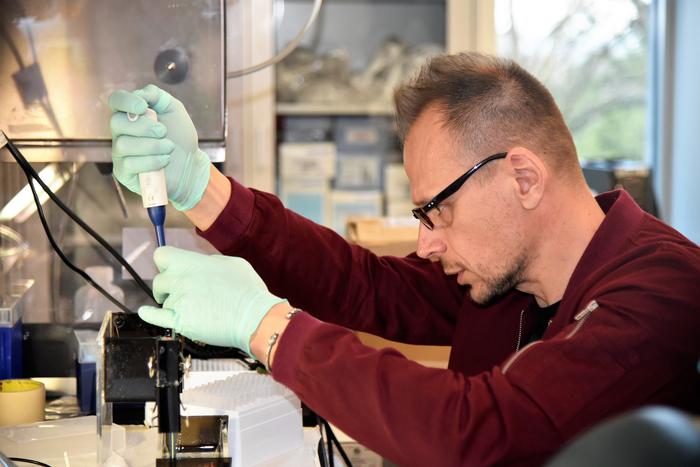
Credit: Hackensack Meridian Health
July 18, 2024, Nutley, NJ – The foundational science to develop an exhaled-breath test for detection of lung diseases including lung cancer is underway, according to new research published by a laboratory at the Hackensack Meridian Center for Discovery and Innovation (CDI).
Two papers published by CDI Associate Member Olivier Loudig, Ph.D., and colleagues show that they have successfully collected, separated, and profiled lung biomarkers from human breath, and also developed animal models to expand their analyses and potentially identify key markers for early and non-invasive detection of metastatic lung tumors.
Significant work remains to be done to identify a range of the biomarkers and prove that its accuracy can be clinically relevant for human patients, but the two publications have established the scientific roadmap as the CDI scientists continue their work toward that goal.
“This innovative non-invasive approach is aimed at establishing a new method to lower the threshold for earlier than ever before detection of this horrible disease,” said Loudig.
“This innovative technology developed by Olivier Loudig offers promise and hope to patients who all too often receive a diagnosis too late for effective intervention,” said David Perlin, Ph.D., the chief scientific officer and executive vice president of the CDI. “This is what the CDI is all about: inspire science innovation to address unmet medical needs.”
Dr. Loudig’s work focuses on the capture and identification of nanoparticles known as extracellular vesicles (EVs), which are released by virtually all cells into the extracellular space such as blood, serum, and other biofluids. Cancer cells especially release a greater number of nanoparticles, which Dr. Loudig has been targeting for earlier-than-ever disease detection and diagnostics. His laboratory at the CDI has developed research programs for biomarker discovery and early detection of lung, prostate, cervical, and bladder cancers using liquid biopsies. To do so, the group of Dr. Loudig developed a technology called EV-CATCHER for selective isolation of cell-specific nanoparticles from biofluids, and is using next-generation sequencing profiles of small-RNAs contained in these nanoparticles for non-invasive identification of lesions and tumors that may be developing in the body. Dr. Loudig’s science and EV-CATCHER technology are the foundation of Hackensack Meridian Health’s first spin-off company, EValuate Diagnostics, founded early this year.
Dr. Loudig has now set his sight on applying EV-CATCHER to purify EVs from human exhaled breath, which contain disease markers that may then be analyzed without invasive sampling of the lung. This approach may revolutionize the diagnosis and surveillance of human lung diseases.
In their latest publication, which appears in the Journal of Extracellular Vesicles, a leading high-impact journal, the CDI team assessed five types of airway samples from 69 subjects and determined that exhaled EVs contain microRNA expression profiles consistent with of those obtained from deeper lung samples via more invasive procedures like bronchoalveolar lavages (BAL).
The team of Dr. Loudig conducted a proof-of-principle study to detect lung cancer by analyzing the microRNA content of exhaled EVs from exhaled breath condensates collected from 18 subjects – 12 who were healthy, and six who had been diagnosed with stage-IV lung cancer. Their analyses confirmed that exhaled EVs selectively purified from the breath of these subjects identified unique microRNA expression profiles that could discriminate patients with lung cancer.
“Our analyses confirm the utility of our customizable EV‐CATCHER assay for the selective purification of exhaled EVs harboring surface proteins of terminal bronchiole and alveoli lung tissue origin from (exhaled breath condensate),” they write.
Their earlier mouse model study of exhaled breath condensates published in March in the journal Extracellular Vesicles and Circulating Nucleic Acids shows they could detect human-derived tumor cell microRNAs using EV-CATCHER to “catch” human exhaled lung tumor EVs from exhaled breath within 1-2 weeks following the injection of human cancer cells. Though the selection of biomarkers needs to be refined and finalized, the scientists conclude that there is promise for a diagnostic of lung diseases – most notably lung cancer.
“We envision that expanding our approach to study human primary and other secondary lung cancers, in adequately-powered animal studies, has the potential to identify relevant exhaled human EV biomarkers,” they write. “Furthermore, since EV-CATCHER can easily be customized to target surface markers of specific EV subpopulations, we foresee that using it to separate lung tumor cell-derived exhaled EVs from immune and innate cell-derived EVs may help further improve the selection of exhaled tumor EVs for the fine-tuned detection of different types of lung cancer.”
“The work of Olivier Loudig is platform technology with exceptional promise,” said Ihor Sawczuk, M.D., FACS, Hackensack Meridian Health’s president of Academics, Research and Innovation, founding chair of the Hackensack Meridian Health Research Institute, and associate dean of Clinical Integration and professor and chair emeritus of Urology at the Hackensack Meridian School of Medicine. “We are glad to support his ongoing investigations into developing innovative solutions to test for disease like cancer.”
Journal
Journal of Extracellular Vesicles
Method of Research
Experimental study
Subject of Research
Human tissue samples
Article Title
Exhaled breath condensate contains extracellular vesicles (EVs) that carry miRNA cargos of lung tissue origin that can be selectively purified and analyzed
Article Publication Date
25-Apr-2024
COI Statement
The authors declare that there is no conflict of interests regarding the publication of this paper.
Cite Scienmag News
Nathaniel Bowman. (July 18, 2024). Hackensack Meridian CDI Lab publishes papers pointing the way toward an exhaled-breath test for lung cancer. Scienmag. https://scienmag.com/hackensack-meridian-cdi-lab-publishes-papers-pointing-the-way-toward-an-exhaled-breath-test-for-lung-cancer/
Nathaniel Bowman. "Hackensack Meridian CDI Lab publishes papers pointing the way toward an exhaled-breath test for lung cancer." Scienmag, 18 July 2024, https://scienmag.com/hackensack-meridian-cdi-lab-publishes-papers-pointing-the-way-toward-an-exhaled-breath-test-for-lung-cancer/. Accessed 3 September 2026.
Nathaniel Bowman. "Hackensack Meridian CDI Lab publishes papers pointing the way toward an exhaled-breath test for lung cancer." Scienmag. July 18, 2024. https://scienmag.com/hackensack-meridian-cdi-lab-publishes-papers-pointing-the-way-toward-an-exhaled-breath-test-for-lung-cancer/

