Researchers have unveiled scDECA, a new computational framework designed to make single-cell RNA sequencing data easier to interpret by combining three different sources of information: raw gene expression measurements, pretrained gene representations, and structural information drawn from protein-protein interaction networks and expression-based cell similarity graphs. The method was described in a peer-reviewed article published in BioData Mining on 8 October 2026 by Myeongbin Oh and Minsik Oh.
Single-cell RNA sequencing allows researchers to characterize cellular transcriptomes at high resolution, but learning robust computational representations of that data remains difficult. The main obstacles are sparsity, dropout and technical noise, artifacts that arise during sequencing and can distort the apparent activity of genes in individual cells. According to the article’s authors, methods that rely directly on raw gene expression are highly sensitive to these artifacts, even though they can capture dataset-specific transcriptional patterns within individual datasets.
An alternative approach has emerged in recent years in the form of large-scale pretrained single-cell models. These models provide global biological priors through pretrained gene representations, meaning they carry knowledge about genes learned from broad datasets. However, the authors note that such models often fail to capture context-dependent signals, the signals that are specific to a particular tissue, condition or experiment. As a result, they write, methods that effectively integrate pretrained biological priors with dataset-specific expression patterns remain relatively limited.
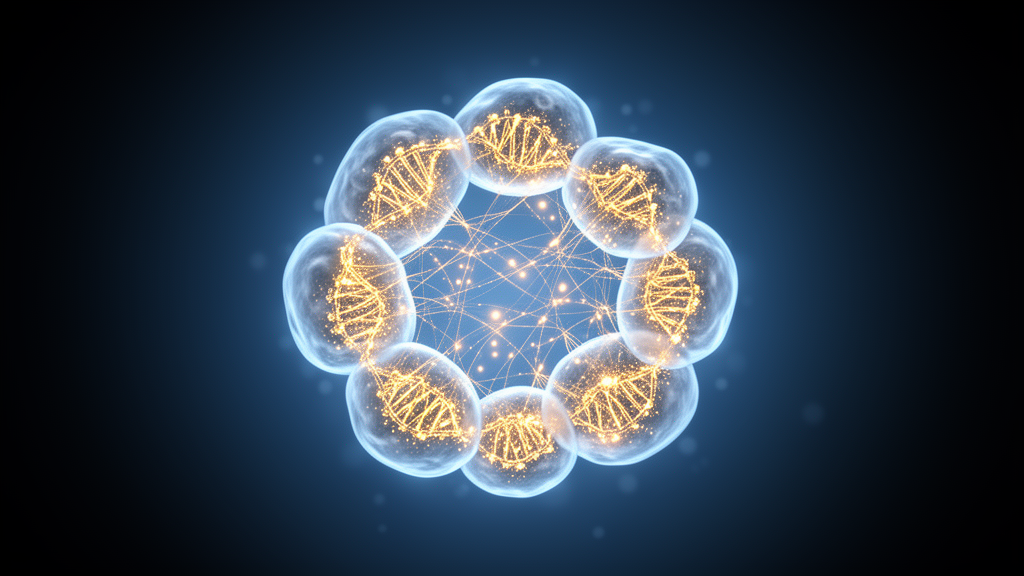
scDECA addresses this gap with a dual-encoder cross-attention architecture. The gene encoder incorporates raw expression values, pretrained gene embeddings and protein-protein interaction structure, so that each gene is represented not only by its measured activity but also by what is already known about it from prior models and from known interaction relationships between proteins.
The cell encoder works differently: it models context-specific cellular relationships using a similarity graph constructed from observed expression profiles. In this graph, cells that show similar transcriptional patterns are connected, allowing the model to capture local structure among cells in the dataset being analyzed rather than relying solely on external knowledge.
The two encoders are then brought together through cross-attention, a mechanism that aligns the gene and cell domains. The output is a unified representation that, according to the authors, captures both global biological organization and dataset-specific transcriptional heterogeneity. In other words, the model aims to preserve broad biological patterns while retaining the distinctive features of each individual dataset.
The authors report that across multiple disease datasets, scDECA improves clustering performance, recovers functional gene programs more consistently, and produces biologically interpretable representations. Clustering is a common downstream task in single-cell analysis, used to group cells into types and states, and improved performance on this task suggests the learned representations are more reliable than those from the approaches the method was compared against.
The recovery of functional gene programs refers to the model’s ability to identify coherent sets of genes working together, which is central to interpreting what cells are doing biologically. More consistent recovery across datasets indicates that the framework is less dependent on the quirks of any single experiment, a persistent problem for methods trained directly on raw expression data.
In their conclusion, the authors state that these results demonstrate the benefit of jointly modeling global biological priors and local structure for robust and biologically meaningful representation learning in single-cell transcriptomics. They position scDECA as an effective framework for integrating pretrained knowledge with dataset-specific transcriptional structure, with the aim of improving interpretability and downstream analysis performance.
The article was published as open access, and the version shared at publication is an accepted manuscript that remains subject to further editorial edits before the final version of record replaces it. For researchers working with single-cell transcriptomic data, the framework offers a concrete example of how pretrained biological knowledge and dataset-specific structure can be combined within a single model, an integration the authors describe as still relatively rare among existing methods.
Subject of Research: A computational framework for single-cell RNA sequencing representation learning that integrates gene-cell interactions with global priors and local structures.
Article Title: scDECA: integrating gene-cell interactions with global priors and local structures in single-cell transcriptomics
Article References: Oh, M., & Oh, M. (2026). scDECA: integrating gene-cell interactions with global priors and local structures in single-cell transcriptomics. BioData Mining. https://doi.org/10.1186/s13040-026-00607-4
Image Credits: AI Generated
DOI: 10.1186/s13040-026-00607-4
Keywords: single-cell RNA sequencing, scDECA, deep learning, gene-cell interactions, protein-protein interaction networks, clustering, representation learning, bioinformatics, computational biology, transcriptomics, integrating, gene-cell
Cite Scienmag News
Juliet Wilcox. (October 28, 2026). New AI framework scDECA fuses gene priors with cell-level structure in single-cell data. Scienmag. https://scienmag.com/new-ai-framework-scdeca-fuses-gene-priors-with-cell-level-structure-in-single-cell-data/
Juliet Wilcox. "New AI framework scDECA fuses gene priors with cell-level structure in single-cell data." Scienmag, 28 October 2026, https://scienmag.com/new-ai-framework-scdeca-fuses-gene-priors-with-cell-level-structure-in-single-cell-data/. Accessed 28 October 2026.
Juliet Wilcox. "New AI framework scDECA fuses gene priors with cell-level structure in single-cell data." Scienmag. October 28, 2026. https://scienmag.com/new-ai-framework-scdeca-fuses-gene-priors-with-cell-level-structure-in-single-cell-data/