


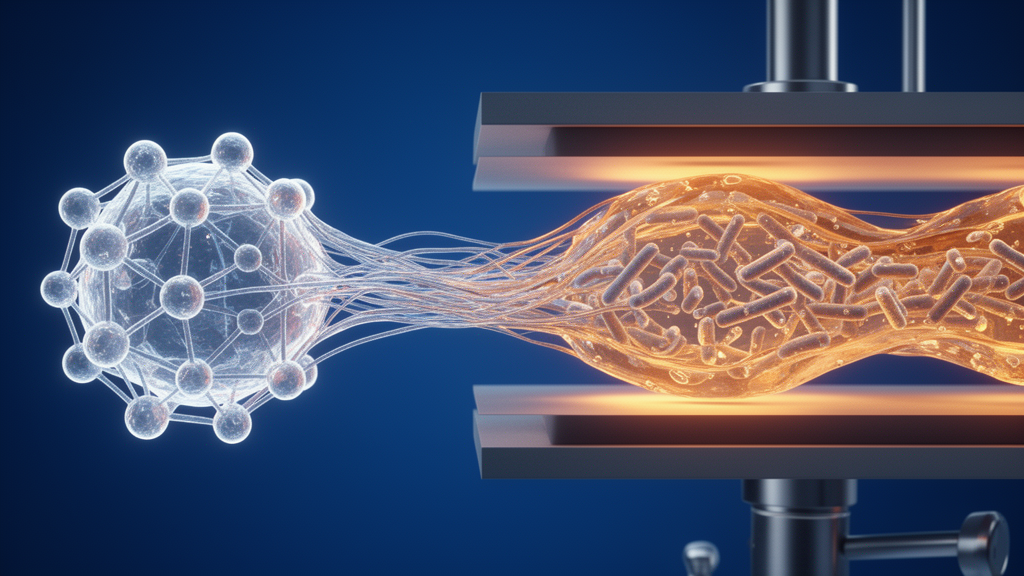
Engineers studying how special engineered fluids carry heat along curved, stretching surfaces may soon be able to skip the slowest part of the calculation. A new study published in Results in Engineering reports that a Bayesian-regularized artificial neural network can reproduce the full velocity, temperature, nanoparticle concentration and bioconvection profiles of Carreau nanofluid flow along a nonlinear stretching cylinder in a fraction of the time required by a conventional boundary-value solver, while matching the numerical reference solutions with mean squared errors as low as 5.21 × 10⁻¹³.
Carreau nanofluids occupy a distinctive niche in fluid mechanics. Unlike Newtonian fluids, whose viscosity stays constant regardless of how fast the fluid is sheared, Carreau fluids capture both shear-thinning and shear-thickening behavior, which matters in polymer processing, biomedical transport and industrial cooling.
The new work, led by Mushtaq K. Abdalrahem and colleagues, builds a mathematical model of a bio-convective Carreau nanofluid flowing past a stretching cylinder, incorporating an unusually rich set of physical effects: a transverse magnetic field, Brownian motion of nanoparticles, thermophoresis, Cattaneo-Christov heat and mass fluxes that replace classical Fourier and Fick laws, activation energy in the chemical reaction term, heat source or sink behavior, and gyrotactic motile microorganisms that drive bioconvection. Thermal slip is included at the cylinder surface, while concentration slip is deliberately neglected on the assumption that nanoparticle concentration at the wall remains balanced.
Using appropriate similarity transformations, the team reduced the governing partial differential equations to a coupled system of nonlinear ordinary differential equations. These were solved numerically with the Python solve_bvp boundary-value solver over a computational domain of 0 ≤ η ≤ 5, discretized with 1001 grid points and a convergence tolerance of 10⁻⁴. Eight computational scenarios were constructed by varying one parameter at a time while holding the others fixed: the magnetic parameter M from 1.0 to 1.7, the curvature parameter K from 1.5 to 2.1, the Prandtl number Pr from 5.0 to 7.0, the Brownian motion parameter Nb from 0.4 to 0.6, the thermophoresis parameter Nt from 0.4 to 0.8, the Peclet number Pe from 1.0 to 2.0, and the bioconvection Lewis number Lb from 2.0 to 2.7. The result was a reference dataset of 8,008 samples used to train and evaluate the network.
The machine learning architecture is deliberately simple: a Bayesian Regularization Scheme Neural Network, or BRSNN, with a single hidden layer of ten neurons. Inputs consist of the similarity coordinate and the governing dimensionless parameters; outputs are the dimensionless velocity, temperature, concentration and bioconvection profiles. Bayesian regularization adjusts network weights during training in a way that controls model complexity and suppresses overfitting, an advantage the authors say proved valuable given the limited dataset. Data were split 80 percent for training, 10 percent for testing and 10 percent for validation, and a parameter-wise partitioning strategy ensured that entire solution profiles belonging to a given parameter combination stayed wholly within either the training or the test set.
That partitioning choice matters because it turns the evaluation into a genuine test of generalization rather than interpolation. Instead of asking the network to fill in gaps between neighboring points of profiles it has already seen, the researchers required the BRSNN to reconstruct complete solution profiles for parameter combinations absent from training. The network passed this stricter examination: training and testing mean squared errors remained tightly clustered, ranging from 5.21 × 10⁻¹³ to 2.14 × 10⁻¹⁰ across the eight scenarios, and error histograms showed predictions clustered overwhelmingly near zero error.
The physical findings from the parameter studies align with established intuition. Increasing the magnetic parameter suppresses the velocity field because the Lorentz force generated by the transverse field resists fluid motion, while increasing the curvature parameter raises velocity gradients by easing the geometric resistance of the cylindrical surface. Higher Prandtl numbers and stronger Brownian motion both lift the temperature profile, with Brownian motion enhancing random nanoparticle displacement and the energy transfer it carries. The concentration field responds differently to the two nanoparticle transport mechanisms: raising Nb lowers concentration near the wall but elevates it farther out, whereas raising Nt produces a steady enhancement across the whole domain. In the bioconvection field, a larger Peclet number strengthens the upward transport of microorganisms, while a larger bioconvection Lewis number suppresses it.
Speed is where the surrogate approach earns its keep. The Python solve_bvp solver needed between 11 and 17 seconds to produce each reference solution, whereas the trained network completed its predictions in under 1 to 4 seconds. The authors are careful to note that this comparison excludes the one-off costs of generating the training data and training the network itself, so the practical benefit accrues mainly in settings where many repeated predictions across the same parameter space are needed rather than in producing a single solution.
Validation extended beyond internal consistency. The team compared BRSNN predictions of the local skin friction coefficient and local Nusselt number against previously published numerical results from Farooq and colleagues for varying values of the magnetic parameter, buoyancy ratio and bioconvection Rayleigh number, finding close agreement with only negligible differences across the tested range. Regression analyses, function-fit plots, performance curves and training-state diagnostics all supported the conclusion that the network captured the underlying nonlinear relationships without overfitting, and a comparison of data-splitting ratios showed that the adopted 80:10:10 partition consistently delivered the lowest errors.
The authors are candid about the limits of the work. The training data come entirely from simulations of the mathematical model, not from experiments, so accuracy has been assessed only against numerical benchmarks. The physical model rests on simplifying assumptions, including steady flow, fixed boundary conditions and an idealized curved surface, and predictions outside the trained parameter ranges risk degraded accuracy through extrapolation. The study also does not compare the Bayesian approach against other machine learning methods, a gap the authors flag for future work alongside experimental validation, multi-phase flow analysis and more complex geometries. Within those boundaries, the study offers a template for turning slow nonlinear transport calculations into fast, parameter-aware predictive tools for thermal management, heat exchanger design and polymer processing applications.
Subject of Research: A machine learning surrogate model for predicting heat and mass transfer in Carreau nanofluid flow over a stretching cylinder
Article Title: Machine learning-based computational analysis of Carreau nanofluid flow in a stretched cylinder using Bayesian regularization scheme
Article References: Abdalrahem, M. K., Pasha, A. A., Shah, Z., Khajamoinuddin, S. M., Iqbal, H., Jawaid, M., Waqas, M., & Hussain, M. A. (2026). Machine learning-based computational analysis of Carreau nanofluid flow in a stretched cylinder using Bayesian regularization scheme. Results in Engineering, 32, Article 113453. https://doi.org/10.1016/j.rineng.2026.113453
Image Credits: AI Generated
DOI: 10.1016/j.rineng.2026.113453
Keywords: Carreau nanofluid, machine learning, Bayesian regularization, neural network, bioconvection, heat transfer, stretching cylinder, numerical simulation, thermophoresis, Brownian motion, activation energy, Cattaneo-Christov
Cite Scienmag News
Blake Davidson. (October 29, 2026). Neural Network Learns to Predict Carreau Nanofluid Flow in Seconds. Scienmag. https://scienmag.com/neural-network-learns-to-predict-carreau-nanofluid-flow-in-seconds/
Blake Davidson. "Neural Network Learns to Predict Carreau Nanofluid Flow in Seconds." Scienmag, 29 October 2026, https://scienmag.com/neural-network-learns-to-predict-carreau-nanofluid-flow-in-seconds/. Accessed 31 October 2026.
Blake Davidson. "Neural Network Learns to Predict Carreau Nanofluid Flow in Seconds." Scienmag. October 29, 2026. https://scienmag.com/neural-network-learns-to-predict-carreau-nanofluid-flow-in-seconds/









