


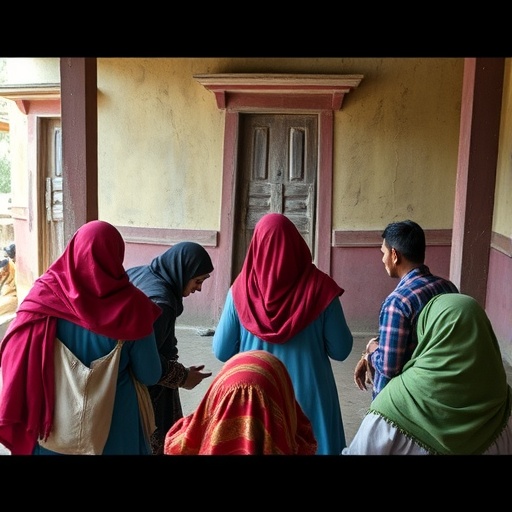
A new study from Nepal is challenging the conventional blueprint for earthquake preparedness, arguing that communities are not merely recipients of disaster plans but critical producers of the knowledge needed to survive and recover. Research conducted in Badamuti, Kathmandu, found that residents’ lived experiences, local relationships and community leadership reveal weaknesses that can be missed by formal emergency systems. The findings suggest that resilience depends as much on trust, social organization and psychological recovery as it does on buildings, warning systems or government response. In particular, the study highlights the potential of women-led initiatives to transform preparedness from a top-down service into a locally controlled form of protection.
Earthquake disasters rarely affect all people equally. The physical shaking may be widespread, but its consequences are shaped by housing quality, income, age, gender, access to institutions and the ability to obtain help after the ground stops moving. Marginalized communities often face greater exposure to unsafe buildings and fewer resources for evacuation, medical care or reconstruction. Yet disaster planning has frequently treated local knowledge as secondary to technical expertise developed by governments, engineers or outside organizations. The Nepal study takes a different approach, examining preparedness through what its authors call a decolonial, community-centered lens. Rather than extracting information from residents as research subjects, the investigators treated knowledge as relational and co-produced through conversation.
The researchers held open-ended dialogues with 14 community members in Badamuti, including women, elders and local leaders. This conversational method was designed to allow participants to describe earthquake impacts and recovery in their own terms instead of selecting answers from a predetermined questionnaire. Such an approach can reveal connections that standardized assessments often separate: the relationship between damaged housing and prolonged stress, between institutional neglect and declining trust, or between everyday community networks and the ability to respond rapidly during a crisis. The sample was small and was not intended to represent every community in Nepal. Its value lies instead in the depth of the accounts and in the decision to place local interpretation at the center of the analysis.
Five broad themes emerged from the discussions. The first concerned the immediate impact of earthquakes and the role of chance in survival. Participants described the disaster experience not simply as a predictable outcome of hazard intensity, but as an event in which timing, location, building conditions and circumstance could determine who escaped harm. This distinction matters scientifically and operationally. Seismic hazard describes the probability and intensity of ground motion, while disaster risk also depends on exposure and vulnerability. Two households experiencing similar shaking may face entirely different outcomes because one occupies a stronger structure, has an accessible escape route or receives help quickly, while the other does not. Preparedness plans that focus only on the earthquake itself may therefore overlook the social conditions that convert shaking into injury, displacement or death.
The second theme was the prolonged difficulty of housing and recovery. Rebuilding is often portrayed as a straightforward engineering task: assess damage, provide funds, reconstruct safer homes. In practice, recovery can be slowed by administrative procedures, shortages of materials, uncertain land or property rights, limited household finances and disagreements over what counts as an acceptable repair. A damaged home is also more than a physical shelter. It is a place where families store possessions, maintain privacy, care for children and elders, and preserve a sense of continuity. When reconstruction takes years, the consequences can accumulate through overcrowding, economic disruption and uncertainty. The study’s findings indicate that preparedness should include realistic recovery pathways, not only emergency drills and stockpiles.
The third theme was enduring psychological trauma. The authors report that the emotional effects of the earthquake did not end when the immediate danger passed. Fear, grief, insecurity and memories of sudden destruction can persist long after physical damage becomes less visible. Psychological recovery is often underfunded in disaster governance because it is harder to measure than collapsed walls or disrupted roads. Yet trauma can affect sleep, concentration, decision-making, social relationships and willingness to return to damaged spaces. It may also shape how people respond during later emergencies. By documenting psychological distress alongside material losses, the study presents resilience as a multidimensional process involving mental health, social connection and the restoration of control over daily life.
The fourth theme involved inadequate government and institutional support. Participants described a gap between official preparedness frameworks and what communities experience on the ground. Institutions may issue guidelines or establish relief programs, but those systems can fail if information does not reach residents, assistance is delayed, eligibility rules exclude vulnerable families or authorities do not understand local priorities. The problem is not necessarily a lack of technical knowledge. It is often a failure to connect knowledge with action. A technically sound plan can remain ineffective when it is not trusted, communicated in accessible ways or adapted to the realities of a particular neighborhood. The study therefore treats governance as part of the hazard system itself: weak institutions can amplify vulnerability, while responsive institutions can strengthen the capacity to cope.
The fifth theme was a strong desire for future preparedness led by the community, especially through women’s initiatives. This emphasis reflects the practical roles women frequently play in maintaining households, coordinating care, preserving social networks and identifying the needs of children, older people and people with disabilities during crises. It also exposes the limitations of disaster programs that consult women without giving them authority, resources or decision-making power. Gender-sensitive preparedness is not simply a matter of adding women to a meeting. It requires recognizing who controls information, whose labor sustains recovery and whose knowledge is treated as legitimate. In Badamuti, the researchers found that women-led organizing could provide a foundation for relational preparedness—an approach based on reciprocal responsibility rather than one-way delivery of aid.
The idea of relational preparedness expands the technical meaning of resilience. In engineering, resilience may refer to a structure’s ability to absorb energy, deform and continue functioning, or to return to service after damage. In social science, resilience describes the capacities of individuals and groups to anticipate, withstand, adapt to and recover from disruption. The Nepal study argues that these capacities are embedded in relationships. Neighbors who know who needs assistance, local leaders who can communicate across households and institutions that listen before a disaster may reduce harm even when resources are limited. This does not make community solidarity a substitute for safe construction, seismic regulation, professional medical care or public investment. Rather, it shows that physical and social systems operate together.
The authors’ decolonial framework also raises a broader question about who has the authority to define risk. Conventional disaster research has often privileged external experts, quantitative models and institutional categories, while treating local accounts as anecdotal. A decolonial approach does not reject scientific or engineering knowledge; it asks how different forms of knowledge can be brought into a more equitable relationship. Local observations can identify evacuation barriers, recurring governance failures or culturally specific forms of support that may not appear in official datasets. Scientific assessments can contribute information about fault activity, building performance and expected ground motion. The challenge is to combine these forms of understanding without allowing one to automatically overrule the other.
The study is particularly relevant to Nepal, where earthquake risk is shaped by active tectonics, dense urban growth and uneven construction quality, but its implications extend far beyond Kathmandu. Cities in earthquake-prone regions around the world often possess sophisticated hazard maps and emergency protocols while remaining vulnerable to institutional fragmentation and social inequality. The research suggests that preparedness programs should begin by listening to residents, mapping local capacities as well as physical hazards, and involving community members in deciding what resilience means. It also points toward long-term investment in psychosocial services, transparent reconstruction support and leadership opportunities for women and other groups commonly excluded from formal decision-making.
Because the research involved 14 participants in one community, it cannot establish how widespread each experience is or measure the effectiveness of specific preparedness interventions. The authors state that the data will be provided upon request, and the study offers an interpretive account rather than a statistical estimate of earthquake risk. Its significance lies in showing what becomes visible when disaster preparedness is examined through conversation and shared authority. The accounts connect survival, housing, trauma, governance and leadership into a single picture of recovery. That picture is difficult to reduce to a checklist, but it may be closer to the conditions communities actually face when disaster strikes.
The central message is both simple and disruptive: resilience cannot be delivered to a community from outside. Governments, engineers and humanitarian organizations remain indispensable, but their efforts are most likely to succeed when residents help define the problem, shape the response and control part of the solution. For Badamuti, preparedness is not only about predicting earthquakes or strengthening walls. It is about ensuring that people are heard before, during and after the emergency; that recovery does not become an indefinite waiting period; and that women and local leaders have the authority to organize protection. In a field often dominated by models of hazards and vulnerability, the study places relationships at the center—and argues that the strongest early-warning system may be a community prepared to act together.
Cite Scienmag News
Violet Maxwell. (August 27, 2026). Nepal Communities Reimagine Earthquake Preparedness Through Decolonial Dialogue on Trauma and Resilience. Scienmag. https://scienmag.com/nepal-communities-reimagine-earthquake-preparedness-through-decolonial-dialogue-on-trauma-and-resilience/
Violet Maxwell. "Nepal Communities Reimagine Earthquake Preparedness Through Decolonial Dialogue on Trauma and Resilience." Scienmag, 27 August 2026, https://scienmag.com/nepal-communities-reimagine-earthquake-preparedness-through-decolonial-dialogue-on-trauma-and-resilience/. Accessed 3 September 2026.
Violet Maxwell. "Nepal Communities Reimagine Earthquake Preparedness Through Decolonial Dialogue on Trauma and Resilience." Scienmag. August 27, 2026. https://scienmag.com/nepal-communities-reimagine-earthquake-preparedness-through-decolonial-dialogue-on-trauma-and-resilience/


