


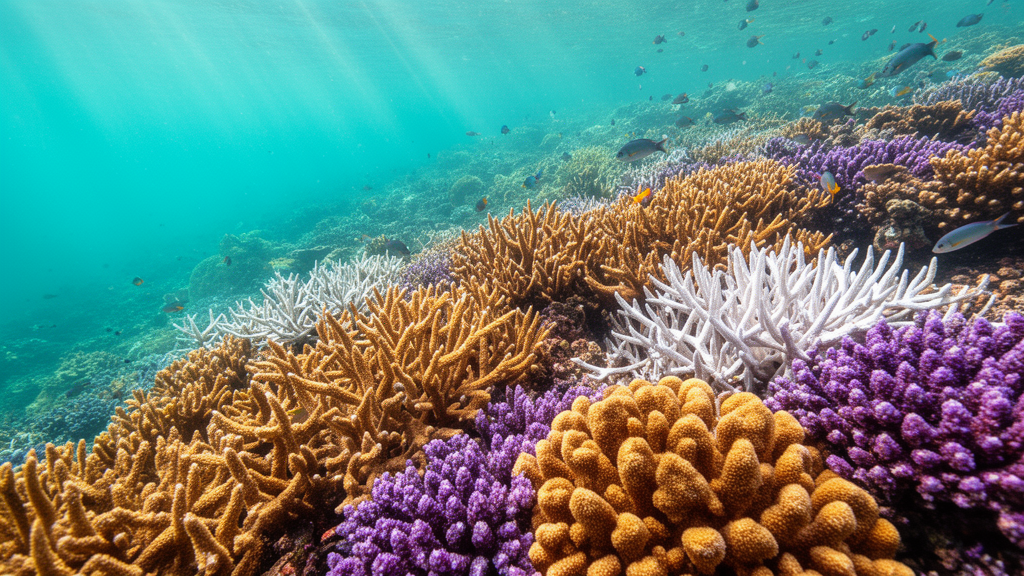
In the most comprehensive reassessment of coral extinction risk ever undertaken, an international team of researchers has found that nearly half of the world’s reef-building coral species face elevated relative risk of extinction. The study, published in Nature, evaluated 892 reef-building coral species against the International Union for Conservation of Nature (IUCN) Red List criteria and determined that 340 of the 774 species with sufficient data — approximately 44 percent — qualify as threatened. This finding represents a dramatic escalation from the previous assessment conducted in 2008 and underscores the accelerating impact of climate-driven ocean warming on one of Earth’s most biodiverse ecosystems.
The research team, led by David O. Obura of CORDIO East Africa alongside Beth Polidoro of Arizona State University and Francoise Cabada-Blanco of the University of Portsmouth, applied a rigorous methodology to overcome one of the greatest challenges in coral conservation: the absence of direct species-level population counts for most reef-building corals. Because monitoring individual coral species across their vast geographic ranges remains logistically impractical, the researchers employed proxy-based inference, combining global coral cover trends with projected annual severe bleaching events under the SSP2-4.5 climate scenario over a thirty-year period. These proxies were then adjusted using trait-based estimates of species vulnerability, accounting for factors such as colony size, growth rate, and thermal tolerance that influence how different coral species respond to environmental stress.
The results paint a sobering picture of coral biodiversity. Of the 774 species with adequate data, 33 were classified as Critically Endangered — the highest risk category short of extinction in the wild — while 251 were listed as Endangered and 56 as Vulnerable. The predominant driver behind these classifications is the risk of population reduction associated with projected thermal stress, reflecting the well-documented relationship between rising sea surface temperatures and mass coral bleaching events. When corals experience prolonged exposure to elevated temperatures, they expel the symbiotic algae living within their tissues, losing both their characteristic colors and their primary energy source. Repeated or severe bleaching can lead to starvation, disease susceptibility, and ultimately colony death.
What makes this reassessment particularly alarming is its temporal context. The findings predate the three hottest years on record and the fourth global coral bleaching event, which occurred between 2023 and 2025. They also predate the first exceedance of the 1.5°C global warming threshold for an annual mean — a milestone that climate scientists have long identified as a critical tipping point for coral reef ecosystems. This means that the extinction risk estimates, already sobering, likely underrepresent the current and future threat landscape facing these organisms as ocean temperatures continue to climb beyond the levels used in the study’s projections.
The IUCN Red List framework operates on a fundamentally different logic than population viability analyses used for individual species management. Rather than predicting whether or when a species may go extinct, the Red List assesses relative extinction risk by comparing population size, rate of decline, and geographic range against standardized thresholds. Species are placed into categories of increasing risk based on how their demographic parameters measure against these criteria. For corals, this means the 44 percent threatened figure represents a relative ranking within the framework rather than a prediction that nearly half of all reef-building coral species will disappear within a specific timeframe. Nevertheless, the categorical assignments carry significant weight in international conservation policy, influencing everything from protected area designations to international trade regulations.
The methodological innovation underlying this reassessment deserves particular attention. The 2008 assessment, which served as the baseline for comparison, relied on different data availability and analytical approaches. In the intervening years, coral taxonomy has undergone substantial revision, with molecular phylogenetics reshaping our understanding of species boundaries and evolutionary relationships. The research team had to reconcile these taxonomic changes while ensuring that category shifts between assessments reflected genuine changes in extinction risk rather than artifacts of reclassification. The supplementary materials accompanying the study detail how the researchers distinguished between genuine and non-genuine changes in classification, providing transparency about which species moved categories due to real population declines versus those that shifted due to updated taxonomic understanding or refined assessment criteria.
Geographic and taxonomic patterns in the results reveal important nuances about where and which corals are most at risk. The study’s species-level dataset encompasses information on family-level relationships, ecoregion distributions, extent of occurrence, reef area within each species’ range, and depth preferences. These variables allow conservation planners to identify not only which species are threatened but also which regions harbor concentrations of high-risk species and which ecological niches may be disproportionately vulnerable. The Caribbean, the Coral Triangle, and the Red Sea each host distinct assemblages of coral species with varying thermal tolerances and recovery capacities, meaning that uniform global conservation strategies will be insufficient to address the full spectrum of extinction risk documented in this assessment.
The researchers are candid about the limitations of their approach and identify clear priorities for future work. Because the ranges of coral species remain under-surveyed, the current assessment necessarily relies on proxies that may not capture range-representative population dynamics with full accuracy. The team emphasizes that future reassessments would be substantially strengthened by species-level population data, thermal-stress metrics calibrated to individual species’ physiological thresholds, and recovery metrics that track how coral populations rebound — or fail to rebound — following bleaching disturbances. Such data would reduce the uncertainty inherent in proxy-based inference and enable more precise assignment of Red List categories.
Beyond the scientific implications, the findings carry profound weight for the more than 100 tropical countries where coral reefs provide ecological functions alongside economic and social benefits. Reef-associated fisheries, coastal protection from storm surge, tourism revenue, and cultural values all depend on the structural complexity and biological diversity that reef-building corals create. The loss of even a subset of the 340 threatened species identified in this study could trigger cascading effects throughout reef food webs, compromising the resilience of these ecosystems and the human communities that depend on them. The researchers argue that their findings reinforce the critical importance of limiting further warming to maintain coral biodiversity and reef ecosystem function — a conclusion that aligns with broader calls for aggressive greenhouse gas emissions reductions alongside targeted local conservation measures.
As the scientific community digests the implications of this landmark reassessment, the message is unambiguous: the window for preventing widespread coral extinction is narrowing rapidly. The convergence of rising global temperatures, increasing bleaching frequency, and the inherent vulnerability of reef-building corals to thermal stress creates a trajectory that, without decisive intervention, will continue to push more species toward higher risk categories. Whether the next reassessment documents further deterioration or the beginning of a recovery will depend largely on the trajectory of global emissions over the coming decade and the effectiveness of conservation strategies implemented at local, regional, and international scales.
Subject of Research: Global IUCN Red List reassessment of extinction risk in reef-building coral species
Article Title: Nearly half of reef-building corals face elevated relative risk of extinction
Article References: Obura, D. O., Polidoro, B., Cabada-Blanco, F., Linardich, C., Carpenter, N., Gutierrez, L., Kemppinen, K., Pettersson, E., Strongin, K., Aeby, G., Alliji, K., Alvarado, J. J., Alvarez-Filip, L., Casado de Amezua, P., Banaszak, A., Bayley, D. T. I., Bluemel, J. K., Cortés, J., Couce, E., … Wilson, B. (2026). Nearly half of reef-building corals face elevated relative risk of extinction. Nature. https://doi.org/10.1038/s41586-026-11263-3
Image Credits: AI Generated
DOI: 10.1038/s41586-026-11263-3
Keywords: coral reefs, IUCN Red List, extinction risk, climate change, coral bleaching, marine biodiversity, ocean warming, conservation biology, reef-building corals, thermal stress, SSP2-4.5, species assessment
Cite Scienmag News
Margaret Porter. (October 16, 2026). Nearly Half of Reef-Building Corals Now Face Elevated Extinction Risk, Global Red List Reassessment Finds. Scienmag. https://scienmag.com/nearly-half-of-reef-building-corals-now-face-elevated-extinction-risk-global-red-list-reassessment-finds/
Margaret Porter. "Nearly Half of Reef-Building Corals Now Face Elevated Extinction Risk, Global Red List Reassessment Finds." Scienmag, 16 October 2026, https://scienmag.com/nearly-half-of-reef-building-corals-now-face-elevated-extinction-risk-global-red-list-reassessment-finds/. Accessed 16 October 2026.
Margaret Porter. "Nearly Half of Reef-Building Corals Now Face Elevated Extinction Risk, Global Red List Reassessment Finds." Scienmag. October 16, 2026. https://scienmag.com/nearly-half-of-reef-building-corals-now-face-elevated-extinction-risk-global-red-list-reassessment-finds/


