


Freshwater scarcity is rapidly becoming one of the defining challenges of the twenty-first century. Industrialization and population growth are pushing demand for clean water beyond what natural supplies can sustain, and some estimates warn that freshwater availability could fall by as much as 40 percent by 2030 if current trends continue. Seawater desalination offers a promising way out of this crisis, and among the various desalination technologies, membrane distillation has attracted growing attention because it operates at low temperatures and atmospheric pressure. This means it can run on low-grade industrial waste heat or solar energy, and it does not demand membranes with high mechanical strength. It also rejects non-volatile compounds such as salts at rates typically above 99.9 percent, regardless of how salty the feed becomes. Yet despite these advantages, membrane distillation has struggled to make the leap from laboratory benches to industrial plants, largely because the membranes themselves keep failing under real-world conditions.
The core problem is wetting. In membrane distillation, a temperature difference between hot saline feed and cold permeate drives water vapor across a porous, hydrophobic membrane. As long as liquid water cannot penetrate the pores, only vapor passes through and salts stay behind. But fouling, scaling, and wetting progressively degrade performance. As salt concentrations approach saturation, crystals nucleate and grow on the membrane surface, gradually transforming it from water-repelling to water-attracting. Once that happens, pores flood, and salt ions leak into the distilled product. Heat loss by conduction and low permeate flux compound the trouble. An effective membrane for this technology therefore needs high hydrophobicity, high porosity, controlled pore size, and strong resistance to wetting, scaling, and fouling all at once — a demanding combination of properties that conventional flat polymer films rarely deliver.
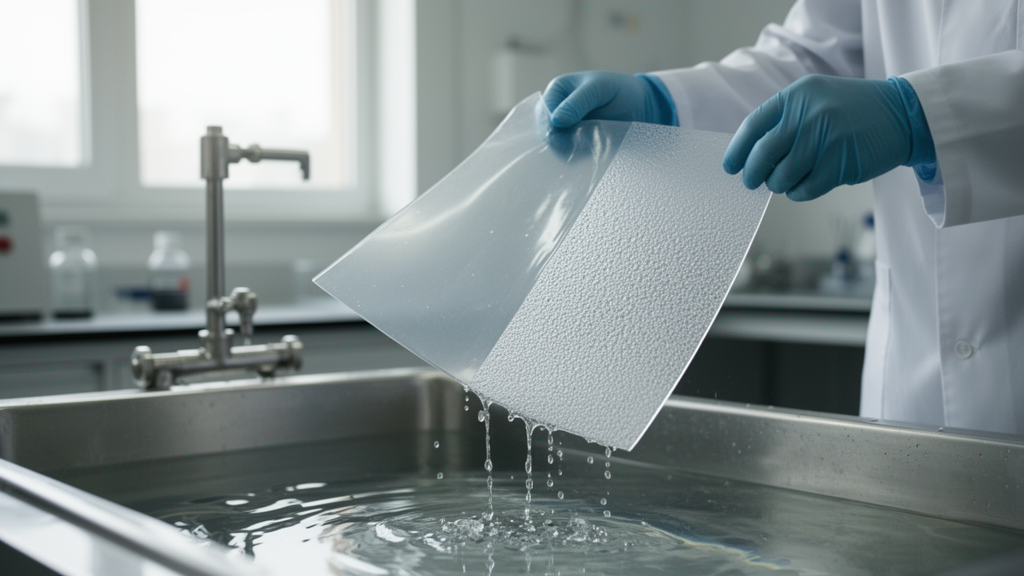
Researchers at the University of Tehran and their collaborators have now reported a strikingly simple way to build such a membrane in a single fabrication step. Writing in the journal Results in Engineering, Kobra Bagheri, Mojtaba Shariaty-Niassar, Javad Karimi Sabet, Abolfazl Dastbaz, and Mahdi Akbari describe a one-step phase-inversion strategy that engineers both surfaces of a polyvinylidene fluoride membrane simultaneously, using nothing more exotic than a roughened glass casting template and a dash of so-called Janus graphene oxide nanosheets dispersed in the polymer solution. The result is a Janus membrane — one with two chemically and physically distinct faces — that nearly doubles water production flux while shrugging off scale formation and running stably for 100 hours on real Caspian Sea water.
The trick relies on two modifications happening at once during non-solvent-induced phase separation, the standard process in which a polymer casting solution is plunged into a coagulation bath and solidifies as solvent and non-solvent exchange. First, the team sandblasted the glass substrate with silica particles to create random micro-roughness. When the PVDF solution was cast onto this template, the membrane surface in contact with the glass inherited the texture, producing a hierarchically rough feed-side surface with random cavities. Second, the researchers added Janus graphene oxide nanosheets — ultrathin sheets with a hydrophilic face and a hydrophobic face functionalized with dodecylamine — to the casting dope at 1 percent by weight relative to the polymer. Because of their asymmetric surface chemistry, these nanosheets spontaneously migrate toward the substrate-contacting side and orient themselves during phase separation, building asymmetric wettability into the membrane without any post-fabrication chemical treatment.
The evidence for this self-assembly is compelling. Energy-dispersive X-ray spectroscopy revealed a clear through-thickness gradient in nitrogen and oxygen, elements characteristic of the nanosheet functional groups: the air-facing top surface contained 8.42 percent oxygen, while the substrate-facing bottom surface contained 20.23 percent, consistent with preferential nanosheet enrichment near the template. Meanwhile, water contact angle measurements confirmed the Janus character. The top surface of the composite membrane was moderately hydrophobic at 73.9 degrees, whereas the patterned bottom surface reached 135.9 degrees — far more water-repellent than either a flat control membrane at 72.7 degrees or a textured membrane without nanosheets at 122 degrees. Interestingly, the bottom surface is chemically richer in hydrophilic groups yet measurably more water-repellent, an apparent paradox the authors resolve through roughness: secondary nano-scale asperities, generated as the orienting nanosheets perturb the demixing front and induce wrinkling, trap air under the droplet in a Cassie–Baxter-type state that drastically reduces solid–liquid contact.
A clever control experiment isolates the synergy. When the same nanosheets were cast onto smooth glass, the contact angle rose by only 6.6 degrees over the plain polymer. On the textured substrate, the identical nanosheet loading raised it by 13.9 degrees — more than double — and scanning electron microscopy showed that only the combination produced the full hierarchical micro-pattern plus secondary roughness. The rough template also prevented membrane shrinkage during coagulation, keeping the film open and porous: the composite membrane achieved 86 percent porosity with a thickness of just 82 micrometers, compared with a dense 65-micrometer flat film. The nanosheets modulate the demixing kinetics, trimming surface pore size to an intermediate 0.35 micrometers — large enough for vapor, small enough to resist liquid intrusion.
Performance in air-gap membrane distillation told the story dramatically. With a 3.5 percent sodium chloride feed at 60 degrees Celsius, the Janus membrane delivered a permeate flux of 16.25 liters per square meter per hour with salt rejection above 99.9 percent — nearly double the 7.75 achieved by the unmodified flat film. When the researchers flipped the membrane so the more hydrophilic face faced the feed, flux collapsed to roughly one-sixth of its normal value while salt rejection held steady, a direct demonstration that the directional Janus architecture is doing functional work: the rough, superhydrophobic face maximizes evaporation area and repels liquid, while the more hydrophilic upper face helps vapor move toward the condensation side.
Resistance to scaling proved equally impressive. In a punishing 12-hour test with a feed containing 7 percent salt plus 1000 parts per million each of calcium and sulfate ions — a recipe for gypsum scale — the flat control membrane held stable for only about four hours before rejection began to fall as crystals accumulated and wetted the pores. The Janus membrane, by contrast, maintained stable flux and rejection throughout all 12 hours, and post-test electron microscopy and elemental analysis showed almost no mineral deposition. The authors attribute this to a near-suspended wetting state in which trapped air creates a slippery interface, raising the energetic barrier to crystal nucleation and shortening the residence time of supersaturated liquid at the surface. After testing, surface sodium content had dropped from 27.08 to 4.19 percent and chlorine from 33.37 to 0.82 percent, indicating the few salt traces could be easily washed away.
Most strikingly, the membrane endured 100 hours of continuous desalination of real Caspian Sea water — a complex matrix with nearly 16,000 parts per million total dissolved solids plus natural organic matter — collected from the coast of Fereydounkenar in northern Iran. Averaging 22.8 liters per square meter per hour, the membrane sustained salt rejection above 99.9 percent for most of the run, easing only to 98.5 percent by the end. Post-run characterization showed the pore structure essentially unchanged at 0.35 micrometers, the contact angle slipping only slightly from 135.9 to 131.0 degrees, and the liquid entry pressure holding at a robust 2.8 bar, while electron microscopy confirmed the template-induced texture had not flattened or delaminated. Compared with previously reported Janus and superhydrophobic membranes — most of which require multi-step patterning followed by fluorination or polymer grafting — this one-step approach stands out for its simplicity, dual-surface engineering, high porosity, and use of a large 32-square-centimeter membrane area with a real seawater feed.
The implications reach beyond a single laboratory result. Membrane distillation has long promised desalination powered by waste heat and sunlight, but membrane failure under scaling and fouling has kept it niche. A fabrication route that turns ordinary phase inversion into self-assembly of an asymmetric, anti-scaling architecture — with no fluorination chemistry, no plasma treatment, and no extra steps — could make such membranes far easier to scale up. The authors even suggest that the distillate quality might allow blending with municipal supplies in Iran’s Mazandaran Province, though they caution that blending ratios and drinking-water compliance remain to be assessed. If the one-step Janus strategy translates from the lab to production lines, the humble two-faced membrane could become a serious contender in the global race to turn seawater into freshwater.
Subject of Research: One-step fabrication of Janus PVDF membranes with template-induced texturing and Janus nanosheet self-orientation for membrane distillation desalination
Article Title: One-step fabrication of PVDF Janus membranes by template-induced texturing and Janus nanosheet self-orientation for membrane distillation
Article References: Bagheri, K., Shariaty-Niassar, M., Sabet, J. K., Dastbaz, A., & Akbari, M. (2026). One-step fabrication of PVDF Janus membranes by template-induced texturing and Janus nanosheet self-orientation for membrane distillation. Results in Engineering, 32, Article 113543. https://doi.org/10.1016/j.rineng.2026.113543
Image Credits: AI Generated
DOI: Not provided
Keywords: membrane distillation, desalination, Janus membrane, PVDF, graphene oxide nanosheets, phase inversion, superhydrophobicity, anti-scaling, water purification, Caspian Sea water, surface wettability, porous membranes
Cite Scienmag News
Denise Maddox. (October 16, 2026). Two-Faced Membrane Made in a Single Step Boosts Desalination Performance. Scienmag. https://scienmag.com/two-faced-membrane-made-in-a-single-step-boosts-desalination-performance/
Denise Maddox. "Two-Faced Membrane Made in a Single Step Boosts Desalination Performance." Scienmag, 16 October 2026, https://scienmag.com/two-faced-membrane-made-in-a-single-step-boosts-desalination-performance/. Accessed 16 October 2026.
Denise Maddox. "Two-Faced Membrane Made in a Single Step Boosts Desalination Performance." Scienmag. October 16, 2026. https://scienmag.com/two-faced-membrane-made-in-a-single-step-boosts-desalination-performance/


