


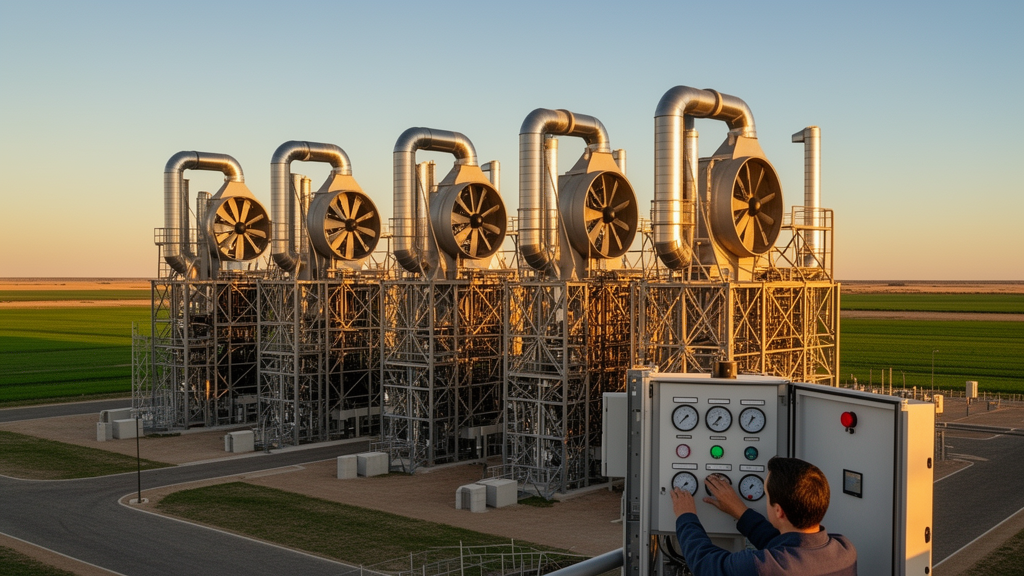
Direct air capture machines that pull carbon dioxide straight out of the atmosphere face a deceptively simple problem: the air never stays the same. Temperature swings, humidity surges, shifting electricity prices, and a grid that is dirtier at some hours than others all conspire to change how much CO2 a machine can capture and how much energy it burns doing so. A new modeling study published in Frontiers in Environmental Engineering shows that if these machines could sense those changing conditions and adapt their operation in real time, they could capture far more carbon while using significantly less energy—roughly doubling the net climate benefit in the scenarios examined.
The research, led by Keju An and colleagues at the National Laboratory of the Rockies in Golden, Colorado, tackles a stubborn computational bottleneck. Detailed models of adsorption systems—devices where solid sorbent materials grab CO2 molecules from air and then release them when heated and placed under vacuum—are so computationally expensive that simulating a full year of hour-by-hour operation was previously impractical. Without year-long simulations, engineers could not properly explore how machines should behave when weather and grid conditions change around them.
The team’s solution was a physics-informed reduced-order model: a stripped-down but physically faithful mathematical description of a temperature-vacuum swing adsorption (TVSA) cycle, the six-stage process of vacuum extraction, heating, desorption, cooling, pressurization, and adsorption. Crucially, the model retains the phenomena that matter most. It tracks CO2 and water co-adsorption on the sorbent, uses a two-pool formulation in which some CO2 binds quickly to accessible sites while a slower pool represents stubbornly retained molecules, and captures incomplete regeneration—the fact that each cycle never fully clears the sorbent, leaving residual loading that carries over as a memory into the next cycle.
That cycle-to-cycle memory is the heart of the study’s argument. Because the sorbent’s state at the start of each cycle depends on everything that happened before, performance cannot be predicted from any single steady-state snapshot. The loading states act as memory variables that determine the working capacity available in the next cycle, the humidity-dependent adsorption behavior, and the energy required for regeneration. The model tracks six coupled states—fast and slow CO2 pools, free and bound water, gas-phase CO2 concentration, and bed temperature—propagating them forward step by step through the year.
To make the framework fast enough for serious optimization work, the researchers generated roughly 120,000 cycle-resolved simulations using Latin hypercube sampling across environmental conditions, operating strategies, system designs, and initial sorbent states. Each simulated cycle recorded its ambient conditions, control settings, internal sorbent states, and resulting performance. This dataset then trained a compact neural network—a single hidden layer of 39 neurons—that reproduces the physics model’s state transitions at a tiny fraction of the computational cost, creating a surrogate fast enough to embed inside a model predictive control framework.
Before trusting the surrogate, the team benchmarked the physics model against published experimental data from Sendi and colleagues. Across twelve benchmark cases spanning typical temperature and humidity conditions, the reduced-order model reproduced productivity with a mean absolute percentage error of 10.2 percent and electricity demand with an error of 11.4 percent. Deviations grew largest under extreme conditions—high temperature with low humidity, or very cold conditions—reflecting the simplifications inherent in a lumped, zero-dimensional formulation. But the model faithfully captured the direction and relative sensitivity of performance to environmental changes, which matters more for large-scale screening than exact point accuracy.
Sensitivity analysis revealed a starkly asymmetric performance landscape. Regeneration temperature dominated everything: raising it from 70 to 130 degrees Celsius cut annual productivity by roughly 10 tonnes of CO2 per cubic meter of bed while adding 0.7 to 0.8 megawatt-hours of electricity demand per tonne captured—a punishing double penalty from hotter, slower cycles. Humidity was the second most influential factor for energy, with relative humidity climbing from 0.1 to 0.9 adding roughly 0.5 megawatt-hours per tonne, a direct consequence of water co-adsorbing alongside CO2 and demanding extra thermal energy during regeneration.
The real payoff came when the neural-network surrogate was handed to the optimization controller and run against hourly 2025 weather, electricity price, and grid carbon intensity data for two contrasting American locations: humid Atoka, Texas and dry, cooler Madison, Wyoming. A baseline machine running fixed settings completed about 1,094 cycles per year. The adaptive controller pushed that to roughly 1,449 cycles in Atoka and 1,379 in Madison by shifting energy-hungry regeneration steps into hours when electricity was cheap and clean, and exploiting favorable humidity windows for capture.
The results were striking. In Atoka, electricity demand fell 18.8 percent while annual CO2 productivity rose 25.5 percent. In Madison, energy dropped 8.9 percent and productivity climbed 22.4 percent. The most dramatic gains appeared in carbon-adjusted net productivity—capture minus the emissions embedded in the electricity consumed—which nearly doubled at both sites, rising 95.2 percent in Texas and 94.4 percent in Wyoming. Notably, the economics did not always align with the climate math: electricity cost fell slightly in Atoka but rose 3.7 percent in Madison, showing that carbon-aware control sometimes accepts higher operating costs to harvest cleaner power.
The authors are careful about scope. Their model is a control-oriented screening tool, not a plant-specific predictor, and because the surrogate learns from the physics model, its uncertainties propagate into the optimization results—meaning the reported gains are relative, model-based estimates rather than guarantees. Still, the framework offers something the field has lacked: a scalable path from adsorption physics through fast dynamic simulation to real-world control, demonstrating that the biggest untapped efficiency reserve in direct air capture may not be new materials or bigger machines, but smarter timing.
Subject of Research: Dynamic modeling and neural-network-based optimization of solid-sorbent direct air capture systems under varying weather and electricity conditions
Article Title: Cycle-resolved dynamic modeling of atmospheric CO2 separation systems under time-varying ambient and electricity conditions
Article References: An, K., Wald, D., Chen, K., & King, R. (2026). Cycle-resolved dynamic modeling of atmospheric CO2 separation systems under time-varying ambient and electricity conditions. Frontiers in Environmental Engineering, 5, Article 1881554. https://doi.org/10.3389/fenve.2026.1881554
Image Credits: AI Generated
DOI: 10.3389/fenve.2026.1881554
Keywords: direct air capture, carbon dioxide removal, temperature-vacuum swing adsorption, reduced-order model, neural network surrogate, model predictive control, humidity, electricity carbon intensity, energy optimization, solid sorbents, climate engineering, Cycle-resolved
Cite Scienmag News
Denise Maddox. (October 16, 2026). Smart Control Could Nearly Double the Real Climate Payoff of Direct Air Capture Machines. Scienmag. https://scienmag.com/smart-control-could-nearly-double-the-real-climate-payoff-of-direct-air-capture-machines/
Denise Maddox. "Smart Control Could Nearly Double the Real Climate Payoff of Direct Air Capture Machines." Scienmag, 16 October 2026, https://scienmag.com/smart-control-could-nearly-double-the-real-climate-payoff-of-direct-air-capture-machines/. Accessed 16 October 2026.
Denise Maddox. "Smart Control Could Nearly Double the Real Climate Payoff of Direct Air Capture Machines." Scienmag. October 16, 2026. https://scienmag.com/smart-control-could-nearly-double-the-real-climate-payoff-of-direct-air-capture-machines/


