


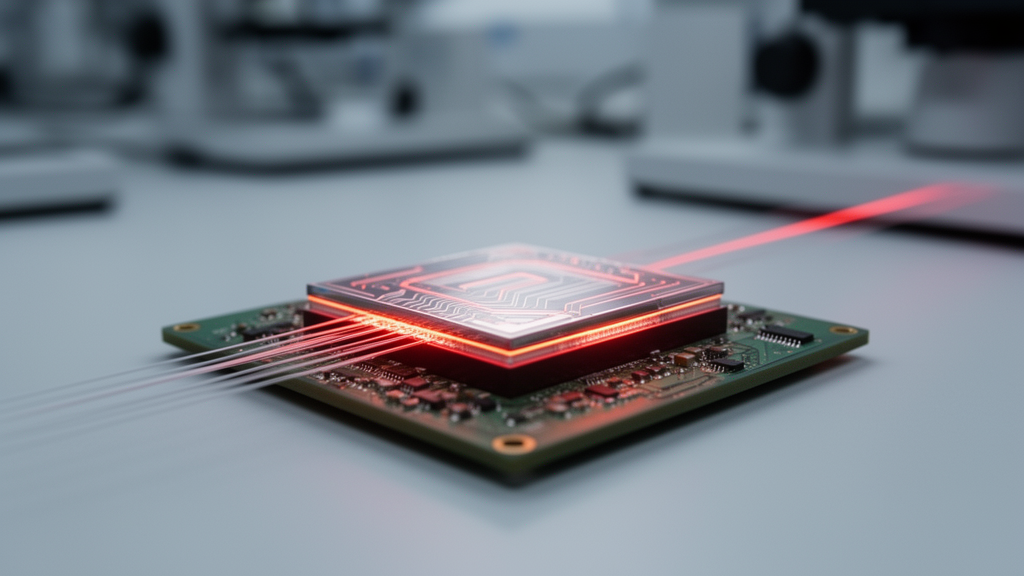
Artificial intelligence is no longer confined to data centers with generous millisecond budgets. Autonomous drones dodging obstacles, smart grids hunting for faults before they cascade, and high-frequency trading systems all demand that raw information becomes a decision in microseconds or less. For conventional digital hardware, that deadline is brutal. Processors may be fast, but the so-called memory wall—the widening gap between computation speed and the bandwidth needed to shuttle data back and forth—means that moving data, not crunching it, dominates both latency and energy. A team at Heidelberg University now reports a hardware route around that bottleneck, demonstrating a compact silicon photonic building block and using it to construct what they describe as the first experimentally validated photonic Kolmogorov–Arnold network operating on nanosecond timescales.
The work, published in Frontiers in Photonics, tackles the central weakness of photonic neural networks: nonlinearity. Optical interference is superb at performing linear operations, such as the matrix–vector multiplications that dominate neural network workloads, essentially at the speed of light. But without nonlinear elements, cascaded optical stages collapse into a single linear transformation, incapable of expressing the rich functions that make deep learning powerful. Many photonic implementations sidestep this by converting light to electrons, processing, and converting back—an optical–electrical–optical detour that erodes the very latency advantage photonics promises.
The Heidelberg team, led by Wolfram Pernice at the Kirchhoff-Institute for Physics together with Holger Fröning’s group at the Institute of Computer Engineering, chose a different path. Their nonlinear unit is a photodiode directly wired to a microring modulator, fabricated on a CMOS-compatible silicon photonics platform through the Applied Micro Foundry multi-project wafer service. When light hits the silicon–germanium photodiode, the generated photocurrent flows straight into the forward-biased PN junction of the microring resonator. No amplification, no signal conditioning, no electronic detour. The injected carriers shift the resonator’s refractive index through the plasma dispersion effect, moving its resonance wavelength and thereby reshaping how much light the ring transmits. The result is a genuinely optical nonlinearity with only two physical control knobs.
Those two knobs are what make the device trainable. The optical power in the resonator’s bus waveguide sets the amplitude of the output, while an integrated microheater thermally tunes the ring resonance—about 20 milliwatts of electrical power per π-phase shift—positioning the Lorentzian-shaped resonance relative to the fixed signal wavelength. Operating near the steepest slope of the resonance yields strong nonlinear behavior; operating further away approaches quasi-linear response. Because both the through and drop ports of the resonator are accessible, the unit even offers complementary nonlinear responses with opposite slopes, a flexibility that proves useful when cascading multiple units.
Characterization revealed the device’s speed limit and, crucially, confirmed it is fast enough to matter. The microring showed an insertion loss of just 0.6 dB at 1,550 nm, and the photodiodes a responsivity of roughly 0.9 A/W. Under pulsed optical excitation producing photocurrents near 3 mA, the transmitted signal followed the input envelope with a measured rise time of approximately 8 nanoseconds—a figure set by the carrier recombination dynamics of forward-biased silicon carrier-injection modulators. Just as importantly, when the team compared the peak amplitudes of dynamically transmitted pulses against predictions from their static model, the agreement was strong, validating that the device’s nonlinear transfer function holds up under high-speed operation.
From these measurements the researchers built a differentiable software model in PyTorch, calibrated against the experimental data, in which photocurrent and heater current jointly determine the ring’s phase shift through carrier-induced and thermo-optic effects. This physical grounding is what elevates the work beyond a device demonstration. The team then asked a pointed architectural question: instead of multilayer perceptrons, which demand large numbers of nonlinear elements, why not exploit Kolmogorov–Arnold networks? These architectures place learnable univariate nonlinear functions along network edges rather than at nodes, a formulation rooted in the Kolmogorov–Arnold representation theorem that achieves expressive function approximation with reduced structural redundancy. The Lorentzian response of the microring, with its two learnable parameters, replaces the B-spline basis functions of the original mathematical formulation.
The photonic implementation imposed honest constraints. Optical fan-out from a single resonator to multiple downstream nodes is not supported, since splitting would require amplification stages that add loss and complexity; instead, signals follow merge-only routing, where many upstream edges can feed one photodiode but each edge connects to only one destination. The photodiode’s finite linear operating range caps how many signals can be combined at a node, and practical limits on chip area, routing, and the peripheral circuitry each ring needs—heaters, resonance stabilization, feedback control—restrict networks to at most a few hundred nonlinear units. Inputs are distributed to the first layer in a round-robin pattern to encourage early mixing of variables, and every subsequent layer obeys the merge-only discipline.
Despite these constraints, the simulated photonic Kolmogorov–Arnold networks approximated a demanding portfolio of structured functions with networks of only a few hundred units. Benchmarks drawn from the original KAN literature included Bessel functions of the first and second kind, modified Bessel functions, Jacobi elliptic sine, incomplete elliptic integrals, associated Legendre functions, spherical harmonics, and functions spanning up to 100 input dimensions. Root-mean-square errors ranged from slightly above zero down to near-machine precision across the set, with unit counts between 110 and 322 microrings. Even the challenging spherical harmonic case, among the highest-error functions, kept its relative residual below 6 percent across the entire domain and considerably smaller over most of the input region.
The comparison with alternative photonic KAN approaches is instructive. Recent ring-assisted Mach–Zehnder interferometer designs offer richer edge functions with nine trainable controls per edge, suited to accelerator-scale architectures with dense connectivity. The PD-MRM unit offers only two trainable parameters per edge, so hardware-constrained networks need more edges—for instance, 243 edges to fit a modified Bessel function that a conventional digital KAN fits with three spline edges. But each of those edges maps directly onto experimentally accessible device controls, and the compact unit is far easier to manufacture at scale. The two approaches, the authors argue, are complementary rather than competing.
There are honest limitations. Because optical intensities are non-negative and combine additively, the architecture cannot directly implement signed edge weights or cancellation, restricting expressivity for functions that inherently require subtractive combinations—though normalization and output-domain shifting recover negative-valued targets. The current model also omits noise sources such as thermal crosstalk and fabrication variability, although prior work suggests training algorithms can harden parametrizations against such physical noise. Looking forward, the team sees clear paths: engineering carrier dynamics through junction design for faster switching, replacing power-hungry thermal tuning with nonvolatile phase-change-material tuning that consumes virtually no electrical energy, and adopting coherent photonic schemes that enable subtraction through controlled interference. Because light propagates continuously through the network—downstream units begin responding the moment signal reaches them rather than waiting for sequential layer execution—inference latency scales sublinearly with depth, anchored by that 8-nanosecond activation time. For applications where microseconds separate success from failure, that physics may prove decisive.
Subject of Research: Photonic Kolmogorov-Arnold networks built from photodiode-microring nonlinear units for ultrafast optical inference
Article Title: Enabling photonic Kolmogorov-Arnold networks for ultra-fast inference
Article References: Pradip, R., Janssen, R., Varri, A., Gründel, N., Ebert, F., Durán, R. G., Lee, T., McRae, L., Römer, J., Schmidt, P., Bankwitz, J. R., Brückerhoff-Plückelmann, F., Fröning, H., & Pernice, W. (2026). Enabling photonic Kolmogorov-Arnold networks for ultra-fast inference. Frontiers in Photonics, 7, Article 1860010. https://doi.org/10.3389/fphot.2026.1860010
Image Credits: AI Generated
DOI: 10.3389/fphot.2026.1860010
Keywords: photonic neural networks, Kolmogorov-Arnold networks, silicon photonics, microring modulator, photodiode, nonlinear optics, ultrafast inference, neuromorphic photonics, CMOS compatibility, carrier injection, analog computing, low-latency AI
Cite Scienmag News
Cassandra Pierce. (October 16, 2026). Silicon Chip Puts Light-Speed Nonlinearities at the Heart of Ultrafast AI Inference. Scienmag. https://scienmag.com/silicon-chip-puts-light-speed-nonlinearities-at-the-heart-of-ultrafast-ai-inference/
Cassandra Pierce. "Silicon Chip Puts Light-Speed Nonlinearities at the Heart of Ultrafast AI Inference." Scienmag, 16 October 2026, https://scienmag.com/silicon-chip-puts-light-speed-nonlinearities-at-the-heart-of-ultrafast-ai-inference/. Accessed 16 October 2026.
Cassandra Pierce. "Silicon Chip Puts Light-Speed Nonlinearities at the Heart of Ultrafast AI Inference." Scienmag. October 16, 2026. https://scienmag.com/silicon-chip-puts-light-speed-nonlinearities-at-the-heart-of-ultrafast-ai-inference/


