


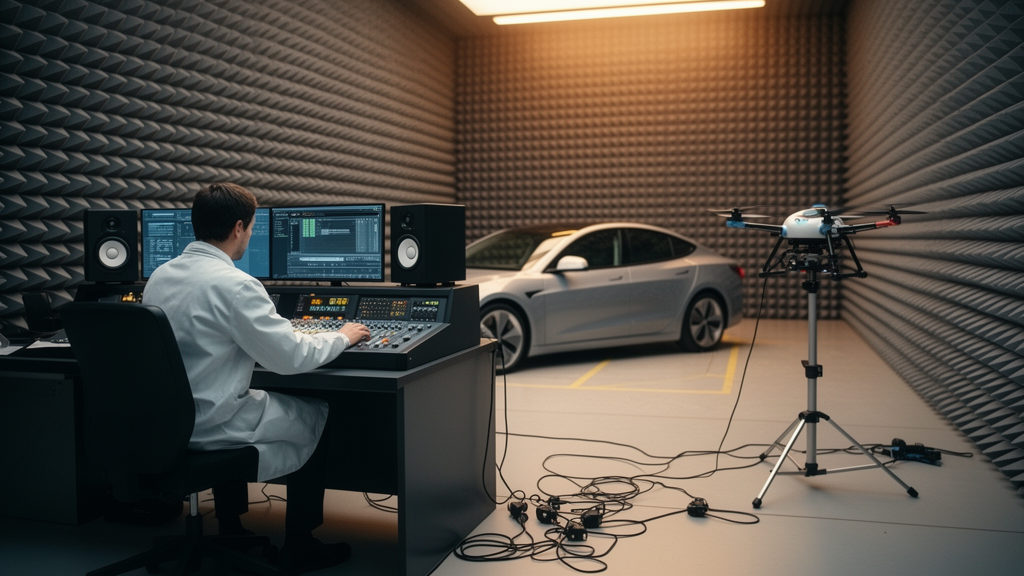
Electric mobility is quietly rewriting the acoustic character of everyday life. As electrified road vehicles replace combustion engines and as advanced air mobility (AAM) concepts—delivery drones, air taxis, and other unmanned aircraft—move from prototypes toward routine operation, the sounds that populate streets and skies are changing faster than the methods used to describe them. A new editorial published in Frontiers in Acoustics argues that this transformation demands a fundamentally different approach to engineering design, one that places human perception at the center of the process rather than treating it as an afterthought. The authors, Antonio J. Torija of the Salford Acoustics Innovation Institute, Siddhartha Krishnamurthy of NASA Langley Research Center, and Roberto Merino-Martinez of Delft University of Technology, call this approach perception-driven acoustic engineering.
The core idea is deceptively simple: sound quality is not a byproduct of engineering but a design target in its own right. Perception-driven engineering, a concept first articulated by Davies in 2007, integrates human response directly into product and system design. As a structured methodology, it combines three interlocking stages—sound acquisition, sound evaluation, and design implementation—while explicitly quantifying acoustic and human factors alongside conventional engineering parameters such as mass, efficiency, and cost. The approach has gained particular traction in aircraft design, where community noise has long constrained operations, but the editorial argues that the shift to electric propulsion makes it indispensable across the entire transportation sector.
The reason is physical as much as psychological. Electric powertrains eliminate the dominant low-frequency rumble and broadband roar of combustion engines, exposing tonal whines from inverters, gear meshes, and cooling systems that were previously masked. In the air, rotor and propeller noise from unmanned aircraft introduces spectral and temporal signatures unlike anything communities have historically encountered. Conventional single-number metrics such as A-weighted sound pressure level, developed for an earlier acoustic era, struggle to capture how these new sounds are actually experienced. The editorial’s central theme is that human response emerges from a combination of acoustic and non-acoustic influences, and that engineering methods must account for these interacting factors explicitly rather than assuming loudness tells the whole story.
That principle is vividly illustrated by one of the studies gathered in the Research Topic. Woodcock and colleagues examined annoyance responses to the sound of a medical-delivery drone under varying operational and contextual conditions. Their findings reveal a layered picture: annoyance decreased as the distance between listener and drone increased, and it rose in quieter ambient environments where the aircraft stood out against the soundscape. But the most striking result concerned context. When participants were told the drone was being used for medical deliveries, their reported annoyance dropped significantly—even though the physical sound reaching their ears was identical. Perceived purpose, in other words, modulates noise response just as powerfully as acoustic mitigation does.
The implications ripple outward. The authors conclude that drone and AAM integration must be socio-acoustically informed, pairing acoustic design and operational planning with communication strategies that shape how communities interpret new sounds. For operators, this means that community engagement is not a public-relations garnish but an engineering variable with measurable effect. For regulators, it suggests that noise policy for emerging aerial mobility cannot rely on sound level limits alone; it must also consider what people are told about the vehicles overhead and how those narratives interact with the acoustic environment. A quieter drone flown without explanation may generate more complaint than a slightly louder one framed as delivering urgent medical supplies.
A second strand of the Research Topic tackles a stubborn measurement problem: how to capture perception in ways that fit within practical design cycles. Münder and colleagues argue that evaluating the acoustic experience of electric vehicles requires accounting for the time-varying nature of the signals themselves. An acceleration event is not a static sound but a perceptual episode with internal structure—a sequence of tonal rises, masking shifts, and transient events that unfold over seconds. To capture this, the team employed the Continuous Evaluation Procedure (CEP), in which participants provide moment-by-moment judgments while listening to accelerating electric vehicles in an immersive simulator.
The results were revealing. CEP uncovered time-dependent patterns in perceived quality and annoyance that conventional single-value ratings simply missed—phases within an acceleration where annoyance spiked or quality dipped, invisible when the entire event is collapsed into one number. The authors recommend systematic adoption of continuous evaluation for transient acoustic events, and their work offers a practical bridge between psychoacoustics and engineering validation. For designers, this means it becomes possible to identify and control specific undesirable perceptual phases within an operational sequence—say, a jarring tonal transition two seconds into a launch—rather than tuning the vehicle against a single aggregate score.
Efficiency is the third pillar. Benghanem and colleagues addressed the need for fast, reliable prediction of perceptual attributes by developing objective models for sensory qualities and desire-to-buy judgments of recreational vehicles. Rather than deploying heavyweight machine learning, they used parsimonious multiple linear regression methods—Lasso and Elastic Net, regularization techniques that shrink and select variables to prevent overfitting. Their models were trained on combinations of standard engineering and psychoacoustic metrics together with descriptors borrowed from Music Information Retrieval (MIR) feature extraction, a field that has spent decades quantifying texture, roughness, and timbre in audio signals.
The outcome demonstrates that compact linear models can reliably represent the full set of perceptual attributes, including desire-to-buy, while relying on only a small number of physical and psychophysical predictors. This is more than a computational convenience. It reinforces a message aligned with Industry 5.0 goals: perception-driven design can link perceptual targets such as softness, aggressiveness, and perceived power to a manageable set of metrics, giving engineers actionable guidance without requiring opaque black-box models. A brand team can specify a desired character for a vehicle’s sound, and the model can trace that character back to the physical parameters that produce it.
The Research Topic also insists that perception-driven engineering operate within wider governance, health, and equity contexts, particularly as new aerial mobility vehicles introduce novel noise exposure patterns with implications for public health and fairness. Lavia and colleagues propose a transdisciplinary Sound, Noise and Health Conceptual Framework aimed at supporting fair and equitable dispersion of aircraft operations. By embedding dispersion and impact management within a structure that integrates stakeholder engagement and non-acoustic moderators, they show how perception-driven acoustics can support policy decisions—shifting the focus from narrow sound level-based optimization toward broader considerations of health, equity, and contextual response. This contribution is especially important for future AAM systems, where routing, scheduling, and operational concepts may evolve faster than community responses can be measured, leaving regulators to manage impacts they cannot yet fully quantify.
Looking ahead, the editorial identifies an emerging consensus about where the field must go. Continued expansion of electric mobility and autonomous systems will only increase the complexity of future soundscapes, and progress will depend on simplified, interpretable models that accurately link physical design parameters to perceived sound quality; advances in auralisation and psychoacoustic modelling that let designers listen to a vehicle before it exists; clearer definitions of key performance indicators to guide optimization; and evaluation methods that integrate contextual and societal factors alongside physical measurements. The stakes extend beyond technical performance. As the editorial frames it, acoustic design must ultimately serve human experience and community wellbeing—a recognition that the sound of the electric future is not something that happens to us, but something we can deliberately shape.
Subject of Research: Perception-driven acoustic engineering for electric mobility and advanced air mobility
Article Title: Editorial: perception-driven acoustic engineering
Article References: Torija, A. J., Krishnamurthy, S., & Merino-Martinez, R. (2026). Editorial: perception-driven acoustic engineering. Frontiers in Acoustics, 4, Article 1802446. https://doi.org/10.3389/facou.2026.1802446
Image Credits: AI Generated
DOI: 10.3389/facou.2026.1802446
Keywords: acoustics, psychoacoustics, advanced air mobility, electric vehicles, drone noise, noise annoyance, sound perception, engineering design, auralisation, noise control, soundscape, community engagement
Cite Scienmag News
Denise Maddox. (October 16, 2026). Why the Sound of Electric Cars and Drones Is Now Engineered Around Human Perception. Scienmag. https://scienmag.com/why-the-sound-of-electric-cars-and-drones-is-now-engineered-around-human-perception/
Denise Maddox. "Why the Sound of Electric Cars and Drones Is Now Engineered Around Human Perception." Scienmag, 16 October 2026, https://scienmag.com/why-the-sound-of-electric-cars-and-drones-is-now-engineered-around-human-perception/. Accessed 16 October 2026.
Denise Maddox. "Why the Sound of Electric Cars and Drones Is Now Engineered Around Human Perception." Scienmag. October 16, 2026. https://scienmag.com/why-the-sound-of-electric-cars-and-drones-is-now-engineered-around-human-perception/


