


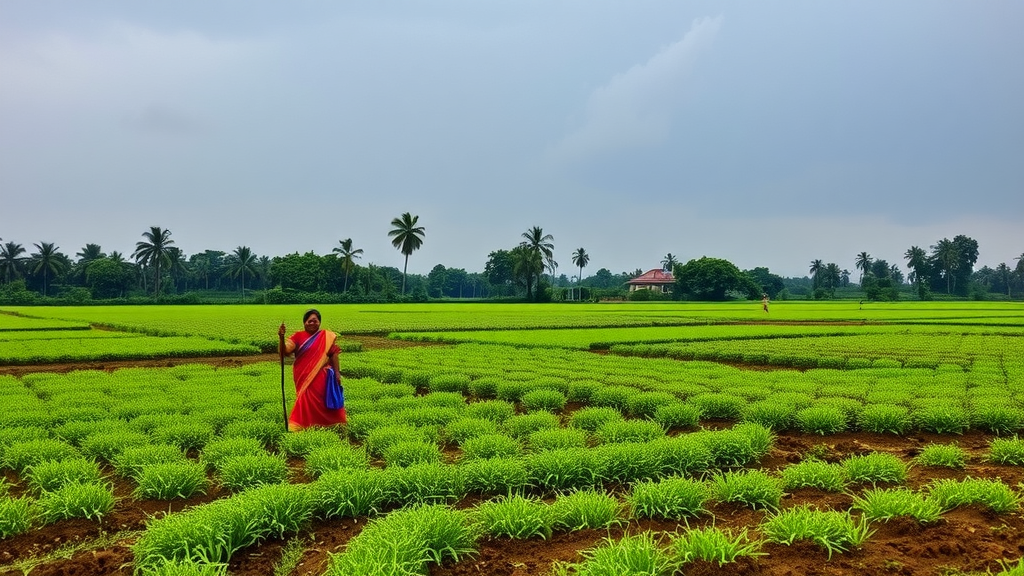
Across the wheat, rice, and mustard fields of Lucknow district in northern India, the soil beneath farmers’ feet is not a static foundation but a shifting, seasonal system. A two-year study of agricultural soils in this corner of the Indo-Gangetic Plain has now documented, in unusually fine detail, how the dramatic swings between monsoon downpours and dry pre-monsoon heat rewrite the physical and chemical character of the region’s farmland. The findings, published in the journal Discover Soil, carry weighty implications for the roughly 21 percent of the district’s population that depends on agriculture, and for the food security of a plain that feeds hundreds of millions.
The research team, led by Nistha Khanna of Mizoram University together with colleagues from Nagaland University and O.P. Jindal Global University, sampled soils from six agricultural sites spread across six of Lucknow district’s eight administrative blocks between 2023 and 2025. Sampling was conducted three times each year: in April and May before the monsoon, in June and July during the monsoon itself, and in October and November after the rains had passed. At each site, soils were drawn from two depths, 0 to 15 centimeters and 15 to 30 centimeters, using a soil corer, then brought to the laboratory for analysis using long-established techniques, including the Walkley and Black titration for organic carbon and the Bray and Kurtz extraction for available phosphorus.
The region receives an average of 896 millimeters of rainfall annually, almost all of it delivered by the southwest monsoon between June and October. This single hydrological pulse, the researchers hypothesized, would leave a measurable fingerprint on nearly every property of the soil. Their hypothesis was largely confirmed. Textures shifted across seasons: pre-monsoon samples mixed sandy clay loam, clay loam, and loam, while monsoon samples were dominated by clay loam and loam, and post-monsoon samples leaned toward sandy clay loam and sandy clay. On average, the soils contained about 45 percent sand, 30 percent clay, and 25 percent silt.
Statistical analysis using linear mixed models revealed that the seasonal signal was strongest for the coarse and fine mineral fractions themselves. Sand content varied dramatically with season, and clay content did likewise, both with p-values below 0.001, an indication that the monsoon physically redistributes particles through percolation and structural change. Soil organic carbon and organic matter also fluctuated strongly across seasons, peaking in the pre-monsoon and post-monsoon periods and dipping during the rains. Soil moisture content and available potassium likewise changed significantly from season to season, while soil pH, bulk density, available nitrogen, available phosphorus, water-holding capacity, and silt content remained comparatively stable.
The measured nutrient levels told a generally encouraging story. Available nitrogen was high across all sites, ranging from 102.23 to 396.08 kilograms per hectare, with the highest value recorded at Site S5 in the surface layer after the monsoon, a pattern the authors attribute to enhanced microbial mineralization of organic matter once the rains replenish soil moisture. Available potassium ranged from 125 to 300 kilograms per hectare and tended to be slightly higher after the monsoon, while available phosphorus spanned 7.53 to 34.3 kilograms per hectare. Soil pH remained in a near-ideal window for nutrient uptake, between 6.5 and 8.12, and average soil organic carbon stood at about 2.5 percent, a level many degraded Indo-Gangetic soils no longer reach.
Correlation analysis added texture to the picture. Soil organic carbon correlated positively with sand content and negatively with clay, suggesting that the coarser soils in the study area may accumulate organic matter more readily, perhaps because better aeration and drainage support microbial litter processing. Phosphorus and potassium moved together closely, hinting at shared geochemical controls, while the negative relationship between silt and pH pointed to subtle acidification tendencies in finer sediments.
To distill this tangle of interacting variables, the team employed principal component analysis, a multivariate technique that compresses correlated measurements into a few independent axes of variation. The first three components accounted for the largest shares of the dataset’s variance, at 29.6, 20.7, and 11.9 percent respectively, and the first five components together explained 79.3 percent. The dominant gradient, the first component, contrasted clay-dominated soils with sandy, organic-rich ones, while the second captured a nutrient-moisture axis that separated fertile, wet soils from comparatively depleted ones. In plain terms, the fate of a Lucknow field is governed first by its texture and organic matter, and second by how water and nutrients travel through it.
Why does this matter beyond the district boundary? The rice-wheat-mustard rotation that dominates Lucknow’s farmland extracts nutrients continuously throughout the year, and flooded rice cultivation alters soil redox chemistry in ways that reshape nitrogen and phosphorus dynamics. Continuous fertilizer application without soil testing, the authors note, frequently produces nutrient imbalances, declining organic carbon, and wasteful nutrient use. By mapping how fertility indicators swing with the seasons, the study gives farmers and policymakers a timing framework: post-monsoon mineralization offers a natural nitrogen flush, potassium availability improves after the rains, and organic carbon conservation efforts are best judged against seasonal baselines rather than single snapshots.
The study is not without limits. The authors acknowledge that environmental drivers such as rainfall intensity and microbial activity, which likely mediate many of the observed seasonal shifts, were not directly measured. Nor does the two-year window capture longer climatic oscillations. Still, by combining principal component analysis with linear mixed models, a methodological pairing rarely applied to seasonal soil data in this district, the work provides something previous single-season surveys could not: a statistically grounded picture of soil as a living, breathing system that inhales with the monsoon and exhales through the dry months. The researchers suggest that season-sensitive management, periodic organic inputs, moisture conservation, and balanced nutrition, will be essential to keeping these soils productive for generations to come.
For the farmers of Lucknow district, whose average land holdings are barely 0.8 hectares, the message is both practical and hopeful. Their soils, the study concludes, retain a moderate to good fertility and a strong capacity for long-term management. The monsoon that floods their paddies and sows their wheat is the same force that reorganizes their soil each year, and understanding that rhythm may prove to be one of the cheapest tools available for sustaining the harvest.
Subject of Research: Seasonal variation in the physicochemical properties of agricultural soils in Lucknow district, Uttar Pradesh, India
Article Title: Seasonal variation in physicochemical properties of some agricultural soils in Lucknow district, Uttar Pradesh of India
Article References: Khanna, N., Lalruatkimi, C., Devi, K. B., Adam, A. A., Yam, G., & Tripathi, O. P. (2026). Seasonal variation in physicochemical properties of some agricultural soils in Lucknow district, Uttar Pradesh of India. Discover Soil, 3(1), Article 147. https://doi.org/10.1007/s44378-026-00302-0
Image Credits: AI Generated
DOI: 10.1007/s44378-026-00302-0
Keywords: soil science, Indo-Gangetic Plain, seasonal variation, soil fertility, soil organic carbon, monsoon, principal component analysis, linear mixed models, sustainable agriculture, Uttar Pradesh, nutrient management, soil texture
Cite Scienmag News
Alan Morgan. (September 12, 2026). Monsoon Rhythms Reshape the Fertility of India’s Crucial Farming Soils. Scienmag. https://scienmag.com/monsoon-rhythms-reshape-the-fertility-of-indias-crucial-farming-soils/
Alan Morgan. "Monsoon Rhythms Reshape the Fertility of India’s Crucial Farming Soils." Scienmag, 12 September 2026, https://scienmag.com/monsoon-rhythms-reshape-the-fertility-of-indias-crucial-farming-soils/. Accessed 4 October 2026.
Alan Morgan. "Monsoon Rhythms Reshape the Fertility of India’s Crucial Farming Soils." Scienmag. September 12, 2026. https://scienmag.com/monsoon-rhythms-reshape-the-fertility-of-indias-crucial-farming-soils/


