


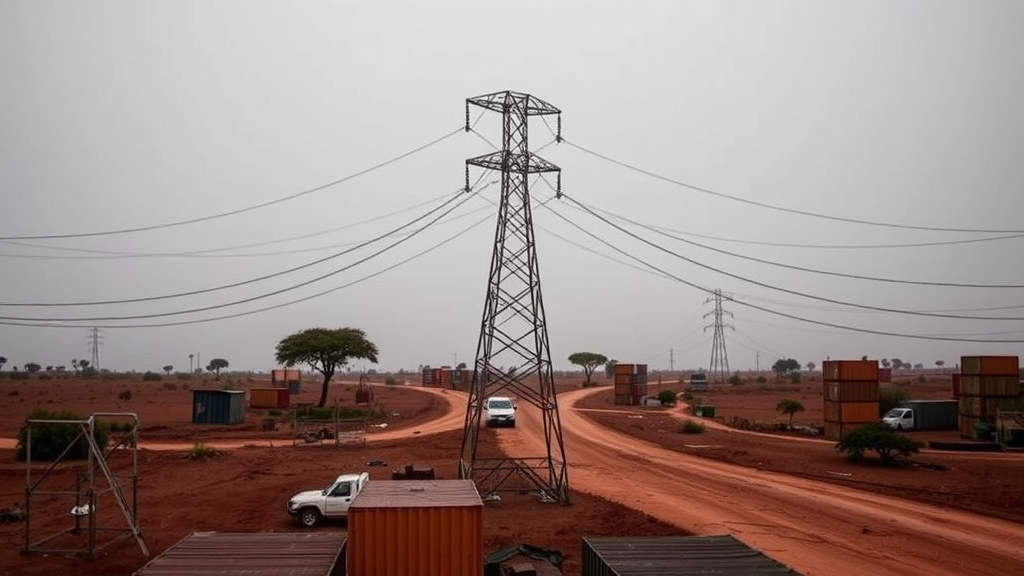
Africa’s electricity systems are entering a period in which the political risks attached to cross-border power trades are set to intensify over the near term, according to new research published in Nature Communications. The study, which examines the exposure of power trading arrangements across the African continent to political risk, arrives at a moment when regional electricity markets are expanding faster than the governance structures designed to protect them. As countries increasingly rely on their neighbors for reliable and affordable electricity, the researchers find that the vulnerabilities embedded in these arrangements are growing rather than receding.
Cross-border electricity trade has long been promoted as one of the most practical pathways toward universal energy access in Africa. Regional power pools, including the Southern African Power Pool, the West African Power Pool, the Eastern Africa Power Pool and the Central African Power Pool, were established to allow member countries to exchange electricity, smooth out seasonal imbalances and exploit complementary generation resources. Hydropower-rich nations can export surplus generation during wet seasons, while countries with thermal or solar advantages can supply power when their neighbors face shortfalls. In principle, this interdependence lowers costs, improves reliability and accelerates the integration of renewable energy into continental grids.
The new analysis suggests that this interdependence carries a political dimension that has been underappreciated in energy planning. When electricity flows across national borders, the security of supply depends not only on physical infrastructure and hydrological conditions but also on the stability of diplomatic relations, the credibility of contractual commitments and the domestic political circumstances of the trading partners. A transmission interconnector is only as reliable as the political willingness of both ends to keep it operating. The researchers characterize this as political risk: the possibility that political events, decisions or instability within or between countries will disrupt the expected benefits of power trades.
What distinguishes the study’s central finding is its temporal claim. Rather than treating political risk as a static background condition, the authors assess how exposure to such risk is likely to evolve in the near term. Their results indicate that exposure is set to increase for African power trades, meaning that a growing share of planned and existing electricity exchanges will be linked to countries or corridors where political conditions could plausibly interfere with trade. This near-term horizon matters for planners and investors, because decisions made today about interconnectors, generation projects and power purchase agreements will mature precisely during the period in which the researchers find risk to be rising.
The mechanisms behind this increasing exposure are rooted in the geography of Africa’s energy transition. Many of the continent’s most ambitious generation projects are large hydropower dams situated on transboundary rivers, and many of the newest interconnector projects cross regions that have experienced contested elections, border disputes, coups or civil conflict. As trade volumes grow, more electricity is routed through corridors that pass through or depend on politically fragile territory. The study’s framework captures this compounding effect: expansion of trade increases the number of politically sensitive links, and each additional link raises the aggregate exposure of the system even if the risk attached to any single link remains unchanged.
Political risk in power trading manifests in several distinct forms. At the most direct level, armed conflict or political violence can damage transmission infrastructure, force the suspension of cross-border flows or render corridors unsafe for maintenance crews. At a second level, government turnover can lead to the renegotiation or repudiation of power purchase agreements, changes in regulated tariffs or the imposition of export restrictions during domestic shortages. At a third level, broader macroeconomic and currency instability can undermine the financial viability of trade contracts, since electricity sales denominated in foreign currency become harder to settle when local currencies depreciate. Each of these channels can convert a politically routine event into a disruption of electricity supply hundreds or thousands of kilometers away.
The researchers emphasize that these risks are not evenly distributed. Some regional power pools operate in environments with comparatively stable institutions and established dispute-resolution mechanisms, while others span borders where such mechanisms are weak or untested. The study’s mapping of political risk onto trading relationships reveals that certain countries function as critical nodes: they occupy positions in the network where multiple trades converge, so political disruption within a single state can propagate through several bilateral arrangements simultaneously. This network perspective shifts the analytical focus from individual country risk assessments to the structure of the trading system as a whole, highlighting how connectivity that delivers efficiency in normal conditions can also transmit shocks in disturbed ones.
For investors and development finance institutions, the findings carry practical implications. Independent power producers and lenders already apply country risk premiums when pricing projects in politically uncertain environments, but the study suggests that these premiums may understate the risk borne specifically by cross-border trades, which layer international political exposure on top of domestic risk. Insurance products covering political violence and contract frustration exist, yet coverage for the particular configuration of risks in regional power pools remains limited. The authors’ near-term projection of increased exposure implies that the window for strengthening contractual safeguards, diversifying trade routes and building institutional capacity is narrower than many current planning documents assume.
The research also speaks to the design of regional institutions. Power pools that have developed standardized trading rules, transparent scheduling procedures and credible mechanisms for settling disputes between members provide a buffer against political interference, because they make defection from agreed arrangements more visible and more costly. The study’s results underscore the value of such institutions precisely where they are hardest to build. Strengthening them, the analysis implies, is not merely an administrative nicety but a form of risk management that directly protects the reliability of electricity supply for millions of people who depend on imported power.
Ultimately, the study reframes a familiar optimism about Africa’s energy future. Regional electricity trade remains one of the most promising tools for expanding access, integrating renewables and lowering costs across the continent, and nothing in the findings suggests that this promise has diminished. What the research makes clear is that the political foundations of that trade deserve the same analytical attention as its engineering and economics. As the near-term horizon brings increased exposure to political risk, the durability of Africa’s power trades will depend on whether the institutions, contracts and diplomatic relationships underpinning them can evolve as quickly as the infrastructure itself.
Subject of Research: Near-term political risk exposure of cross-border electricity trade in Africa
Article Title: Near-term increased exposure to political risk for African power trades
Article References: Bonserio, T., Carlino, A., Giuliani, M., & Castelletti, A. (2026). Near-term increased exposure to political risk for African power trades. Nature Communications. https://doi.org/10.1038/s41467-026-77362-x
Image Credits: AI Generated
DOI: 10.1038/s41467-026-77362-x
Keywords: political risk, Africa, electricity trade, regional power pools, energy security, transmission interconnectors, hydropower, energy transition, investment risk, grid integration, Nature Communications, energy policy
Cite Scienmag News
Faith Mcneil. (September 12, 2026). Political Risk Looms Larger for Africa’s Cross-Border Power Trade. Scienmag. https://scienmag.com/political-risk-looms-larger-for-africas-cross-border-power-trade/
Faith Mcneil. "Political Risk Looms Larger for Africa’s Cross-Border Power Trade." Scienmag, 12 September 2026, https://scienmag.com/political-risk-looms-larger-for-africas-cross-border-power-trade/. Accessed 5 October 2026.
Faith Mcneil. "Political Risk Looms Larger for Africa’s Cross-Border Power Trade." Scienmag. September 12, 2026. https://scienmag.com/political-risk-looms-larger-for-africas-cross-border-power-trade/


