


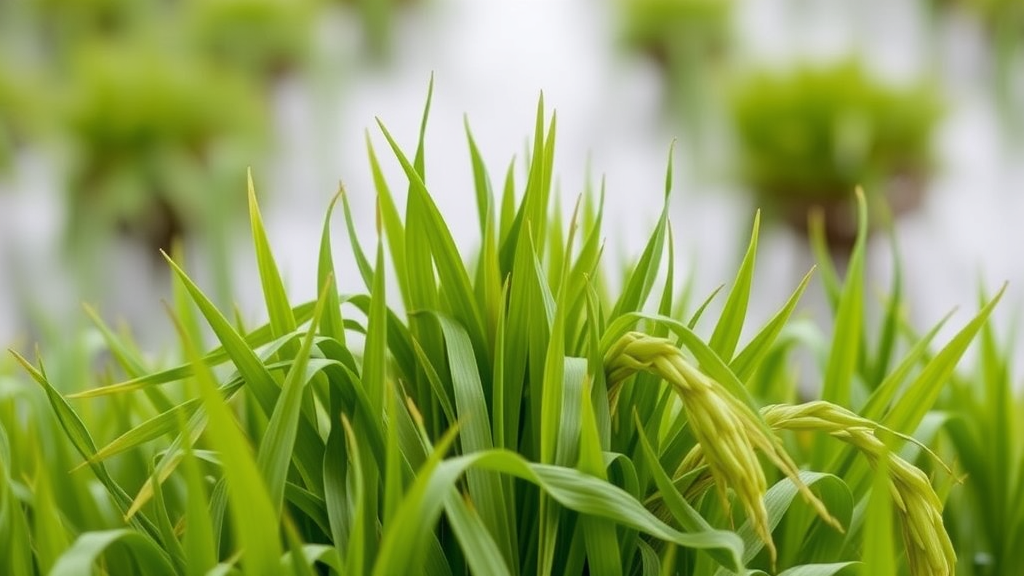
A weed that rice farmers have long regarded as little more than a nuisance for yield and herbicide budgets has now been caught playing a far more consequential role in the field. Chinese sprangletop (Leptochloa chinensis), a fast-colonizing grass that thrives in rice paddies across Asia, has been identified as a previously unrecognized natural host of southern rice black-streaked dwarf virus (SRBSDV), one of the most destructive viral pathogens of rice. The discovery, reported in the journal Crop Health, shows that the virus can replicate quietly inside this weed at low levels without causing any visible symptoms, and that planthopper insects can pick the virus up from the weed and pass it on to rice seedlings. The finding adds a critical missing link to the epidemiology of a disease that has devastated rice harvests in southern China and neighboring countries since it first emerged.
SRBSDV is a member of the genus Fijivirus in the family Spinareoviridae, carrying a segmented genome of ten double-stranded RNA segments that encode both structural and non-structural proteins. First identified in China in 2008, the virus causes stunted growth, leaf curling, and the formation of white to dark brown waxy protrusions along the stems of infected rice plants, symptoms that translate into substantial yield losses. Its transmission depends on the white-backed planthopper (Sogatella furcifera, WBPH), which acquires the virus in a persistent manner and carries it between plants. Because the insect feeds on a wide range of grasses in the Poaceae family, rotating among rice, maize, Chinese sorghum, and assorted weeds across cropping seasons, plant virologists have long suspected that unsown grasses could serve as viral reservoirs that bridge the gap between one rice crop and the next. What has been missing is direct molecular evidence that a common paddy weed actually harbors infectious SRBSDV in the field.
The trail began in August 2024, when researchers surveying rice paddies affected by SRBSDV in Huzhou, in China’s Zhejiang Province, noticed L. chinensis plants growing abundantly within infected fields. The team collected seven grass weed specimens at random and brought them back to the laboratory. To confirm the identity of the plants, the researchers extracted genomic DNA and sequenced the internal transcribed spacer (ITS) region, a standard DNA barcode for plant species identification. BLAST analysis showed that the sequences matched the reference L. chinensis sequence in GenBank with 100 percent identity, removing any taxonomic ambiguity about what the team had collected.
Virus testing followed. The researchers extracted total RNA from all seven plants and ran reverse transcription polymerase chain reaction (RT-PCR) assays targeting the viral S10 segment, which encodes the coat protein. Five of the seven samples, an infection rate of 71 percent, tested positive for SRBSDV, and Sanger sequencing of the amplified products confirmed the result. The high proportion of infected weeds, found in a field where the plants grew side by side with symptomatic rice, strongly suggested that L. chinensis is not an incidental victim of viral spillover but a genuine natural host capable of maintaining the virus in the agroecosystem.
To characterize the infection in detail, the team turned to transcriptome sequencing and small RNA profiling of the virus-positive weeds. Transcriptome data confirmed the presence of all ten viral genomic segments, but the sequencing depth was low, with average coverage below tenfold, pointing to restricted viral transcriptional activity inside the weed. Small RNA sequencing told a complementary story: the weed was producing virus-derived small interfering RNAs (vsiRNAs) that peaked at 21 to 22 nucleotides in length, a signature of dicer-mediated processing that mirrors the antiviral RNA interference response previously documented in infected rice. The presence of these vsiRNAs indicates that the virus is actively replicating in the weed and that the plant’s RNAi machinery is engaged in fighting it, even though the plant shows no symptoms.
Quantitative measurements reinforced the picture of a low-level but authentic infection. Quantitative RT-PCR targeting the S10 segment revealed that viral accumulation in L. chinensis reached about 1.14 × 10⁴ copies per microgram of total RNA, roughly an order of magnitude lower than the 1.34 × 10⁵ copies per microgram measured in infected rice, a statistically significant difference. Transmission electron microscopy then provided the most direct evidence of all: scattered double-layered spherical virions of roughly 70 nanometers in diameter, morphologically characteristic of SRBSDV, were observed in the phloem cells of the weed’s asymptomatic leaves. Together, the genomic, small RNA, and ultrastructural data demonstrate that SRBSDV establishes a persistent, low-titer, symptomless infection in Chinese sprangletop.
Genome comparisons added an evolutionary dimension to the finding. The team sequenced the full-length S1 segment, which encodes the viral RNA-dependent RNA polymerase (RdRP), from both the weed and rice isolates collected in the same Huzhou fields. The weed-derived sequence, deposited in GenBank under accession PV636942, showed 99.78 percent nucleotide identity with the NCBI reference genome and 99.76 percent identity with the co-localized rice isolates. Eleven nucleotide differences separated the weed and rice viral populations, five of which were nonsynonymous substitutions that altered amino acids. Because these differences were consistently detected across all clones and biological replicates, the researchers concluded that they represent genuine biological variation rather than PCR artifacts, suggesting modest host-specific adaptation of the RdRP gene that has not compromised the virus’s ability to move between hosts.
The decisive question was whether the virus harbored in the weed remains infectious and transmissible. To answer it, the researchers prepared a crude viral extract from infected L. chinensis leaves and microinjected it into SRBSDV-free white-backed planthopper nymphs reared under controlled laboratory conditions. Eight days after injection, RT-PCR detected SRBSDV in 40 percent of the injected insects, confirming that the virus acquired from the weed could establish itself in its vector. The injected planthoppers were then allowed to feed on susceptible rice seedlings for four days, and 15 days later, 35.7 percent of the exposed rice plants tested positive for SRBSDV. In a parallel experiment, infected planthoppers were fed on healthy L. chinensis seedlings, and 25 percent of those seedlings subsequently became infected, demonstrating that the weed can also acquire the virus through normal insect feeding.
The authors are careful to note the limits of the microinjection approach, which bypasses the midgut barrier that planthoppers must negotiate during natural feeding. Even so, the experiments serve as a critical proof of concept: the virus sequestered in this weed remains biologically potent, capable of infecting both its insect vector and the rice crop. The team argues that several ecological factors compensate for the low viral titer measured in individual weeds. L. chinensis often grows at very high densities around and within rice paddies, multiplying the number of potential infection foci. It shares habitat intimately with the WBPH vector throughout the season. And it can itself be infected by viruliferous insects, closing the loop on a weed-vector-weed cycle that can persist independently of rice.
The epidemiological implications reach well beyond a single weed species. Current SRBSDV management focuses on controlling the planthopper vector and removing symptomatic rice plants, strategies that leave cryptic reservoirs such as L. chinensis untouched. The researchers propose that integrated approaches combining weed eradication with the disruption of vector-weed interactions could substantially reduce viral carryover between cropping seasons, much as weed management has proven important for other plant virus systems. They also point to the evolutionary flexibility revealed by the RdRP sequence divergence as evidence that SRBSDV can adapt across Poaceae hosts without losing transmissibility, underscoring the need for continued surveillance. Future work, the team says, should screen additional Poaceae weeds for SRBSDV, identify the molecular drivers of viral host adaptation, and test the field-level efficacy of weed control in suppressing outbreaks. For rice farmers across Asia, the message is that the grasses they fight for yield reasons may also be quietly keeping a dangerous virus alive between seasons, and that winning the battle against SRBSDV may require winning the battle against the weeds.
Subject of Research: Identification of Leptochloa chinensis as a new reservoir host of southern rice black-streaked dwarf virus
Article Title: Leptochloa chinensis identified as a new reservoir host of southern rice black-streaked dwarf virus
Article References: Ren, P., Lei, J., Qi, Y., Chen, M., Ye, Z., Chen, Z., Chen, J., Zhang, C., Li, J., Wu, J., & Mao, Q. (2026). Leptochloa chinensis identified as a new reservoir host of southern rice black-streaked dwarf virus. Crop Health, 4(1), Article 17. https://doi.org/10.1007/s44297-026-00079-2
Image Credits: AI Generated
DOI: 10.1007/s44297-026-00079-2
Keywords: southern rice black-streaked dwarf virus, Leptochloa chinensis, Sogatella furcifera, reservoir host, rice, plant virus, white-backed planthopper, vsiRNAs, weed management, Fijivirus, epidemiology, RdRP
Cite Scienmag News
Alan Morgan. (September 12, 2026). Common Rice Field Weed Revealed as Hidden Reservoir of Devastating Dwarf Virus. Scienmag. https://scienmag.com/common-rice-field-weed-revealed-as-hidden-reservoir-of-devastating-dwarf-virus/
Alan Morgan. "Common Rice Field Weed Revealed as Hidden Reservoir of Devastating Dwarf Virus." Scienmag, 12 September 2026, https://scienmag.com/common-rice-field-weed-revealed-as-hidden-reservoir-of-devastating-dwarf-virus/. Accessed 5 October 2026.
Alan Morgan. "Common Rice Field Weed Revealed as Hidden Reservoir of Devastating Dwarf Virus." Scienmag. September 12, 2026. https://scienmag.com/common-rice-field-weed-revealed-as-hidden-reservoir-of-devastating-dwarf-virus/


