


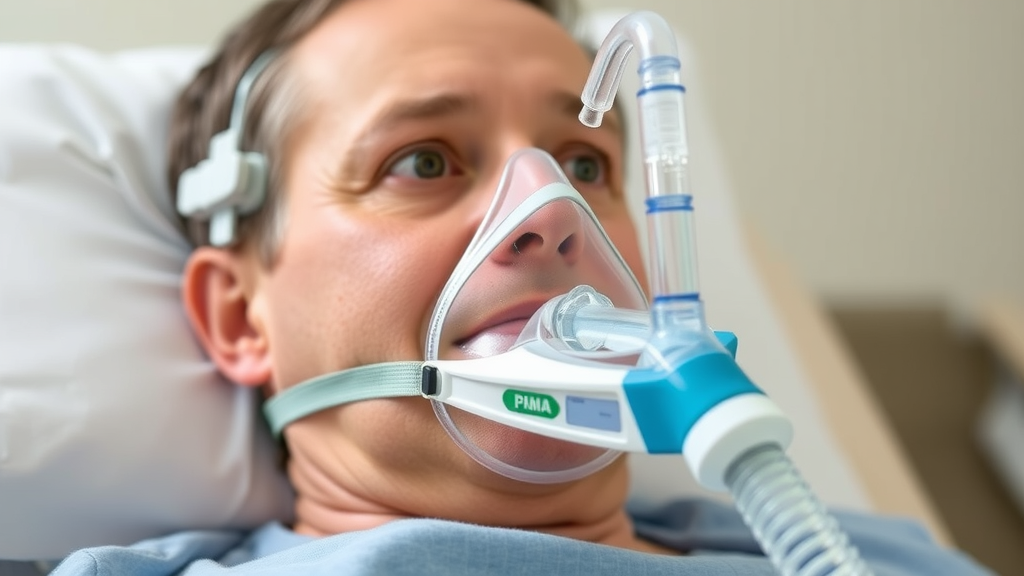
For people living with amyotrophic lateral sclerosis, the slow failure of the muscles that control breathing is the disease’s most feared complication. Non-invasive ventilation, delivered through a snugly fitted mask, has long been the standard of care, offering a documented survival benefit of roughly 205 days and meaningful improvements in quality of life. Yet a substantial share of ALS patients simply cannot live with the mask. Interface discomfort, claustrophobia, thick respiratory secretions, swallowing difficulties, and problems maintaining a seal all conspire to make non-invasive ventilation intolerable, leaving patients and clinicians with few options short of invasive tracheostomy, a step freighted with ethical, clinical, and quality-of-life consequences. A new retrospective case series published in Respirology Case Reports now offers the most detailed real-world picture to date of what happens when these patients are switched to a quieter, gentler alternative: high-flow nasal cannula therapy delivered at home.
High-flow nasal cannula is a deceptively simple piece of technology. Instead of a mask covering the nose and mouth, heated, fully humidified gas is delivered through a wide-bore nasal interface at flow rates of up to 60 liters per minute, with the fraction of inspired oxygen adjusted to the patient’s needs. The therapy provides several physiological advantages: it generates low levels of positive airway pressure, flushes carbon dioxide out of the upper airway’s anatomical dead space, reduces the work of breathing, and improves clearance of secretions. Because it leaves the mouth free, patients can talk, eat, and drink while receiving support, and the open nasal interface dramatically reduces the claustrophobia and skin breakdown that plague mask users. Evidence in other neuromuscular diseases has hinted that patients tolerate it better than conventional ventilation, but data specific to ALS have been scarce, largely confined to small observational studies from high-income tertiary centers at moderate altitudes.
The new study, conducted by a multidisciplinary home respiratory care team, followed 18 ALS patients enrolled between January 2014 and December 2024 in a specialized home care program for neuromuscular disease. All had confirmed ALS, evidence of chronic respiratory failure, and clinician-documented intolerance to non-invasive ventilation attributable to interface problems, claustrophobia, excessive secretions, dysphagia, behavioral intolerance, or anatomical obstacles. The researchers combed electronic medical records for demographic details, comorbidities, arterial blood gas measurements, respiratory muscle strength, functional status, hospitalizations, infections, and mortality, comparing outcomes at the start of high-flow therapy with the last available follow-up.
The cohort tells its own story about how relentlessly ALS advances. The average age at which high-flow nasal cannula was initiated was 65.1 years, roughly eight years after the average age at diagnosis of 57.5. Women made up two-thirds of the group, and the mean body mass index was 23.6 kilograms per square meter. Notably, 61 percent of patients also carried a diagnosis of obstructive sleep apnea, a comorbidity that may compound ventilatory vulnerability. Comorbidities otherwise were sparse: four patients had hypertension, one had diabetes, and none had cancer, thrombotic disease, or autoimmune conditions beyond a single case of rheumatoid arthritis. These are, in other words, patients whose respiratory failure was driven by ALS itself rather than by a burden of other illness.
The pattern of intolerance to masks was revealing. In seven of the 18 cases, intolerance was partial, rooted in difficulty adapting to the interface, claustrophobic sensations, or discomfort with the delivered airflow. Six patients, about a third of the cohort, managed short periods of mask ventilation alternating with high-flow support, using the cannula for an average of about 4.7 hours daily. During the observation period, half of the patients required at least one hospitalization and a third experienced respiratory infections, rates the authors note are comparable to other ALS cohorts. Five patients, 27.8 percent, died during follow-up. The researchers are careful to frame these figures as reflections of advanced disease stage in a population that had already exhausted first-line support, rather than as failures of the high-flow strategy itself.
The physiological findings are the study’s technical core. Before starting therapy, patients showed a mean arterial pH of 7.40, a partial pressure of oxygen of 62.7 millimeters of mercury, a carbon dioxide partial pressure of 36.4 millimeters of mercury, and bicarbonate values ranging from 16 to 29 millimoles per liter. After a period on high-flow cannula, pH ticked up slightly to 7.42, oxygen pressure eased to 59.8 millimeters of mercury, carbon dioxide rose to 42.4 millimeters of mercury, and bicarbonate climbed to 27.8 millimoles per liter. None of these shifts reached statistical significance, and paired analyses confirmed wide confidence intervals spanning zero for every parameter. The authors interpret this stability as clinically meaningful: high-flow nasal cannula does not deliver enough inspiratory pressure support to raise tidal volume or reverse chronic hypercapnia the way mask ventilation can, yet in these carefully selected patients it maintained gas exchange without triggering respiratory acidosis or abrupt deterioration from carbon dioxide retention.
Functional trajectories told a starker story. The Barthel Index, a standard measure of independence in daily activities, fell by an average of 23.3 points, from 35.0 at the start of therapy to 11.7 at the final assessment, a highly significant decline driven chiefly by losses in walking and climbing stairs. The Cruz Roja Functional Classification showed the same slope: at baseline, nearly 78 percent of patients were already at Grades 3 or 4 of physical disability, and by final follow-up more than half had progressed to Grade 5, total dependence, while mild mental impairment rose from 22 percent to 39 percent of the group. Intriguingly, respiratory muscle strength did not follow suit. Maximum inspiratory and expiratory pressures remained essentially unchanged, with p-values of 0.97 and 0.76 respectively. This dissociation, the authors argue, underscores that functional decline in ALS is propelled not only by weakening respiratory muscles but by progressive limb weakness, bulbar dysfunction, and global neurological deterioration.
How do these results sit within the broader literature? The authors point to prior work in neuromuscular disease, including a study by Lionello and colleagues, that likewise documented high patient acceptance of high-flow therapy, with comfort, preserved speech and eating, and reduced claustrophobia cited as decisive advantages. One difference stands out: in that earlier study, three patients receiving continuous 24-hour high-flow support experienced treatment failure, whereas no complications directly attributable to the device were documented in the present cohort. The researchers caution that the descriptive design and small sample make this observation far from definitive, but they suggest it may reflect individualized titration of flow and oxygen and the close multidisciplinary follow-up that a dedicated home care program provides.
The study’s limitations are laid out candidly. A retrospective case series of 18 patients cannot establish causal relationships, and the absence of a comparison group prevents any direct judgment of whether high-flow cannula outperforms persisted mask use or invasive ventilation. Follow-up duration varied by patient because assessments relied on the last recorded clinical evaluation, and treatment discontinuation dates were not systematically documented. Baseline blood gases were drawn during routine care rather than a standardized protocol, so the researchers could not consistently determine whether they were obtained during mask ventilation, how much time elapsed before follow-up measurements, or how long patients had used masks before transitioning. These gaps limit the ability to characterize the longitudinal physiological effects of the therapy or to test whether prior mask exposure shaped tolerance.
Even with those caveats, the report matters for a population with few good options. It provides descriptive, real-world evidence that home-based high-flow nasal cannula is feasible in ALS patients who cannot tolerate masks, that it holds gas exchange steady despite limited ventilatory assistance, and that it may do so without device-attributable complications when embedded in structured multidisciplinary home care. The functional decline observed tracks the natural history of the disease rather than the support modality. The authors call for prospective comparative studies to define more precisely where high-flow therapy belongs in the respiratory management of ALS, but for patients facing the choice between an intolerable mask and an invasive tracheostomy, a comfortable nasal interface that buys stability may represent exactly the middle path the field has been looking for.
Subject of Research: Use of high-flow nasal cannula as home respiratory support in ALS patients intolerant to non-invasive ventilation
Article Title: Use of High‐Flow Nasal Cannula in Amyotrophic Lateral Sclerosis Patients Intolerant to Non‐Invasive Ventilation: A Case Series
Article References: Varon‐Vega, F., Franco Parra, C. E., Adame Ochoa, D. F., Uricoechea, N., Tuta‐Quintero, E., & Martinez Ayala, M. C. (2026). Use of High‐Flow Nasal Cannula in Amyotrophic Lateral Sclerosis Patients Intolerant to Non‐Invasive Ventilation: A Case Series. Respirology Case Reports, 14(9), Article e70744. https://doi.org/10.1002/rcr2.70744
Image Credits: AI Generated
DOI: 10.1002/rcr2.70744
Keywords: amyotrophic lateral sclerosis, high-flow nasal cannula, non-invasive ventilation, chronic respiratory failure, home respiratory care, arterial blood gases, ventilatory support, neuromuscular disease, Barthel Index, case series, respiratory muscle strength, bulbar dysfunction
Cite Scienmag News
Ophelia Keating. (September 12, 2026). High-Flow Nasal Cannula Emerges as Lifeline for ALS Patients Who Cannot Tolerate Ventilation Masks. Scienmag. https://scienmag.com/high-flow-nasal-cannula-emerges-as-lifeline-for-als-patients-who-cannot-tolerate-ventilation-masks/
Ophelia Keating. "High-Flow Nasal Cannula Emerges as Lifeline for ALS Patients Who Cannot Tolerate Ventilation Masks." Scienmag, 12 September 2026, https://scienmag.com/high-flow-nasal-cannula-emerges-as-lifeline-for-als-patients-who-cannot-tolerate-ventilation-masks/. Accessed 4 October 2026.
Ophelia Keating. "High-Flow Nasal Cannula Emerges as Lifeline for ALS Patients Who Cannot Tolerate Ventilation Masks." Scienmag. September 12, 2026. https://scienmag.com/high-flow-nasal-cannula-emerges-as-lifeline-for-als-patients-who-cannot-tolerate-ventilation-masks/


