


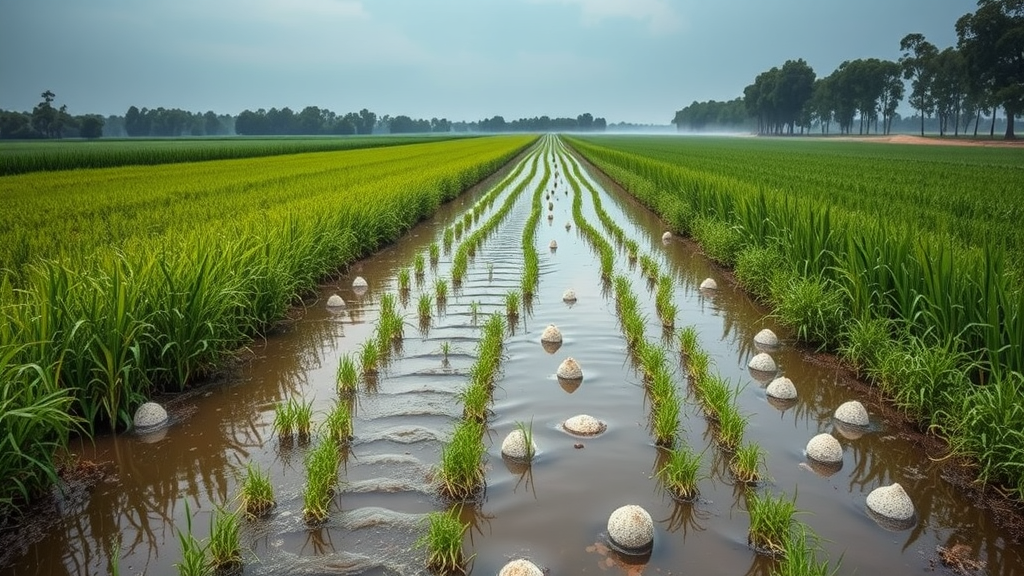
Every year, farmers around the world apply millions of tonnes of nitrogen fertilizer to their fields, and every year a large share of that nitrogen never reaches the crops it was meant to feed. Some leaches into groundwater, some runs off into rivers, and some escapes into the atmosphere as greenhouse gases. For decades, scientists studying the global agricultural nitrogen cycle have treated this lost nitrogen as a problem to be minimized. But a new global analysis published in Nature Sustainability turns the conventional picture on its head by focusing on a nitrogen source that most nutrient budgets have quietly ignored: the irrigation water itself.
The study, which presents the first comprehensive global assessment of nitrogen inputs to cropland delivered through irrigation, finds that nitrate-rich irrigation water constitutes a substantial portion of the global agricultural nitrogen budget. In regions where groundwater and surface water used for irrigation carry elevated nitrate concentrations, each pass of the irrigation system effectively fertilizes the field a second time. When that water is pumped from aquifers contaminated by decades of fertilizer use and manure application, it returns to the soil a nutrient that farmers, agronomists, and nutrient management models have been counting as lost.
The implications are striking. If irrigation water carries significant reactive nitrogen onto fields, then standard fertilizer recommendations, which are typically calibrated without accounting for this input, may systematically overestimate the amount of additional nitrogen a crop needs. Over-application of nitrogen fertilizer is not merely an economic waste; it drives a cascade of environmental harms, including nitrous oxide emissions, a greenhouse gas nearly three hundred times more potent than carbon dioxide over a century, as well as eutrophication of lakes and coastal seas and contamination of drinking water supplies. Recognizing irrigation as a nitrogen delivery pathway could therefore help close a persistent gap in nutrient accounting and reduce some of the excess.
The research team assembled a global picture by combining spatially explicit datasets on irrigation water withdrawals with measurements and model estimates of nitrogen concentrations in the water sources feeding the world’s irrigated croplands. Irrigation accounts for roughly seventy percent of global freshwater withdrawals, and the water it mobilizes comes from a wide range of origins: deep groundwater aquifers, shallow wells, rivers diverted through canal networks, and reservoirs. Each of these sources carries a different nitrogen signature. Water drawn from intensively farmed regions with shallow, nitrogen-contaminated aquifers can carry nitrate concentrations far above natural background levels, while water from pristine mountain reservoirs may carry almost none.
By mapping these concentrations against the geography of irrigated agriculture, the analysis reveals a highly uneven distribution of irrigation-borne nitrogen. Hotspots emerge in regions where high irrigation demand overlaps with nitrogen-polluted water sources, conditions that are common in parts of South Asia, northern China, the Middle East, and the intensively farmed plains of North America. In these areas, the nitrogen arriving through irrigation pipes and canals can rival or approach the magnitude of other recognized nitrogen inputs, such as atmospheric deposition or biological nitrogen fixation by legumes. In contrast, regions irrigated with clean surface water contribute far less, underscoring that irrigation nitrogen is not a uniform global background but a concentrated phenomenon tied to local hydrology and land-use history.
What makes this pathway so easy to overlook is that it is, in a sense, a feedback loop of the nitrogen cycle that humans have created. Nitrogen fertilizer applied decades ago percolated into aquifers that are now being tapped for irrigation. The water returns the legacy nitrogen to the surface, where crops take up some of it and the rest re-enters the environment. This recycling means that the true efficiency of fertilizer use is different from what conventional budgets suggest, and that the nitrogen pollution problem has a memory. Even if fertilizer application were reduced tomorrow, nitrate already stored in groundwater would continue to be pumped back onto fields, and into rivers and wells, for years to come.
The authors argue that this input should be explicitly accounted for in fertilizer application and irrigation strategies. In practice, that means nutrient management plans in irrigated regions should begin with a measurement or estimate of the nitrogen already arriving in irrigation water before calculating how much fertilizer to add. Precision agriculture tools, soil and water testing, and variable-rate fertilizer application could all be adapted to credit the irrigation input. In some settings, farmers might reduce synthetic fertilizer rates meaningfully without any yield penalty, saving money and cutting the surplus nitrogen that drives pollution. In others, where irrigation water is clean, the correction would be small, but the accounting would still be more honest.
The findings also carry weight for global environmental models. Earth system models and nutrient budget assessments used by international assessments, including those tracking humanity’s disruption of the nitrogen cycle, have historically treated irrigation as a water flux rather than a nutrient flux. Incorporating irrigation-borne nitrogen could change estimates of nitrogen use efficiency at regional and global scales, alter projections of future nitrous oxide emissions, and refine the baselines used to evaluate whether countries and farming systems are making progress toward sustainable nitrogen management. Because irrigated agriculture produces a disproportionate share of the world’s food, getting its nitrogen accounting right matters for food security as well as for the environment.
There are also practical challenges ahead. Nitrate concentrations in irrigation water vary seasonally and with pumping depth, and many farming regions lack systematic monitoring of the water they apply. Building reliable global and national inventories of irrigation nitrogen will require expanded water quality monitoring networks, better data sharing between hydrology and agronomy communities, and models that couple groundwater flow, land management, and crop demand. The study provides a first global framework for doing so, and its maps of hotspots offer a clear starting point for where on-the-ground measurements would pay off most.
Ultimately, the research reframes a familiar villain. The nitrate in irrigation water is pollution in one context and a resource in another, and the difference depends entirely on whether it is counted. As the world grapples with the twin challenges of feeding a growing population and shrinking agriculture’s environmental footprint, the study suggests that one of the most overlooked levers may already be flowing through the pipes and canals of the world’s irrigated fields. Recognizing that hidden input, the authors conclude, is an essential step toward fertilizer strategies and irrigation practices that are both more precise and more sustainable.
Subject of Research: Global quantification of reactive nitrogen inputs to cropland delivered through irrigation water
Article Title: Global analysis of nitrogen inputs from irrigation water to cropland
Article References: Serra, J., Lassaletta, L., Ros, G. H., Quemada, M., Giannini-Kurina, F., Aguilera, E., Graversgaard, M., Marques-dos-Santos, C. S. C., Cameira, M. R., De Vries, W., Dobermann, A., Zhang, X., Rahimi, J., Dalgaard, T., & Butterbach-Bahl, K. (2026). Global analysis of nitrogen inputs from irrigation water to cropland. Nature Sustainability. https://doi.org/10.1038/s41893-026-01930-8
Image Credits: AI Generated
DOI: 10.1038/s41893-026-01930-8
Keywords: nitrogen cycle, irrigation water, cropland, nitrate, fertilizer management, groundwater contamination, nutrient budgets, agricultural sustainability, nitrous oxide emissions, water quality, global analysis, Nature Sustainability
Cite Scienmag News
Sloane Callahan. (September 12, 2026). Irrigation Water Delivers a Hidden Flood of Nitrogen to World Croplands. Scienmag. https://scienmag.com/irrigation-water-delivers-a-hidden-flood-of-nitrogen-to-world-croplands/
Sloane Callahan. "Irrigation Water Delivers a Hidden Flood of Nitrogen to World Croplands." Scienmag, 12 September 2026, https://scienmag.com/irrigation-water-delivers-a-hidden-flood-of-nitrogen-to-world-croplands/. Accessed 5 October 2026.
Sloane Callahan. "Irrigation Water Delivers a Hidden Flood of Nitrogen to World Croplands." Scienmag. September 12, 2026. https://scienmag.com/irrigation-water-delivers-a-hidden-flood-of-nitrogen-to-world-croplands/


