


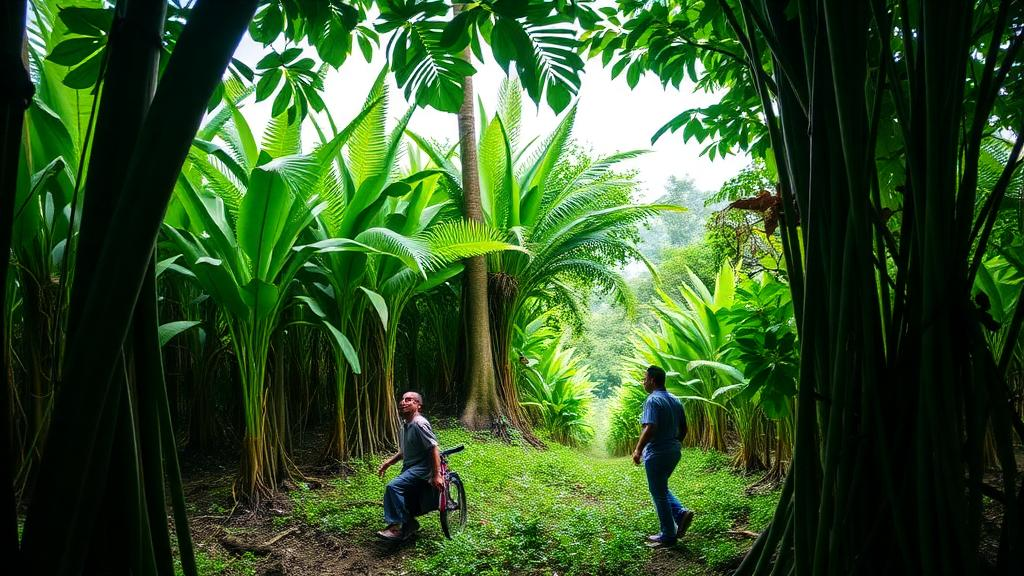
Deep in the forests of South Sulawesi, a humble tuber has been quietly building an export empire. Konjac, known locally as porang, is a knobby, unglamorous root that yields glucomannan, a soluble fiber prized by the food, pharmaceutical, and cosmetics industries for everything from shirataki noodles to weight-loss supplements. By 2020, Indonesia had planted roughly 20,000 hectares of the crop nationally, and exports between January and November of that year were worth nearly 880 billion rupiah. Yet a new study from Sidenreng Rappang Regency suggests that beneath this commercial success story lies a system whose sustainability is far more fragile, and far more lopsided, than any single score can reveal.
Researchers led by Syaharuddin Alrif, Rahim Darma, Muhammad Hasbi, and Reza Asra applied a multidimensional sustainability assessment, adapted from a fisheries evaluation technique called RAPFISH, to the emerging konjac agrifood system in Sidenreng Rappang, one of the first areas in South Sulawesi to cultivate the crop commercially. Their approach, which they call RAP-Konjac, scored 27 attributes across five dimensions: economic, social, environmental, technological, and institutional. Thirty-two key informants, including twelve smallholder farmers, six local collectors, processing representatives, extension officers, academic researchers, and regional planners, provided structured scores on a five-point scale, with risk-based attributes such as export dependency reverse-coded so that higher values always meant more sustainable conditions.
The choice of study area was deliberate. Sidenreng Rappang had roughly 164 hectares of konjac under cultivation involving about 30 farmer groups and 600 farmers, and two districts, Pitu Riase and Watang Sidenreng, accounted for approximately 141 hectares, or 86 percent of the regency’s identified konjac area. Pitu Riase serves as the principal production center, while Watang Sidenreng hosts a processing factory capable of handling 40 to 70 tons of fresh tubers daily, along with aggregation, marketing, and logistics functions. Together they offered a complete window into the value chain, from field to factory gate.
The analytical machinery behind the assessment is elegant in its transparency. Multidimensional scaling transforms the ordinal attribute scores into positions within an ordination space, generating a sustainability index on a 0-to-100 scale for each dimension. Stress statistics below 0.20 and coefficients of determination above 0.80 confirmed that the ordinations fit the data well; in this study, stress values ranged from 0.145 to 0.165 and R-squared values from 0.924 to 0.933. Monte Carlo simulations, which rerun the analysis under random scoring perturbations, shifted the indices by no more than 1.39 points, meaning the results were robust to the inevitable uncertainty in expert judgment.
The headline number looks reassuring. Averaged across the five dimensions, the konjac system scored 57.41, placing it firmly in the moderately sustainable category. But the researchers’ central insight is that this aggregate figure conceals a striking asymmetry. The environmental dimension scored 67.73, the strongest of the five, while the technological dimension scored just 48.80, the only one classified as less sustainable. The 18.93-point gap between the best and worst dimensions reveals a system whose ecological foundation has developed far faster than its capacity to convert that potential into stable quality, local value addition, and resilient market participation.
The technological weakness is not a deep collapse but a near-threshold constraint, sitting just below the 50-point boundary that separates less sustainable from moderately sustainable. That positioning matters for policy, because it suggests comparatively focused improvements in farmer-level post-harvest facilities, industrial downstream processing access, certified seed systems, logistics, and innovation support could shift the dimension into a stronger category. Without such improvements, farmers remain locked into selling fresh tubers, while actors with processing facilities capture most of the value added. Nationally, the scale of this mismatch is stark: of more than 700,000 tons of konjac produced in 2020 and 2021, only about 150,000 tons met export requirements, a gap attributed to product quality, processing capacity, and compliance with market standards.
To identify where intervention would matter most, the team performed a leverage analysis, removing each attribute in turn from the ordination and measuring how much the sustainability configuration shifted. Seven attributes exceeded the high-leverage threshold of a root mean square change of 10 or more. Supply chain efficiency scored 14.90 and export market dependency 14.89, followed almost identically by agricultural extension at 14.88 and partnership effectiveness at 14.66. Seed variety conservation (11.56) and pest and disease management (11.14) anchored the environmental dimension, while industrial downstream processing technology sat exactly at the 10.00 threshold. Notably, none of the five social attributes reached even the borderline range, suggesting that social factors function as long-term enablers rather than immediate leverage points.
Combining each dimension’s sustainability status with its leverage scores produced a clear policy priority ranking: technology first, then economic restructuring, institutional strengthening, ecological consolidation, and finally inclusive rural capacity building. The economic findings carry a particular warning. Heavy dependence on a narrow export market exposes farmers and processors to external demand shocks, shifting quality standards, and buyer concentration, while fragmented supply chains raise transaction costs and weaken farmers’ bargaining positions. The researchers argue that konjac development should not be managed solely as an export-oriented commodity opportunity; transparent pricing, clearer grading standards, domestic market development, and stronger buyer-farmer coordination are equally essential. Institutional support, especially commodity-specific extension services, is the glue that holds these improvements together, because konjac cultivation, drying, slicing, grading, and quality standards all demand specialized knowledge that many farmers currently lack.
The environmental story is more nuanced than the strong 67.73 score might suggest. The assessment covered locally observable management practices, erosion risk, pest management, seed conservation, and chemical input use, but it did not quantify water use, energy consumption, or greenhouse gas emissions, so the index reflects local environmental management rather than a complete life-cycle footprint. Even so, the high leverage of seed variety conservation and pest management signals a real vulnerability: as commercial cultivation expands, reliance on selected planting materials can erode genetic diversity and intensify disease pressure. Ecological suitability, the authors conclude, is a necessary foundation for konjac development but is nowhere near sufficient on its own for a sustainable transformation.
Perhaps the most transferable lesson of the study is methodological. A system can be classified as moderately sustainable overall while remaining poorly prepared for transformation in one or more of its enabling dimensions, a condition the researchers call asymmetric sustainability. By pairing dimension-specific indices with attribute-level leverage scores, RAP-Konjac turns stakeholder knowledge into a transparent, testable order of policy attention, an approach that could be applied to other konjac-producing regions and to other emerging bio-based commodities racing from forest edge to global market. The konjac boom in South Sulawesi is real, and its ecological footing is comparatively solid, but whether smallholder farmers capture a fair share of the glucomannan economy will depend on closing the technology gap before the raw-material export pathway hardens into permanence.
Subject of Research: Multidimensional sustainability assessment of Indonesia's emerging konjac (porang) agrifood system using RAPFISH-based multidimensional scaling in Sidenreng Rappang Regency
Article Title: Multidimensional sustainability assessment of Indonesia's emerging konjac agrifood system: A case study in Sidenreng Rappang
Article References: Alrif, S., Darma, R., Hasbi, M., & Asra, R. (2026). Multidimensional sustainability assessment of Indonesia's emerging konjac agrifood system: A case study in Sidenreng Rappang. Environmental and Sustainability Indicators, 32, Article 101555. https://doi.org/10.1016/j.indic.2026.101555
Image Credits: AI Generated
DOI: 10.1016/j.indic.2026.101555
Keywords: konjac, porang, glucomannan, sustainability assessment, RAPFISH, multidimensional scaling, agrifood system, Indonesia, South Sulawesi, smallholder farmers, value chain, transition readiness
Cite Scienmag News
Sloane Callahan. (October 5, 2026). Indonesia’s Konjac Boom Looks Green but Hides a Technology Gap. Scienmag. https://scienmag.com/indonesias-konjac-boom-looks-green-but-hides-a-technology-gap/
Sloane Callahan. "Indonesia’s Konjac Boom Looks Green but Hides a Technology Gap." Scienmag, 5 October 2026, https://scienmag.com/indonesias-konjac-boom-looks-green-but-hides-a-technology-gap/. Accessed 5 October 2026.
Sloane Callahan. "Indonesia’s Konjac Boom Looks Green but Hides a Technology Gap." Scienmag. October 5, 2026. https://scienmag.com/indonesias-konjac-boom-looks-green-but-hides-a-technology-gap/


