


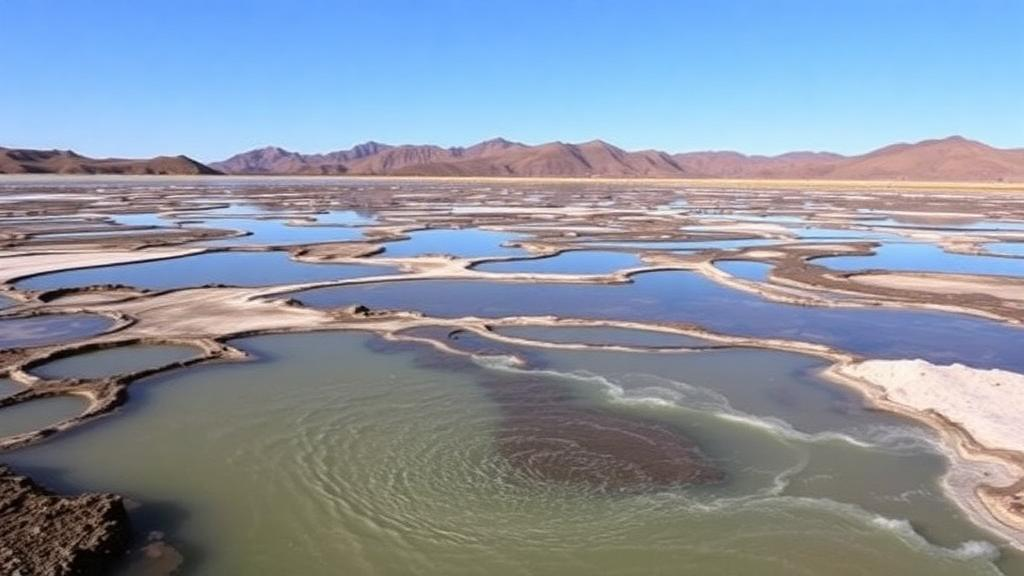
Cherrapunji, the fabled Meghalaya plateau town that has long competed for the title of the wettest place on Earth, is quietly running dry. A new study published in Regional Environmental Change has dissected more than twelve decades of rainfall records, river stages, groundwater levels and local geology to explain one of hydrology’s most striking paradoxes: a place drenched by roughly eleven metres of monsoon rain each year that nevertheless faces hyper-arid, extremely dry conditions through its winter and pre-monsoon seasons. The research, led by Nabaprabhat Paul of Amrita Vishwa Vidyapeetham with colleagues at the National Institute of Technology Patna and Amrita Chennai, offers one of the most complete socio-hydro-climatic portraits yet of a region whose water security is deteriorating even as its rainfall legend endures.
The team assembled daily rainfall data spanning 123 years, from 1901 to 2024, and subjected it to a battery of statistical tests designed to separate genuine long-term trends from natural variability. They applied the Mann-Kendall test and its modified variant, which corrects for autocorrelation in the time series, alongside Sen’s slope estimator to quantify the magnitude of change. To probe extremes, they used the Peak Over Threshold method, which counts and sizes rainfall events exceeding a defined limit. Drought behaviour was tracked with the Standardised Precipitation Index and the Aridity Index, while low-flow analysis captured how streamflow during dry periods has evolved. The result is a multi-layered diagnosis of a water system under stress from every direction.
The headline finding is deceptively small: an annual decrease in rainfall of 8.4 millimetres per year. That figure alone would not raise alarms, but the monthly breakdown reveals where the damage concentrates. March rainfall is declining at 0.578 millimetres per year, April at 1.419 millimetres per year, July at 1.593 millimetres per year and August at 1.84 millimetres per year, the last being the heart of the monsoon. December, by contrast, shows a marginal increase of 0.005 millimetres per year, statistically negligible in practical terms. The pattern matters because losses in the pre-monsoon months erode the soil moisture and spring recharge that communities depend on before the monsoon arrives, while losses in July and August shrink the total volume available for storage.
Paradoxically, even as total rainfall declines, the extremes are intensifying. The Peak Over Threshold analysis shows that both the frequency and the intensity of extreme rainfall events have been increasing, with a daily deluge of 580 millimetres now assigned a return period of 100 years. This combination, fewer moderate rains and more violent downpours, is a signature increasingly reported across a warming Indian subcontinent, and it is uniquely hostile to water storage. Intense rainfall on degraded or steep terrain runs off rapidly rather than percolating into aquifers, so the water arrives as flood hazard instead of replenishing springs and wells. The study’s findings align with broader evidence that Indian rainfall extremes have grown more spatially variable and more intense even as seasonal totals stagnate or fall.
The hydrological story beneath the surface is equally troubling. By interlinking river stage records, groundwater levels and the region’s geology with the rainfall record, the researchers pieced together a picture of chronically low storage. The Shillong Plateau’s terrain and geology offer limited capacity to hold the enormous volumes that cascade through it during the monsoon, and the low-flow analysis confirms the consequence: streamflow during dry periods is reducing by 0.80 days per year, meaning the rivers run low ever earlier and stay low ever longer. The Aridity Index for July, August and September is decreasing by 0.003 millimetres per year, and the Standardised Precipitation Index reinforces the same conclusion, pointing to intensifying water scarcity through the winter and summer seasons.
What elevates the study beyond a statistical exercise is its socio-hydrological dimension. The researchers combined the secondary data analysis with a community assessment in Nongkya village, using participatory rural appraisal methods to capture how residents experience the scarcity that the numbers describe. The survey found that 61 percent of households experience water scarcity, a figure that independently corroborates the hydro-climatic indicators. This convergence between measured trends and lived experience is precisely what the socio-hydro-climatic framework is designed to achieve: water security is not a function of rainfall alone but of how climate, geology, infrastructure and human demand interact across the year.
The seasonal swing the region endures is extraordinary. The study characterises Cherrapunji’s annual hydro-climatic variability as ranging from hyper-arid and extremely dry conditions to humid and extremely wet ones, a range that few places on Earth experience within a single year. Managing water under such volatility demands infrastructure that can capture monsoon surpluses and carry them through a dry season that is lengthening year by year. Instead, the region’s storages remain low, its springs and streams falter earlier each dry season, and households increasingly face the classic paradox of the wet desert, a term that has been applied to Cherrapunji for nearly two decades as deforestation and land degradation compounded the climatic pressures.
Against this backdrop, the authors propose a set of adaptation strategies grounded in the specific hydrology of the plateau. Micro rainwater harvesting, small-scale capture systems distributed across households and slopes, would intercept some of the intense runoff before it escapes the landscape. Soil and land management aimed at enhancing percolation would help convert violent monsoon downpours into groundwater recharge, addressing the storage deficit at its source. Perhaps most significantly, the researchers argue for integrating traditional knowledge with technological approaches, recognising that Khasi communities have managed this landscape for centuries and that engineered solutions imposed without local insight have historically underperformed. The recommendation echoes a growing consensus in water security research that community-driven, participatory approaches outperform purely top-down interventions.
The implications extend well beyond a single town. Cherrapunji functions as a natural laboratory for the water security challenges that climate change is amplifying across South Asia, where the monsoon is becoming more erratic, extremes more severe, and dry-season stress more acute. The study’s methodological toolkit, combining modified trend tests, extreme-value analysis, drought indices, low-flow assessment and community perception surveys, offers a replicable template for other regions navigating the same transition from predictable seasonality to volatile hydro-climatic whiplash. As the authors make clear, the question for Cherrapunji is no longer whether the rain will fall, but whether anything can be done to keep it from vanishing the moment it does.
Subject of Research: Socio-hydro-climatic analysis of water security and rainfall trends in Cherrapunji, semi-arid India
Article Title: Socio-hydro-climatic analysis for water security in semi-arid India: a case of Cherrapunji, India
Article References: Paul, N., Pushpalatha, R., Roshni, T., Nair, A., Dutta, D., Singh, P. P., & P., A. (2026). Socio-hydro-climatic analysis for water security in semi-arid India: a case of Cherrapunji, India. Regional Environmental Change, 26(4), Article 211. https://doi.org/10.1007/s10113-026-02701-z
Image Credits: AI Generated
DOI: 10.1007/s10113-026-02701-z
Keywords: Cherrapunji, water security, rainfall trends, Mann-Kendall test, Standardised Precipitation Index, aridity index, low flow, groundwater, extreme rainfall, water scarcity, Meghalaya, climate change
Cite Scienmag News
Sloane Callahan. (October 5, 2026). The Wettest Place on Earth Is Running Out of Water, a 123-Year Study Reveals. Scienmag. https://scienmag.com/the-wettest-place-on-earth-is-running-out-of-water-a-123-year-study-reveals/
Sloane Callahan. "The Wettest Place on Earth Is Running Out of Water, a 123-Year Study Reveals." Scienmag, 5 October 2026, https://scienmag.com/the-wettest-place-on-earth-is-running-out-of-water-a-123-year-study-reveals/. Accessed 5 October 2026.
Sloane Callahan. "The Wettest Place on Earth Is Running Out of Water, a 123-Year Study Reveals." Scienmag. October 5, 2026. https://scienmag.com/the-wettest-place-on-earth-is-running-out-of-water-a-123-year-study-reveals/


