


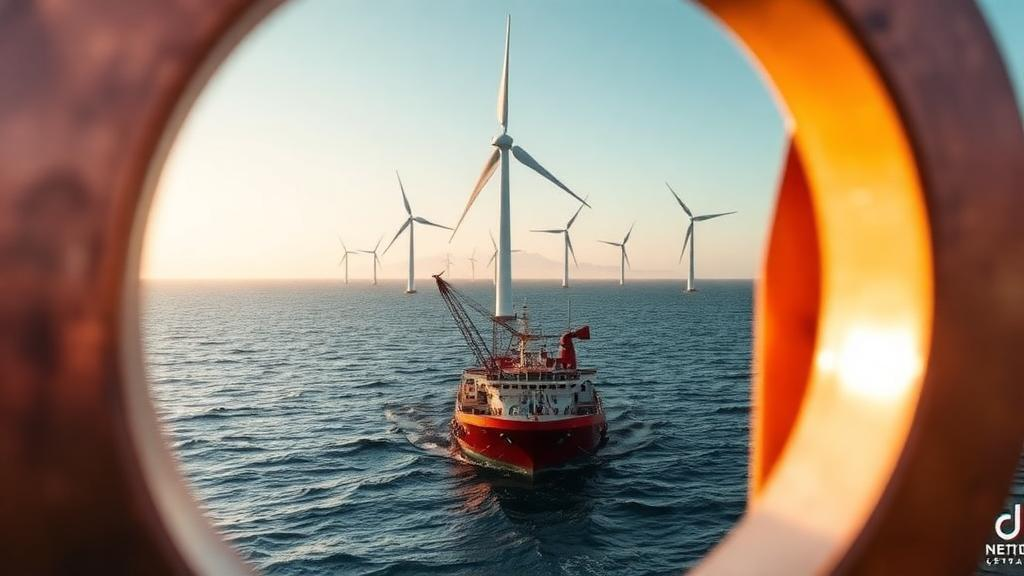
Offshore wind has become the poster child of Europe’s race to climate neutrality, a technology so visibly clean that its turbines seem to erase the very idea of an environmental footprint. Yet every gleaming tower, every kilometre of submarine cable and every composite blade begins life as extracted, processed and manufactured material, and that material carries a burden of its own. A new study published in the Journal of Industrial Ecology has now put that hidden footprint under an unusually rigorous microscope, combining two powerful analytical tools to ask a deceptively simple question: which of the United Kingdom’s offshore wind farms squeeze the most electricity out of the least environmentally costly material?
The research team, led by Adrian Sobral-Lores of the University of Santiago de Compostela together with colleagues in Spain and Chile, examined twenty operational offshore wind farms in the United Kingdom. Their approach wove together life cycle assessment, or LCA, the standard method for tracing environmental impacts from raw material extraction through manufacturing, installation, operation and end of life, with data envelopment analysis, or DEA, a mathematical benchmarking technique that compares each facility against the best performers in the sample. The twist that sets this work apart is a contribution-analysis step inserted between the two: before any benchmarking takes place, the LCA identifies precisely which material flows dominate the environmental profile, and only those materials are fed into the efficiency model.
The results of that hotspot analysis are striking in their clarity. Low-alloy steel, the workhorse metal of towers, foundations and hubs, accounted for 49.37 percent of the average environmental contribution across eighteen impact categories. Copper, the metal of choice for cables and electrical equipment, contributed a further 21.99 percent. Adding chromium steel, glass fibre and aluminium brought the five selected materials to 78.65 percent of the total average environmental contribution. In other words, less than a handful of substances effectively determine whether an offshore wind farm is environmentally lean or heavy, a finding that dramatically narrows where engineers and policymakers should focus their attention.
With these five materials established as the environmentally decisive inputs, the team built a Slack-Based Measure DEA model under variable returns to scale, using lifetime electricity generation as the single output. The choice of model matters: unlike simpler radial approaches, the slack-based formulation captures non-proportional excesses in individual inputs and remains valid when inputs are measured in different physical units. Because the sample contained only twenty facilities, the researchers also respected a classical adequacy rule from the DEA literature, which limits the number of input and output variables relative to the number of units being compared, and they tested the robustness of their model by repeating the analysis with four and then three inputs.
The benchmarking verdict was split. Nine of the twenty wind farms achieved a perfect efficiency score of 1.00, defining the empirical frontier against which their peers were measured. The remaining eleven fell short, with scores ranging from 0.584 for the least efficient facility to 0.795 for the closest of the laggards. Crucially, the model did not merely rank the farms; it produced material-specific reduction targets for each inefficient one, quantifying how much less low-alloy steel, copper, chromium steel, glass fibre or aluminium each facility would need to generate the same lifetime electricity. The largest single gap involved copper at one wind farm, where a reduction of 78.66 percent was projected, while the least efficient farm showed substantial excesses across all five materials simultaneously.
Here the study makes its most methodologically important move. Rather than assuming that material savings translate automatically into environmental gains, the researchers transferred the DEA-derived reduction targets back into the life cycle inventories and ran a second, full LCA on the adjusted inventories, holding electricity generation and all other inventory flows constant. This verification step proved essential, because the environmental consequences of material savings vary enormously depending on the impact category. Median improvements across the eleven inefficient farms ranged from 8.85 percent for fossil resource scarcity to 30.32 percent for terrestrial and freshwater ecotoxicity, and the maximum reduction reached 59.18 percent for both ecotoxicity indicators at a single facility.
The pattern of these gains tells a coherent story about cause and effect. Toxicity, ecotoxicity, acidification and land-use categories, all of which are strongly influenced by copper and other metal inputs, showed the largest improvements, while global warming potential, with a median reduction of 10.62 percent, responded more modestly because the dominant driver, low-alloy steel, was subject to comparatively smaller projected cuts. The sensitivity analysis reinforced confidence in the overall picture: when aluminium and then glass fibre were excluded from the model, all eleven inefficient farms remained inefficient, classification agreement between scenarios ranged from 95 to 100 percent, and the material-reduction targets for the shared inputs were unchanged to the precision reported by the software.
The study also explored what distinguishes efficient farms from inefficient ones, and the correlations it uncovered are intriguing, if exploratory. Efficiency showed a statistically significant positive association with distance from shore in both Pearson and Spearman analyses, and a significant monotonic relationship with the number of turbines. Positive but non-significant trends linked efficiency to installed capacity and estimated electricity generation, hinting that larger farms may achieve higher material eco-efficiency. By contrast, efficiency was essentially unrelated to individual turbine capacity, rolling load factor or year of commissioning. With only twenty observations, the authors are careful to frame these correlations as hypothesis-generating rather than causal, and they acknowledge that because site-specific conditions such as wind resource quality were not embedded as control variables, part of the measured efficiency variation may reflect location and design circumstances rather than pure resource management.
The authors are equally careful about what the reduction targets do and do not mean. The DEA projections represent comparative benchmarks derived from peer farms in the sample, not engineering prescriptions that could be applied directly to a real project. Structural, geotechnical and site-specific constraints, from water depth and seabed characteristics to fatigue and installation limits, determine how much steel a foundation genuinely requires, and the optimal quantity differs for every site. Supporting engineering literature cited in the study suggests real headroom exists: integrated structural optimisation has been shown to cut the mass of a turbine support structure by nearly twenty percent, and alternative foundation designs have delivered life-cycle environmental scores roughly eighteen percent below conventional monopiles. The benchmark targets, in this light, mark the territory where such optimisation efforts are most worth pursuing.
One caveat deserves emphasis for anyone tempted to extrapolate the numbers to tomorrow’s projects. The underlying inventory comes from an earlier generation of UK offshore wind farms, and the authors caution that the efficiency scores and material targets should not be directly applied to modern installations using turbines above fifteen megawatts or floating foundations, whose material requirements can differ substantially. Still, the framework itself, which links hotspot identification, efficiency benchmarking and environmental verification in a single loop, remains applicable wherever comparable inventories exist, and recent assessments of floating wind confirm that steel, cables and composite blades remain the dominant hotspots. As Europe pursues its target of 300 gigawatts of installed offshore wind capacity by 2050, the lesson of this study is that the greenest kilowatt-hour is not only the one generated without emissions, but the one generated with the least steel and copper behind it, and that knowing exactly which materials matter is the first step toward building a wind fleet that is clean from seabed to scrapyard.
Subject of Research: Material eco-efficiency assessment of offshore wind farms using integrated life cycle assessment and data envelopment analysis
Article Title: Assessing the eco-efficiency of offshore wind energy using a combined life cycle assessment and data envelopment analysis approach
Article References: Sobral-Lores, A., Rebolledo-Leiva, R., Feijoo, G., & Moreira, M. T. (2026). Assessing the eco-efficiency of offshore wind energy using a combined life cycle assessment and data envelopment analysis approach. Journal of Industrial Ecology. https://doi.org/10.1007/s44498-026-00191-0
Image Credits: AI Generated
DOI: 10.1007/s44498-026-00191-0
Keywords: offshore wind, life cycle assessment, data envelopment analysis, eco-efficiency, low-alloy steel, copper, United Kingdom, renewable energy, environmental impacts, materials, sustainability, benchmarking
Cite Scienmag News
Sloane Callahan. (October 5, 2026). Steel, Copper and the Hidden Footprint of Offshore Wind Farms. Scienmag. https://scienmag.com/steel-copper-and-the-hidden-footprint-of-offshore-wind-farms/
Sloane Callahan. "Steel, Copper and the Hidden Footprint of Offshore Wind Farms." Scienmag, 5 October 2026, https://scienmag.com/steel-copper-and-the-hidden-footprint-of-offshore-wind-farms/. Accessed 5 October 2026.
Sloane Callahan. "Steel, Copper and the Hidden Footprint of Offshore Wind Farms." Scienmag. October 5, 2026. https://scienmag.com/steel-copper-and-the-hidden-footprint-of-offshore-wind-farms/


