


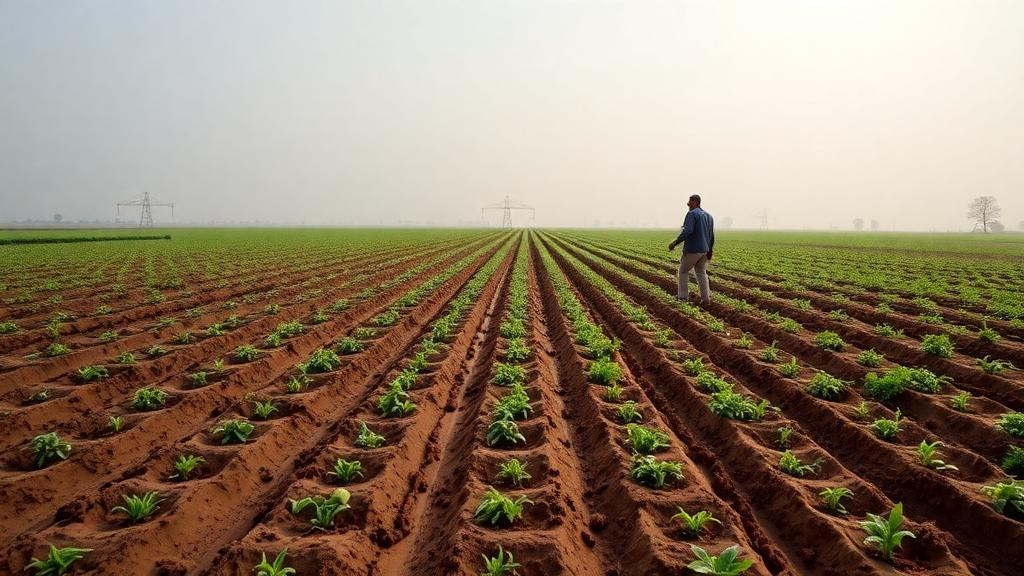
In the intensively farmed plains of Punjab, India, the soil’s most dangerous contaminant is not coming from smokestacks or factory effluents. It is coming from the irrigation canals and tube wells that sustain the region’s celebrated agricultural productivity. A new study published in Environmental Geochemistry and Health has found that arsenic accumulating in agricultural soils, delivered by decades of flood irrigation with arsenic-bearing groundwater, creates a greater composite ecological risk than the heavy-metal pollution surrounding Punjab’s industrial hubs. The finding upends a long-standing assumption in environmental science across South Asia, where hazard rankings have traditionally been dominated by the sheer tonnage of metals deposited near industrial estates.
The research, conducted by Varsha Chauhan and Kiran Kumari of the Forensic Science Department at Lovely Professional University, employed a formally replicated factorial design that crossed three land-use types with three agro-ecological districts. Thirty-six soil samples were analysed using energy-dispersive X-ray fluorescence, a technique that bombards a sample with X-rays and reads the characteristic fluorescent signatures emitted by each element, allowing rapid multi-element quantification without chemical digestion. Each sampling unit included four field replicates, a level of replication that lends statistical weight to comparisons that many previous regional surveys, relying on single composite samples, could not support.
The study’s central result is what the authors describe as a paradox for pollution indices. The agricultural sampling unit in Amritsar recorded the highest Potential Ecological Risk Index of the entire survey, at 723.54, surpassing the primary industrial hotspot, which scored 624.17 despite carrying a far higher Pollution Load Index of 20.11. The discrepancy arises because the two indices weight toxicity differently. The Pollution Load Index simply tallies how many times guideline concentrations are exceeded, rewarding sites with large quantities of relatively less toxic metals. The Potential Ecological Risk Index, by contrast, multiplies enrichment by element-specific toxicity coefficients, and arsenic’s coefficient is among the highest of any trace metalloid.
That arsenic signal in Amritsar was extraordinary by any measure. The agricultural soils there contained 80.8 milligrams of arsenic per kilogram of soil on average, with a standard deviation of 10.7, yielding an Enrichment Factor of 45.19 relative to background crustal abundances. The geo-accumulation index, which classifies contamination on a seven-point scale, reached Class 6, the category reserved for extremely contaminated sediments and soils. The source, the researchers argue, is chronic flood irrigation drawing on groundwater that naturally carries dissolved arsenic, a problem well documented across the alluvial aquifers of the Indus and Ganges basins. Each irrigation cycle deposits a fresh increment of the metalloid onto paddy fields, where waterlogged conditions can further mobilise it.
The factorial design also revealed something that simpler sampling strategies would have missed entirely. Land-use type emerged as the primary geochemical driver for 15 of the 32 quantified elements, with partial eta-squared values reaching 0.862, a measure indicating that land-use classification alone explained the vast majority of variance in those elemental concentrations. More strikingly, statistically significant interaction effects between land use and district were detectable only because the study was structured as a true 3-by-3 factorial experiment. In other words, the contamination signature of a given land use depends on where it sits, and only a design that samples every combination of the two factors can separate those intertwined influences.
The bad news extends well beyond arsenic. All nine sampling units simultaneously exceeded Central Pollution Control Board guideline values for six elements: zinc, lead, arsenic, chromium, nickel, and copper. Pollution Load Index values ranged from 8.46 to 20.11 across the region, confirming that multi-element soil pollution is not a localised phenomenon around industrial clusters but a region-wide condition. This blanket exceedance complicates remediation priorities, because it means that even sites scoring moderately on any single index carry a cocktail of toxic elements above regulatory thresholds, and the relative contributions of agriculture, industry, and geogenic sources vary from district to district.
To probe the biological consequences of this chemical burden, the team sequenced the V3–V4 variable regions of the 16S ribosomal RNA gene from soil bacteria at three representative sites. This amplicon sequencing approach catalogues which bacterial lineages are present by reading a short, universally conserved gene that acts as a molecular barcode. The community profiles traced a clear diversity gradient consistent with Pollution-Induced Community Tolerance theory, an ecological framework holding that as contamination intensifies, sensitive taxa are eliminated and only tolerant survivors remain, compressing diversity. Shannon entropy, a standard diversity metric, fell from 3.906 at the least contaminated site to 3.007 at the most contaminated.
The taxonomic shifts accompanying that diversity loss were equally telling. Pseudomonadota, a phylum rich in metabolically versatile and stress-tolerant species, rose from 60.1 percent to 83.0 percent of the community along the contamination gradient, while Actinomycetota, a group valued for its roles in nutrient cycling and bioremediation, collapsed from 20.0 percent to 3.5 percent. Eight genera showed responses consistent enough across sites that the authors propose them as a candidate biomonitoring panel, a set of indicator organisms whose relative abundances could flag escalating soil toxicity before chemical indices alone reveal a problem. A Procrustes alignment, a statistical technique that tests whether two multivariate datasets can be brought into correspondence, yielded a low correlation statistic of 0.170, which the authors present as exploratory evidence that trace-element chemistry and microbiome structure are co-organised across the landscape, though they are careful not to overstate this link.
From these converging lines of evidence, the study identifies three co-existing contamination pathways operating across Punjab: geogenic arsenic delivered through irrigation water, industrial and urban metal deposition, and mixed agricultural inputs. The authors argue that this plurality demands an integrated monitoring framework that pairs rapid EDXRF elemental screening with 16S rRNA community profiling, stratified by land use, rather than the single-index, industry-focused assessments that have historically guided soil policy in South Asian agro-industrial regions. Such a framework, they suggest, would catch exactly the kind of agricultural arsenic hotspot that conventional metal-load rankings overlook.
The implications reach far beyond Punjab. Groundwater arsenic affects vast tracts of Bangladesh, eastern India, Nepal, and Pakistan, and paddy cultivation under flood irrigation is the dominant land use across much of that territory. If irrigation-borne arsenic can drive ecological risk indices above those of industrial hotspots in Punjab, the same mechanism may be quietly operating across hundreds of thousands of square kilometres of South Asian farmland. The study’s datasets are publicly available through the NCBI Sequence Read Archive under accession number PRJNA1470979, and the authors, who report no conflicts of interest, acknowledge support from a University Grants Commission research fellowship. What their work makes plain is that the fields feeding the region may be accumulating a toxic legacy invisible to the indices long trusted to find it, and that the tools to see it, an X-ray fluorescence analyser and a sequencing run, are now well within reach of routine environmental monitoring.
Subject of Research: Arsenic contamination and ecological risk in agricultural versus industrial soils of Punjab, India, assessed by EDXRF elemental profiling and 16S rRNA microbiome sequencing
Article Title: Arsenic-driven agricultural soil risk exceeds industrial contamination in Punjab, India: a replicated EDXRF and 16S rRNA assessment across three land-use types and three agro-ecological districts
Article References: Chauhan, V., & Kumari, K. (2026). Arsenic-driven agricultural soil risk exceeds industrial contamination in Punjab, India: a replicated EDXRF and 16S rRNA assessment across three land-use types and three agro-ecological districts. Environmental Geochemistry and Health, 48(14), Article 568. https://doi.org/10.1007/s10653-026-03464-6
Image Credits: AI Generated
DOI: 10.1007/s10653-026-03464-6
Keywords: arsenic contamination, soil pollution, Punjab, EDXRF, 16S rRNA sequencing, heavy metals, irrigation groundwater, ecological risk index, soil microbiome, pollution-induced community tolerance, agricultural land use, India
Cite Scienmag News
Alan Morgan. (October 5, 2026). Farm Fields Beat Factories: Arsenic From Irrigation Emerges as Punjab’s Worst Soil Threat. Scienmag. https://scienmag.com/farm-fields-beat-factories-arsenic-from-irrigation-emerges-as-punjabs-worst-soil-threat/
Alan Morgan. "Farm Fields Beat Factories: Arsenic From Irrigation Emerges as Punjab’s Worst Soil Threat." Scienmag, 5 October 2026, https://scienmag.com/farm-fields-beat-factories-arsenic-from-irrigation-emerges-as-punjabs-worst-soil-threat/. Accessed 5 October 2026.
Alan Morgan. "Farm Fields Beat Factories: Arsenic From Irrigation Emerges as Punjab’s Worst Soil Threat." Scienmag. October 5, 2026. https://scienmag.com/farm-fields-beat-factories-arsenic-from-irrigation-emerges-as-punjabs-worst-soil-threat/


