


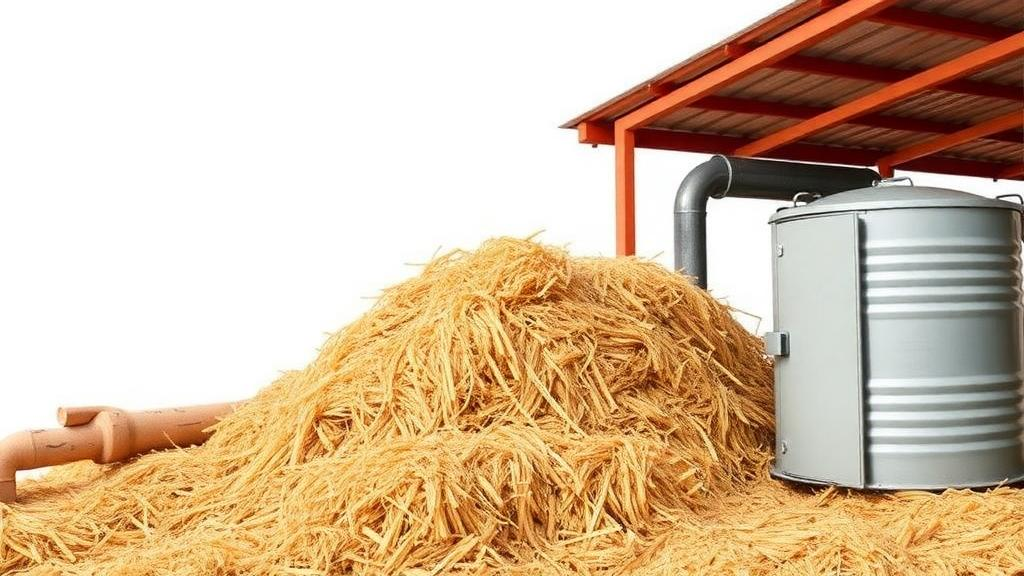
Sugarcane bagasse, the fibrous residue left behind after juice extraction, has long been touted as a workhorse feedstock for renewable natural gas. Mills generate it in enormous seasonal pulses, which means biogas operators must pile it up and feed digesters months later. A new study from researchers at the Indian Institute of Technology Guwahati, published in Clean Technologies and Environmental Policy, shows that this seemingly mundane logistical step—storage—can quietly undermine the entire climate rationale for turning bagasse into methane. The team, led by Prakash Singh with Vikash Kumar and Ajay S. Kalamdhad, provides the first integrated evidence connecting how long a lignocellulosic residue sits in storage to both the microbial efficiency of its anaerobic digestion and the life-cycle carbon footprint of the fuel it ultimately produces.
The researchers started from a deceptively simple hypothesis: prolonged storage progressively degrades the fermentable components of bagasse, so the same tonne of biomass delivered to a digester after months in a stockpile carries less biochemical potential than fresh material. Their experiments confirmed a systematic decline in methane yield as storage duration increased. But the more consequential finding concerned the food-to-microorganism ratio, a core operating parameter in anaerobic digestion that describes how much organic substrate is offered per unit of microbial biomass in the inoculum. Getting this ratio right is the difference between a stable, high-yielding digester and an acidified, stalled one, because methanogenic archaea must be balanced against the acidogenic bacteria that hydrolyze and ferment the substrate ahead of them.
As bagasse aged in storage, the optimal food-to-microorganism ratio shifted downward. In practical terms, older biomass demands a more conservative organic loading rate: operators must feed less substrate per unit of microbial capacity to avoid overwhelming the methanogens with volatile fatty acids. This is a double penalty for plant economics. Not only does each tonne of stored bagasse yield less methane, but the digester also loses operational flexibility, becoming more sensitive to loading errors. A plant designed around fresh-feed assumptions may find that its winter feedstock, drawn from months-old stockpiles, pushes reactors toward instability unless throughput is throttled back, reducing the useful energy a given vessel can deliver per year.
The biochemistry behind this decline is well understood in outline even though its consequences for plant design have been underappreciated. Bagasse is a lignocellulosic material, a matrix of cellulose, hemicellulose, and lignin. The hemicellulose and amorphous cellulose fractions are the readily fermentable carbohydrates that anaerobic microbes convert to volatile fatty acids and then to biogas. During storage, ambient moisture, oxygen infiltration, and native microbial communities consume these accessible fractions. What remains is a substrate enriched in recalcitrant lignin and crystalline cellulose, which hydrolyze slowly and incompletely. The digester microbial community therefore receives a diet that is both leaner and harder to digest, depressing specific methane yields and slowing kinetics.
What elevates this study beyond a conventional biochemical methane potential exercise is its life-cycle framing. The authors did not stop at measuring cubic meters of methane per tonne of substrate; they traced the climate consequences of using the resulting biomethane as a transport fuel. When methane was derived from long-stored biomass, the climate footprint per unit of useful energy delivered rose measurably. The logic is straightforward: the same upstream emissions from harvesting, handling, and storing the residue get amortized over less methane, and the degraded substrate requires more conservative loading, which spreads fixed plant emissions across lower output. At sufficient storage durations, the analysis found, biomethane’s advantage over fossil alternatives erodes, a result that should unsettle anyone who assumes agricultural residues are automatically climate-friendly fuels.
This finding exposes a trade-off that industrial biomethane planning rarely confronts. Feedstock logistics—the need to bridge seasonal harvest gaps with stockpiles or silage—are usually treated as a neutral engineering problem, solved with bale wrappers, bunkers, or open piles. The study demonstrates that storage is instead an active determinant of sustainability outcomes. The choice of storage method and duration propagates through the entire value chain, from digester stability to the carbon intensity of the compressed biogas dispensed at the pump. In regions such as India, where bagasse-based bio-CNG is being actively commercialized and sugar mills operate on pronounced crushing seasons, this coupling between logistics and climate performance is not an academic curiosity but a design constraint.
The work also carries methodological implications for the laboratory. Biochemical methane potential tests are the standard currency for comparing feedstocks and pretreatments, yet they are typically run on whatever material happens to be on the shelf, with a food-to-microorganism ratio chosen from convention rather than optimization. The study’s experimentally validated guidance indicates that both variables—storage history and loading ratio—must be reported and controlled if results are to translate to plant performance. A yield measured on fresh bagasse at a generous substrate loading may substantially overstate what a mill running on six-month-old stockpile material can achieve at the ratio its microbes can actually tolerate. For biogas plants handling seasonally available lignocellulosic residues, the paper offers practical input data for feedstock management and bench-scale evaluation alike.
The broader literature on ensiling and storage has hinted at these effects before. Studies on maize silage, rice straw, and cover crops have documented how ensiling practices, additives, and storage periods modulate methane formation, and work on corn stover bales stored outdoors has shown measurable feedstock degradation. What distinguishes the new research is its integration: it links storage duration, microbial process efficiency, and life-cycle climate impacts in a single analytical framework, rather than treating each as a separate question. That integration is what allows the authors to state the problem in terms an operator or policymaker can act on—shorten storage, protect fermentable fractions, and adjust loading ratios to match the substrate’s true state rather than its nominal identity.
For the biogas industry, the actionable takeaways are concrete. Plants should characterize feedstock at the point of use, not at harvest, and recalibrate food-to-microorganism ratios as storage duration extends. Storage strategies that minimize loss of fermentable components—densified briquetting, co-ensiling with wetter wastes, or alkaline preservation, all approaches explored in the wider literature—deserve renewed attention as climate mitigation measures in their own right, not merely as spoilage control. Procurement contracts and carbon accounting frameworks may eventually need to reflect storage duration as a parameter in calculating the carbon intensity of biomethane, much as they already account for land-use change and transport distances.
The study ultimately reframes a humble operational question—how long can we let bagasse sit?—into a first-order determinant of whether residue-based biogas delivers on its climate promise. As governments scale biomethane mandates and sugar-producing regions invest in bio-CNG infrastructure, the Guwahati team’s message is clear: the digester is only as green as the stockpile behind it. Managing that stockpile with the same rigor applied to reactor engineering may prove one of the cheapest climate safeguards available to the renewable gas sector.
Subject of Research: Effect of storage duration and food-to-microorganism ratio on methane yield and life-cycle climate performance of anaerobic digestion of stored sugarcane bagasse
Article Title: Optimizing food-to-microorganism ratio to enhance methane yield and environmental performance of stored sugarcane bagasse
Article References: Singh, P., Kumar, V., & Kalamdhad, A. S. (2026). Optimizing food-to-microorganism ratio to enhance methane yield and environmental performance of stored sugarcane bagasse. Clean Technologies and Environmental Policy, 28(10), Article 264. https://doi.org/10.1007/s10098-026-03617-2
Image Credits: AI Generated
DOI: 10.1007/s10098-026-03617-2
Keywords: anaerobic digestion, sugarcane bagasse, biomethane, food-to-microorganism ratio, feedstock storage, methane yield, lignocellulosic biomass, life-cycle assessment, biogas, biofuel, waste management, carbon footprint
Cite Scienmag News
Sloane Callahan. (October 5, 2026). Storage Time Quietly Erodes the Climate Case for Bagasse Biogas. Scienmag. https://scienmag.com/storage-time-quietly-erodes-the-climate-case-for-bagasse-biogas/
Sloane Callahan. "Storage Time Quietly Erodes the Climate Case for Bagasse Biogas." Scienmag, 5 October 2026, https://scienmag.com/storage-time-quietly-erodes-the-climate-case-for-bagasse-biogas/. Accessed 5 October 2026.
Sloane Callahan. "Storage Time Quietly Erodes the Climate Case for Bagasse Biogas." Scienmag. October 5, 2026. https://scienmag.com/storage-time-quietly-erodes-the-climate-case-for-bagasse-biogas/


