


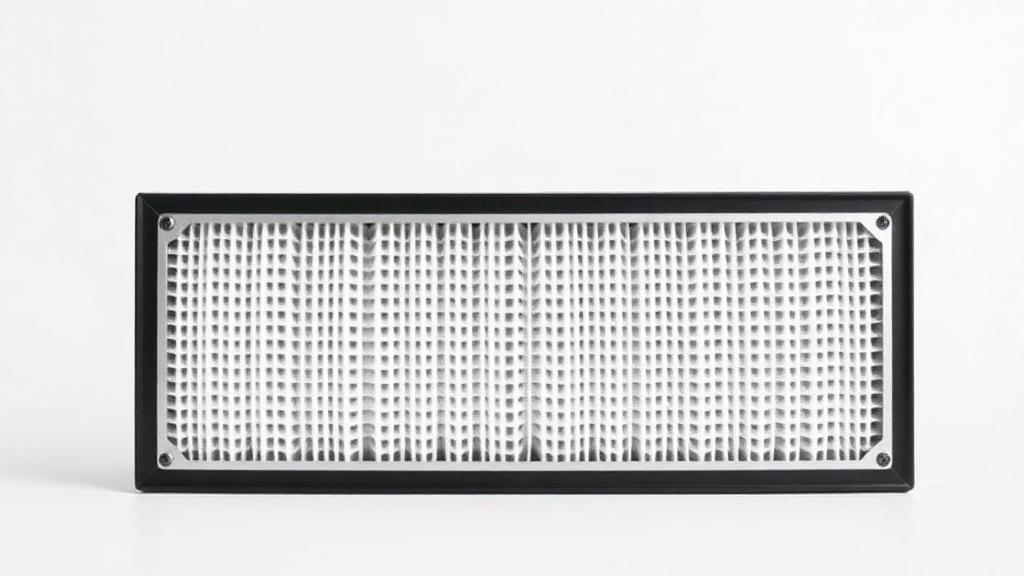
Air purification has long been caught in an uncomfortable trade-off. Filters that remove particles with very high efficiency tend to clog quickly, driving up energy consumption as fans push air through increasingly blocked material, while filters that resist clogging often sacrifice the removal efficiency that makes clean air possible in the first place. A team of researchers in China now reports a design that appears to break this compromise. Writing in Nature Sustainability, Jian Zhang, Ming Li, Yunmao Zhang, Xu Hou and colleagues describe a charge-induced liquid-lined filter, or CILF, that achieves single-pass purification efficiency of up to 99.6 percent at an air velocity of one metre per second while sustaining that performance over 3,500 hours of continuous operation.
The central insight of the new work is that the three most desirable properties of an air filter need not live in the same solid material. Conventional fibrous filters, including the melt-blown polypropylene media used in respirators and the dense glass-fibre mats inside HEPA units, capture particles mechanically or electrostatically on solid surfaces. Every captured particle stays put, gradually blocking the pores, raising the pressure drop across the filter and eventually forcing a costly replacement. The CILF instead delegates capture to a dynamic liquid lining that is continuously replenished, so that trapped contaminants are swept away rather than accumulated.
The researchers organise the capture process into three stages that operate in sequence. In the first stage, long-range electrostatic attraction draws airborne particles toward the filter from a distance, exploiting electric charges to overcome the fundamental weakness of purely mechanical filtration, in which only particles that happen to collide with a fibre are removed. In the second stage, particles arriving at the liquid interface are captured rapidly at the surface, where capillary and electrostatic forces combine to pull them across the boundary between air and liquid. In the third stage, the liquid bulk itself acts as a high-capacity sink, absorbing and storing the collected particles deep within its volume.
This division of labour is what gives the filter its durability. Because the liquid lining is refillable and continuously renewed, particles that would otherwise clog a solid filter are instead dissolved or suspended in the liquid phase and carried off. The team reports that the filter maintained high performance throughout 3,500 hours of continuous operation, a figure that dwarfs the service intervals typical of high-efficiency solid filters, which often degrade noticeably within weeks of intensive use. The self-cleaning behaviour of the moving liquid lining means the filter does not progressively blind itself, and the pressure drop across it remains stable rather than climbing over time.
The design builds on a growing body of work on liquid-based filtration. In 2022, a team reported in Nature a continuous air purification approach based on aqueous interface filtration and absorption, demonstrating that liquids could serve as active capture media rather than passive wetting agents. Related efforts have explored liquid-gating mechanisms with tunable multiphase selectivity and antifouling behaviour, first described in Nature in 2015, as well as biomimetic systems inspired by the human circulatory and respiratory systems. The new contribution of the CILF is to combine the liquid approach with charge-induced capture, adding the long-range electrostatic attraction that pure liquid-interface systems lack while retaining their resistance to clogging.
The physics of the interfacial capture stage draws on well-studied phenomena. Particles sitting at liquid interfaces experience capillary forces that can bind them strongly to the boundary, and electric fields can induce attractive interactions between like-charged particles at such interfaces, an effect documented experimentally more than two decades ago. By engineering the charge state of the liquid lining, the researchers harness these forces deliberately: particles approaching the interface are pulled in and then drawn into the bulk liquid, where the vast absorption capacity of the liquid phase stores them far from the airstream. Supplementary videos accompanying the paper show charge-induced adsorption on solid surfaces, bulk-phase absorption in the liquid, and the dynamic liquid lining performing its self-cleaning function.
To demonstrate that the laboratory performance translates into practical air cleaning, the team built a full-scale air cleaner prototype incorporating the CILF. In a thirty-cubic-metre test chamber, the prototype achieved a clean-air delivery rate of 377 cubic metres per hour, a measure of how much purified air a device can supply and one of the key metrics used to compare commercial air purifiers. The tests were conducted under industry standard conditions, providing a benchmark that allows direct comparison with existing filtration technologies rather than relying solely on laboratory-scale measurements.
Perhaps the most striking aspect of the work is the breadth of applications the researchers demonstrate. The team implemented the filters across a range of real-world settings, from personal protective masks to air purification systems compatible with microgravity environments. The microgravity application is particularly notable: conventional filters rely on gravity-assisted settling and replaceable cartridges that generate waste, both of which are problematic on spacecraft, where every kilogram of consumables must be launched at great expense. A filter whose capture medium is a refillable liquid, and whose performance does not depend on gravity, offers an intriguing option for long-duration missions. At the other end of the scale, a liquid-lined filter in a face mask could in principle maintain high efficiency without the breathing resistance that builds up as solid mask filters load with particles.
The energy and sustainability implications are significant. Because the filter maintains a low and stable pressure drop, the fans driving air through it consume less power than they would against a progressively clogging medium, and the refillable liquid lining replaces the steady stream of discarded filter cartridges that conventional high-efficiency systems generate. Prior analyses of air filtration have highlighted both the monetary cost of replacing high-efficiency filters and the environmental burden of disposing of them, and low-cost do-it-yourself air cleaners popularised during the COVID-19 pandemic underscored the demand for affordable, durable alternatives. A filter that combines HEPA-level efficiency with long service life and simple maintenance addresses precisely the gap that has kept such alternatives from matching professional equipment.
Challenges remain before charge-induced liquid-lined filters appear in homes, hospitals and spacecraft. The nature and management of the working liquid, its consumption rate, the electrical power needed to sustain the charge-induced capture, and the behaviour of the system across extremes of temperature and humidity are all questions that the broader deployment of the technology will need to answer, and the paper’s supplementary materials, including extensive notes and tables, suggest the authors have begun mapping this terrain in detail. Still, the headline numbers are difficult to ignore: 99.6 percent single-pass efficiency at a face velocity of one metre per second, 3,500 hours of continuous high performance, and a clean-air delivery rate of 377 cubic metres per hour in a full-scale prototype. If the approach scales as the authors suggest, the familiar ritual of replacing clogged filters may one day give way to simply topping up a liquid reservoir, and the trade-off that has defined air purification for decades may finally be resolved in favour of clean air that is simultaneously efficient, durable and affordable.
Subject of Research: A charge-induced liquid-lined filter for high-efficiency, durable and low-maintenance air purification
Article Title: Highly efficient air purification by a charge-induced liquid-lined filter
Article References: Zhang, J., Li, M., Chen, S., Guo, Z., Yang, B., Li, L., Zhou, X., Zhang, J., Ye, C., Liu, J., Yao, W., Zhang, Y., & Hou, X. (2026). Highly efficient air purification by a charge-induced liquid-lined filter. Nature Sustainability. https://doi.org/10.1038/s41893-026-01920-w
Image Credits: AI Generated
DOI: 10.1038/s41893-026-01920-w
Keywords: air purification, liquid-lined filter, electrostatic capture, particulate matter, Nature Sustainability, filter durability, clean-air delivery rate, interfacial science, self-cleaning, microgravity, sustainable technology, fluidics
Cite Scienmag News
Sloane Callahan. (October 5, 2026). Liquid-Lined Filter Purifies Air at 99.6% Efficiency Without Clogging. Scienmag. https://scienmag.com/liquid-lined-filter-purifies-air-at-99-6-efficiency-without-clogging/
Sloane Callahan. "Liquid-Lined Filter Purifies Air at 99.6% Efficiency Without Clogging." Scienmag, 5 October 2026, https://scienmag.com/liquid-lined-filter-purifies-air-at-99-6-efficiency-without-clogging/. Accessed 5 October 2026.
Sloane Callahan. "Liquid-Lined Filter Purifies Air at 99.6% Efficiency Without Clogging." Scienmag. October 5, 2026. https://scienmag.com/liquid-lined-filter-purifies-air-at-99-6-efficiency-without-clogging/


